Compensation Claim
pp. 36-37 · Read in the full issue
Nauru
Australia, NZ Silent on Nauru Compensation Claim
Australia, Britain and New Zealand appear unlikely to meet Nauru’s $72
million dollar mining compensation claim.
By Richard Dinnen
THE AUSTRALIAN Government has refused to pay any part of the SA72 million claimed by Nauru as compensation for the de
vastation caused by phosphate mining
on the island. The claim follows the tabling in the Nauru Parliament last December of the 10-volume report of the Commission of Inquiry into re habilitation of the worked-out phos phate lands. The claim is made against the three nations responsible for min ing on Nauru Australia, New Zea land and Britain and each has shown a distinct lack of interest in
meeting it.
The $72 million claim represents the main finding of a comprehensive report strongly critical of the three mining nations. “Entrusted by the world community with this sacred trust of civilisation, the three powers concerned failed to act in accordance with that trust and acted for their own benefit rather than the people in their
care,” the report says and while the Commissioners admit these are grave assertions to advance against govern ments of such stature and status, they say that after careful examination of documentary evidence no other con clusion is possible.
Those nations stand accused of breaching the trust placed in them and acting for their own gain and thus to the detriment of the people of Nauru. While the mining nations will regard the report as a minor irrita tion, Nauru President Hammer De- Roburt told his Parliament it was a milestone in development. “It charts out a course of progress for this island extending over the next 20 years or even more,” he said. “It contains an elaborate survey of the resources of Nauru, and future possibilities based on a complete rehabilitation of Top side, which comprises 80 per cent of our land surface.”
The Nauru Government set up the
inquiry in 1986 and appointed a three-man Commission of Inquiry,
comprising international lawyer Pro
fessor Christopher Weeramantry, Au
stralian mining executive Robert Chal lon and Nauru public servant Gideon Degidoa. Their mandate was to con sider which government or organisa tion should accept responsibility for rehabilitating the areas of phosphate land worked out during the German administration, League of Nations Mandate, Japanese occupation and the United Nations Trust. The Commis sion extended to a study of cost and feasibility of any proposed rehabilita tion. The Commission began public hearings in early 1987 and sat in Nauru, Melbourne and Wellington.
The three nations gained control of Nauru with a League of Nations trust at the end of World War I and gov erned until independence in 1968.
The nations mined Nauru as a joint authority, the British Phosphate Com pany (BPC), and by independence had removed a third of the island’s avail able reserves. A 1968 Act of Parlia ment established a now sizeable re habilitation fund but that was always intended for rehabilitaion of land mined after independence. The part ner governments nave denied respon
sibility, claiming the 1967 phosphate
agreement under which tne Nauru Local Government Council purchased the physical assets of the BPC set tled all issues including rehabilitation.
The three nations made a pre independence payment of $2l million intended to cover rehabilitation costs to that date. They then contended that Nauru could pay for its own re habilitation because it would earn large amounts of money from phosphate sales after independence a sugges tion the Commission found “untenable in law and morality”. Nauruans could not be asked to use their own funds to rehabilitate mining which took place both before and after independence, President Deßoburt told Parliament.
The Commission found that the 1967 phosphate agreement remained conspicuously silent on the rehabilita tion question. The partner govern ments had considered a draft proposal that extended the financial arrange ments to cover future needs including
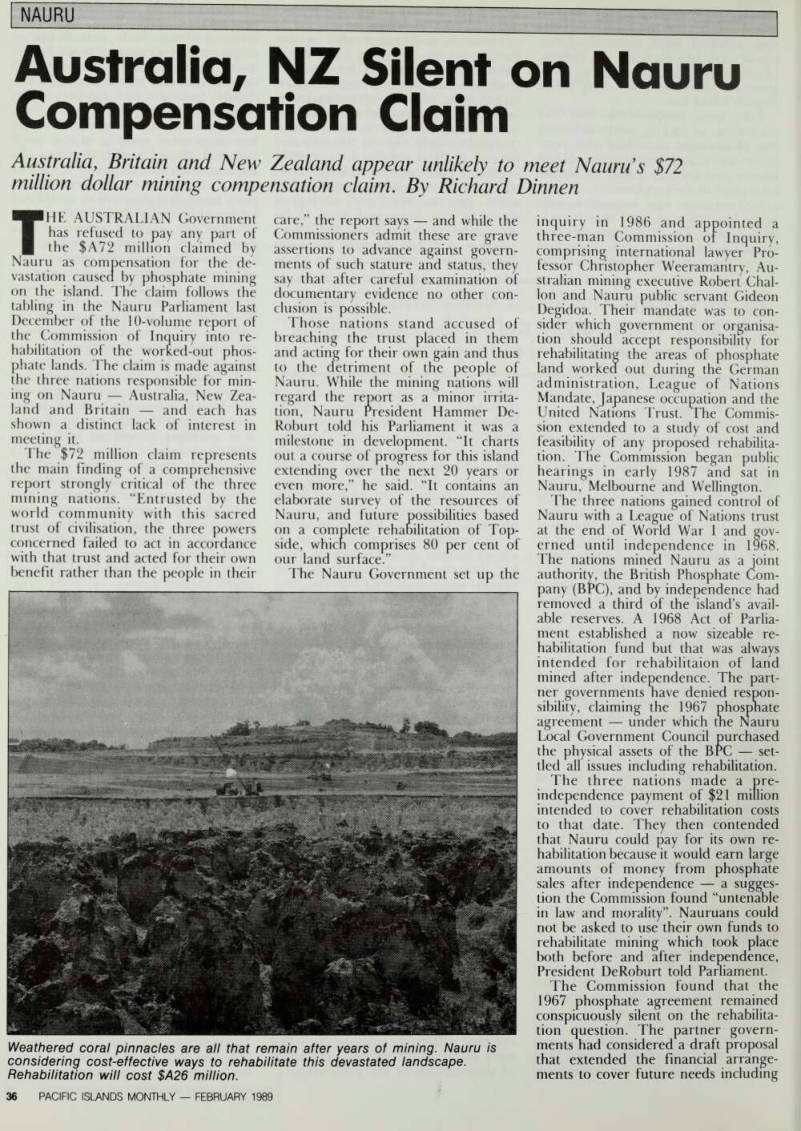
Weathered coral pinnacles are all that remain after years of mining. Nauru is considering cost-effective ways to rehabilitate this devastated landscape.
Rehabilitation will cost $A26 million.
resettlement or rehabilitation. That this clause was not included in the fin al agreement, the Commission said, clearly shows there was no under standing that the agreement released the partner governments from the obligation to rehabilitate.
They have committed a violation of the obligations on Mandatory and Trustee powers in failing to restore mined out land to useful condition, the report said.
The question of responsibility for rehabilitation of land or relocation of the island’s 8000 residents has long been a hot issue. The Commission says
the former administering authority
was aware more than 20 years before the termination of the Trust that an alternative land area would have to be provided for Nauruans if rehabilita tion did not take place. “Despite its awareness of this fact, it continued to pursue a policy that progressively, and at an accelerated pace, rendered the island unfit for habitation,” said the
President. “The only possible justifica
tion for pursuing such a course of conduct despite its awareness of its re sults was a resolve to make good the damage done in one way or another.”
In distinguishing two stages re habilitation and development the Commissioners were careful to balance their stinging criticism of the partner
governments with what President De- Roburt described as a “heartening and yet realistic view of the opportunities for rehabilitation”. It had long been held that rehabilitation would be ridi culously expensive a view the Com mission finally lays to rest. It suggests modern machinery can be used to re move and crush limestone pinnacles,
allowing residual mining to take place.
The land can then be contourea and prepared for subsequent use. Some phosphate, crushed limestone, humus and nutrients can be used to produce
a topsoil eventually comparable with
that presently stockpiled on Topside.
Newly discovered groundwater could
be treated for irrigation use. The Commission injects an optimistic note with the assertion that rehabilitation will pave the way for a range of land uses. But the task ahead is a formid able one 80 per cent of Nauru’s land surface will have been rendered useless by 1990 and the total cost of rehabilitation is estimated at a mini mum of SA2I6 million.
“We are no longer visualising the
arrival of giant ships disgorging vast
amounts of soil culled from wherever in the world to fill the holes,” says President De Roburt. “Rather we see a
carefully designed program extending
over 20 years where natural soil ana
plant regeneration takes place at the
same time as secondary resource min ing and re-contouring. It should draw an enthusiastic response in what should be a truly national endeavour.”
No doubt Nauruans will be keen to share this vision and bring it to life.
Faced with a $72 million price tag, the partner governments are unlikely to share the enthusiasm.
Australian Foreign Affairs Minister Gareth Evans visited Nauru last
September and stated emphatically
that his country would make no furth er compensation payments. Australia has not altered its stance, and has told Nauru it will not be bound by the findings of the Commission.
Senator Evans reportedly believes the 1968 payment was a fair one, tak ing full account of Nauru’s future eco nomic needs including rehabilitation, and was fairly negotiated. Nauru also ‘benefited’ from the transfer by BPC of the then existing mining equipment and other assets at a ‘favourable price’.
Australia has argued that phosphate income brought to Nauru a standard of living far m excess of other island states. It is an assertion that illustrates the Australian Government’s myopic view of the region and tendency to ignore the environmental, social and health problems that may be con cealed in a ‘wide brown land’ but can not be ignored in the vast Pacific. □