Book Reviews
pp. 48-49 · Read in the full issue
Late in 1988, the Institute of Pacific Studies published a number books by islanders about the region. A number of titles are reviewed here.
From The Mangrove Swamps
By Tomasi R. Vakatora. SFS in the
islands, SUS 7 elsewhere
THE author has observed Fiji's political and social evolution at close quarters, and tells that story through an account of his em ergence from a humble family in a village on the Rewa Delta to mem bership of Fiji's Cabinet. V akatora was administrator of many government projects and head of ministries before he entered politics, eventually holding a number ol portfolios and becoming Speaker. He is well qualified to giye an inside account of the events of 1987, and in this volume considers the future of Fiji at length.
Pacific Courts And Legal
SYSTEMS Edited by Guv Powles and Mere Pulea. ISBN 982-02-0046-6 Islands SFB, SUSI 4 elsewhere.
MORE than 50 people engaged
in courts and the law in the Pacific discuss their work, ex perience and areas of concern, provid ing insights into the 28 countries and territories of the region. Judges, magistrates, court administrators,
policymakers, prosecutors, lawyers and
academics have contributed valuable information to this book, which offers a country-by-country analysis of court systems, sources of law, government systems and the legal profession, with emphasis on critical areas such as legal aid and representation and training of practitioners. It is published in associa tion with the University of the South Pacific’s Law Unit in Vanuatu and the Faculty of Law at Monash University, Melbourne.
Pacific Universities
Achievements, Problems,
PROSPECTS Edited bv Ron Crocombe and Malama Meleisca ISBN 982-02-0039-3. Islands SFIO, SUSIS elsewhere.
TER TIARY education was virtual ly unknown in the Pacific until 1945 but bv 1987 there were nine universities offering degrees and the prospect of three more opening within a fev\ years. Staff at these uni versities have contributed chapters on the complex educational realities of the region. Chapters on the number
of islanders studying overseas are in cluded, and national perspectives on higher education and its future are closelv examined.
Traditional Architecture In
VANUATU Bv Christian Coiffiei translated bv V Anun and P Hereniko. ISBN 982-02-0047-4.
Islands SFS, SUSB elsewhere.
THE diversity of technological
forms chosen by generations of m-Vanuatu is depicted in a clear text supported bv many photographs,
site plans and drawings Village
architecture in Vanuatu has changed greatlv over the past century; mis book examines the evolution of spatial organisation of buildings and the de sign, construction techniques and use of materials. Its scope is comprehen sive, but it does not include the urban areas of Luganville on Espiritu Santo or Port Vila on Elate.
Micronesian Politics
Volume Three in the series Politics in the Pacific Islands. ISBN 982-02-0038-5. Islands SF7, SUSI 2 elsewhere.
SIX million Pacific islanders make up the most politically frag mented community on earth: di into 22 political units, they often have to struggle to define their rela tionship with the metropolitan powers closest to them. Present-day Mic ronesia is here examined by a political scientist, a former politician, a pub lisher, a historian, a journalist and an educator. The book covers Kiribati, Nauru, the Marshall Islands, the Federated States of Micronesia, Guam, the Commonwealth of the Northern Marianas and the Republic of Palau.
Law, Politics And
Government In The Pacific
ISLANDS STATES Edited by Vash H Ghai. ISBN 982-02-0049-0. Islands SFB, SUSIS elsewhere.
THE book concentrates on the constitutional and governmental systems of the independent Paci fic island states, including the con siderable developments that have taken place since their independence.
Pacific Isi Ands
Communication Journal Voi
15 No 2 Freedom And
Training For The Pacific
MEDIA Edited by Ron Crocombe and Marjorie Crocombe. SF3.
THE authors examine the effect on Pacific media and com munications of crises such as the two Fiji coups. The training of Pacific people in all aspects of media work is given considerable space, with academics stressing the need for co
operation throughout the region.
FIJIANS AT WAR bv Asesela Ravuvu. ISBN 982-02-0025-3. Islands SF4, SUS 6 elsewhere. study was first published in I 1974 and is now in its second I printing. It studies Fijian atti tudes to war, based on oral and writ ten evidence, examines the reasons for Fijian participation in the two World Wars and the impact of these experi ences on the relationships between
Europeans, Indians and Fijians.
Land Rights Of Pacific
WOMEN 1986 (reprint). ISBN 982-02-0012-1. Islands |F4, SUS 6 elsewhere.
WOMEN’S rights to land
throughout the Pacific re
main generally secondary to
those of men, even in matrilineal societies. Christianity, commerce and centralised government have, howev er. brought important changes, and adjustments to law and adaptation of behaviour continue. This increasingly important topic is considered in case studies of Fiji, Vanuatu, 1 onga, West ern Samoa and the Cook Islands.
French Polynesia A Book
Of Selected Readings, Edited
by Nancy Pollock and Ron Crocombe. ISBN 982-02-0032-6.
Island Price SFB, SUST2 elsewhere. fRFNCH Polynesia has made a significant contribution to the Pacific’s heritage, but little ill ation is available in English about its past and the issues faced by France’s Polynesian territories today.
This book attempts to fill the gap with an overview of history, customs, the land, current issues and concerns for the future.
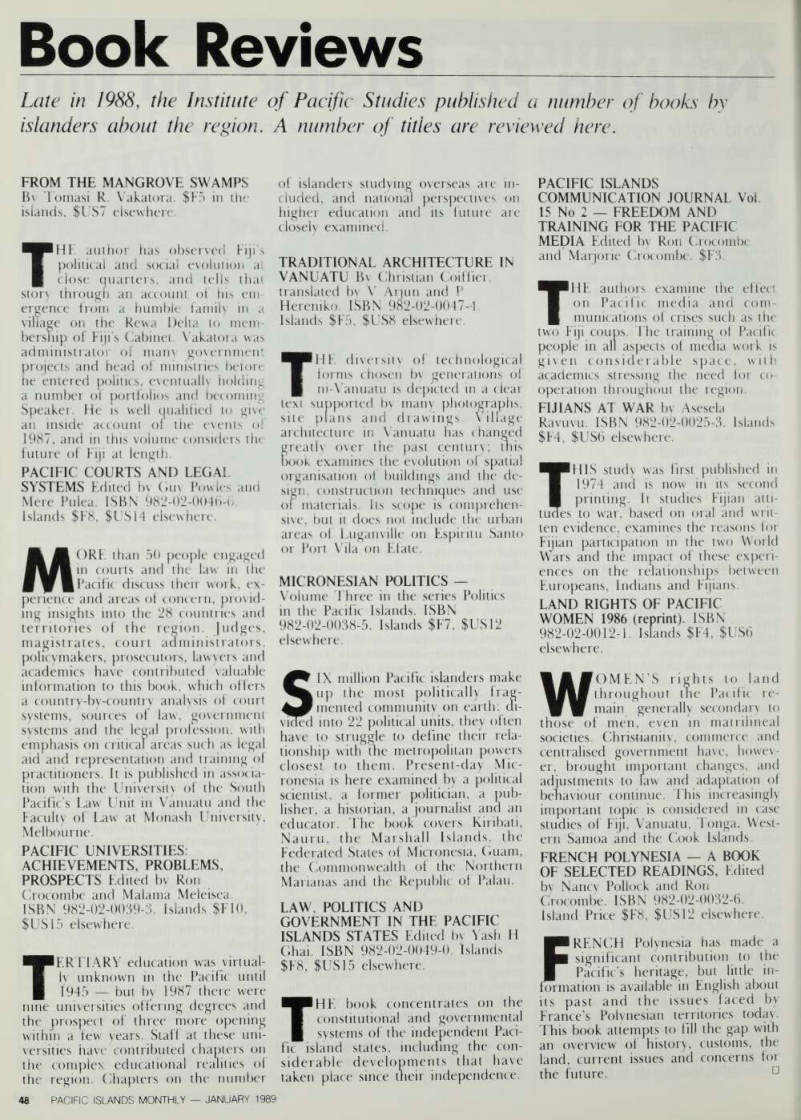
Return To Tahiti: Bligh’S
Second Breadfruit Voyage By
Douglas Oliver. Melbourne University Press SA85.95 Reviewed by Dr Sven Wahlroos E EVERYONE with a serious in terest in Polynesian history and culture is familiar with the name Douglas Oliver. His monumental three-volume work Ancient Tahitian Society , published in 1974 by the Uni versity of Hawaii Press, is essential to an understanding of the Society Is lands and, indeed, of Eastern Polynesia; his recently revised The Facitic Islands is also on the book shelves of all ardent students of the South Pacific. Oliver’s name on the cover of a book is virtually a guaran tee of high quality and meticulous
scholarship.
Now he has delighted us with another important work — one that will appeal especially to Bounty and Tahiti enthusiasts. Return to Tahiti: Bligh's Second Breadfruit Voyage fills a conspicuous void in the vast litera ture connected with the Bounty story.
The only other important work on the subject of which I am aware is Ida
Lee’s Captain BUgh's Second Voyage
to the South Sea (Longman’s, 1920), which is interesting and valuable to be sure, but does not meet the high stan dards of scholarship Oliver attains.
In Return to Tahiti Oliver concen trates on the approximately 14 weeks Bligh spent at Tahiti with his two ships, Providence and Assistant. We
experience this stay not only through
Bhgh’s logbook but also — on a day by-day basis — through the personal
logs of First Lieutenant Bond, Third Lieutenant Tobin and the commander of the Assistant , Lieutenant Portlock.
Fascinating excerpts from their jour nals are accompanied by interesting and informative remarks by Douglas Oliver, who accomplishes the difficult feat of making sense of the extremelv complex Tahitian social and political structure of the time For this achieve ment alone, all students of Tahitian historv and of the Bounty adventure must be in his debt.
Oliver s previous works were all well written, but with the conservatively stiff prose of the conventional scien tist; in Return to Tahiti , however, he has loosened up and writes entertaing ly and sometimes humorously without sacrificing any scientific accuracy. The book is simply a great pleasure to read and it is difficult to put it down; in fact, 1 experienced a sense of regret when I came to the end of the story (the mark of a truly great book).
The author is well aware of who his readers are; on Page 140 he writes: “Anyone choosing to read this far in a book about Bligh’s second breadfruit journey mav be assumed, I suppose, to be well acquainted with the events and consequences of the first.” It is indeed difficult to imagine that anv one reading Return to Tahiti would not be familiar with the Bounty mutiny, but in lecturing on the latter subject I have often Teen surprised at the large proportion of Bounty enthu siasts who km w nothing about the second bread! ruit expedition. They should all read this intriguing account.
There are, of course, no perfect books. This one is attractive not only in content but also in appearance; illustrated with truly delightful water colours painted by Thiro Lieutenant George Tobin. However, the book has some irritating technical drawbacks. In 281 pages I counted 28 typographical errors in Oliver’s text alone (I did not feel safe in examining the journal ex cerpts for typos). More seriously, however, the index compiled by Elmar Zalums is skimpy and sloppy and de tracts severely from the usefulness of the book as a reference work. I hope that there will be a new edition of this important book with a reduced num ber of technical errors and a vastly expanded index. (Oliver himself has not made any mistakes I can detect, other than an inexplicable statement on page 42 to the effect that Captain Edwards, commander of the Pandora , arrested “all 22 of the Bounty people still on the island”. The actual number was 14, so this could hardly be a
typographical error.)
However, these technical flaws drown in the overall quality, interest and superb scholarship of this work. I warmly recommend it to anyone in terested in the South Pacific. □