'Niukila Fri Pasifik' on film
p. 47 · Read in the full issue
David Robie reports on a new documentary about the making of the controversial Treaty of Rarotonga.
ON AUGUST 6 1985, the 40th anniversary of the atomic blast that devastated Hiroshi ma, the leaders of the South Pacific Forum gathered in the thatch-roofed Rarotonga Hotel for a historic meet ing. Eight of the 13 leaders endorsed and signed the Rarotonga Treaty de claring a regional nuclear-free zone.
The ink was barely dry before dis sent within the Forum became public.
A day after New Zealand Prime Minis ter David Lange, the conference spokesman, assured journalists that all Forum members would sign the docu ment, Vanuatu Prime Minister Father Walter Lini declared his country would not sign at least until the treaty was watertight.
The region’s news media quickly lost interest in the issues raised by the treaty, but now a landmark television documentary, Niuklia Fri PasiFik (Bis lama for ‘Nuclear Free Pacific’) has rattled the skeletons in the Forum closet with an incisive and entertaining look at the evolution of the nuclear free Pacific ideal. The independent British-New Zealand production was made early in 1988 at a cost of SNZ 180,000 after a year of research and fund-raising. The 50 minute documentary was financed with a
three-way contract involving, Britain’s
innovative Channel Four, Television New Zealand and the NZ Film Com mission. It was recently completed in the modest Wellington studios of Van guard Films and is due for screening m Britain in February and later in the year in Australia ana New Zealand.
While the documentary may cause discomfort to some politicians, award
winning co-producer Alister Barry
says the show is surprising, but not controversial. “It will accurately reflect the positions and forces that were at play in the development of the treaty,” ne says. “I can’t see any of those play ers being in a position to complain because we’ve gone to a lot of trouble to find out what their different posi tions were and we’re committed to making sure the balance of those forces are understood.”
If the documentary generates any controversy, says Barry, it will do so by revealing the details of a story some of those involved would prefer was not told. “The New Zealancl Gov ernment, for example, will feel un comfortable that its role in the making
of the treaty does not match the popu lar and politically use ul image it nas tried to portray of itself as cnampion of the nuclear-f ee ideal. Australia will find it uncomfortable because, while it portrayed itself as diplomatic and me asured, it was completely determined to get what it wanted.”
Barry and co-producer Philip Shing ler believe the documentary reveals far greater involvement in the treaty by the nuclear powers than would be conceded by those who celebrate it as a great success story. “We’ve been sur prised to find just how involved the US was in the actual details of the formulation of the treaty,” says Barry.
“The popular image projected of the
treaty was that it was a regional initia tive. Certainly that’s true in one sense, but the nuclear powers also had a good hand in the show.”
Barry concedes such involvement was almost inevitable. “If you want to get the nuclear powers to agree to the limitations imposed on them by the
treaty, obviously you’ve got to get
them to go along with it.’ That was the attitude of Australia, New Zealand and several Polynesian nations. But the Melanesian stance was “Were a group of sovereign nations and we can make a treaty regardless of what the nuclear powers do”. But the Australia- New Zealand approach should not be seen as ‘big brother’ attitude: the Paci fic islanders Barry and Shingler inter viewed during the making of the film acknowledged the “care and sensitiv
ity” with which the Australians and the New Zealanders approached the
treaty diplomacy.
The documentary is something of a television miracle, given the obstacles of time, distance, finance and the co operation of the politicians involved. 1 1 economic viability was the yardstick, television networks would have canned the project before it reached first base.
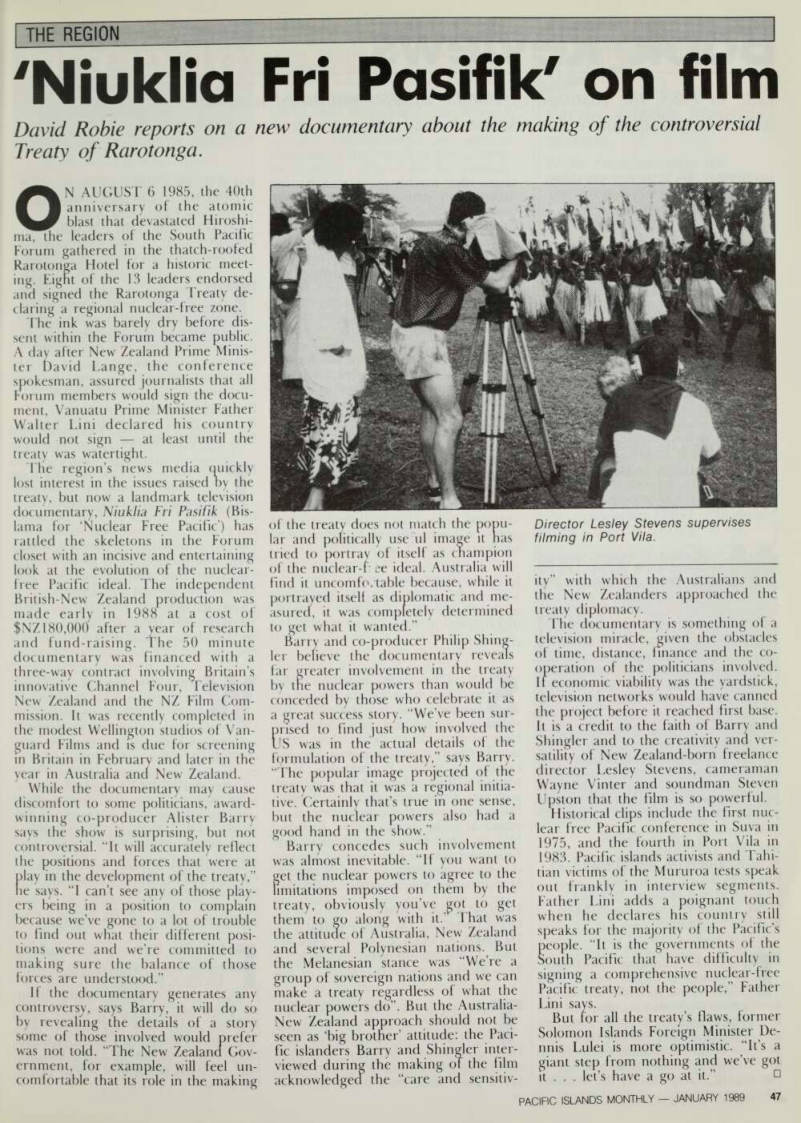
It is a credit to the faith of Barry and Shingler and to the creativity and ver satility of New Zealand-born freelance director Lesley Stevens, cameraman Wayne Vinter and soundman Steven Upston that the film is so powerful.
Historical clips include the first nuc lear free Pacific conference in Suva in 1975, and the fourth in Port Vila in 1983. Pacific islands activists and Tahi tian victims of the Mururoa tests speak out frankly in interview segments.
Father Lini adds a poignant touch when he declares his country still speaks for the majority of the Pacific’s people. “It is the governments of the South Pacific that have difficulty in
signing a comprehensive nuclear-free
Pacific treaty, not the people,” Father Lini says.
But for all the treaty’s flaws, former Solomon Islands Foreign Minister De nnis Lulei is more optimistic. “It’s a giant step from nothing and we’ve got it . . . let’s have a go at it.” □
Director Lesley Stevens supervises filming in Port Vila.