Pacific Report
pp. 27-33 · Read in the full issue


ON March 1, 1954, the United States exploded a 17 megaton bomb 1300 times the destructive force of the bombs dropped on Hiroshima and Nagasaki on Bikini Atoll. Codenamed Bravo, the explosion was one of 66 atmospheric tests conducted in the Marshall Islands by the Americans between 1946 and 1958, a crucial stepping-stone in the Cold War race for nuclear superiority, Rongelap Atoll was directly in the path of Bravo’s fallout; since 1954 its habitants have suffered a heavy legacy of radiation-linked ill health and were forced to abandon their homeland in
May 1985.
Jane Dibblin, a former deputy editor of the Journal of European Nuclear Disarmament and a writer for Britain’s New Statesman, visited the Marshall Islands in 1986 to research her book Day Of Two Suns (Virago
Press). She has produced a damning account of the American nuclear tests and the plight of thousands of dis
placed and suffering islanders.
It would be tempting to regard this book as being on the same level as the classic Moruroa, Mon Amour (and its
sequel, Poisoned Reign, by Marie-
Therese and Bengt Danielsson.
However, while Dibblin’s work is in general a welcome addition to the growing literature on nuclear colonial ism in the Pacific, it is flawed in sever al respects.
First, there are serious doubts with regard to her research and, indeed, integrity; several primary sources deal ing with the irradiated Marshall Islan ders were not contacted directly by
her, yet some of their copyright mate rial has been included, sometimes out of context. For example, extensive in terviews with Rongelap Islanders by American radiation researcher Glen Alcalay for his own book on the topic were included without his permission, Threatened with a court injunction over breach of copyright, the pub lisher has since includea a disclaimer in an attempt to make amends.
In addition Dibblin treats the au thors of the only two books that have detailed first-hand accounts of the Rongelap evacuation on board Ram bow Warrior rather shabbily. Copyr ight material from both Goodbye
Rongelap, byjapanese photojournalist
Hiromitsu Toyosaki, and my own account, Eyes of Fire, has been lifted
without acknowledgement, permission
or even citation in the bibliography, Some of my material is presented as
an apparent interview’, while where Toyosaki’s book is mentioned both ti tle and publisher are named incorrect ly. And, though Australian filmmaker Dennis O’Rourke’s award-winning documentary Half Life heavily influ enced Dibblm’s book, she relegates the only mention of the film to a footnote, wrongly describing it as a “Yorkshire
TV documentary”.
Second, Dibblm’s work suffers from an unresolved tension between being an expose of nuclear colonialism in the Marshalls and a manual for Nuc lear Free and Independent Pacific movement activists. While the chapters dealing specifically with the Marsnalls are well organised, the book begins to unravel by the time it tries to give potted accounts of other Pacific issues.
At the heart of the book is a moving chapter on island women as leaders in the struggle for independence, and an emphasis throughout on the women and children who were victims of nuc lear ‘abuse’. Women politicians, elders, laywers, health workers and maids
working for a pittance on Kwajalein
speak out with emotive frankness.
Despite its flaws, Day of Two Suns is nevertheless a valuable resource and a challenge to (mainly white) peace movements to support Pacific islan ders fighting for their cultural and so cial survival.
David Robie
□ Another Tuvalu Sea Saga
OVERTONES of the amazing survival of the four Tuvaluans who drifted for 51 days and fetched up in Futuna (see PIM, September) were sounded with the rescue of another Tuvaluan, 27 days adrift from Nauru.
In the case of 34-year-old Temou Teiti, however, rejoicing was mixed with sorrow both for him and his family because his cousin, 32-year-old Anania Tefeke, who had set out with him on a fishing trip on October 1, died before they were picked up. A
Philippines fishing vessel found
Temou with his cousin’s body in their aluminium dinghy drifting near Bougainville, and took him to Arawa.
The Filipino fishermen decided to sink the dinghy with Anania’s body, judging that authorities would not nave allowed it into PNG. At last re port Temou was being put up at a notel awaiting repatriation to Nauru.
The two cousins’ fishing trip had been in preparation for the celebra tion of Tuvalu’s national anniversary.
“We had just caught 38 fish and de cided to go home m very high spirits ”
Continued on Page 32
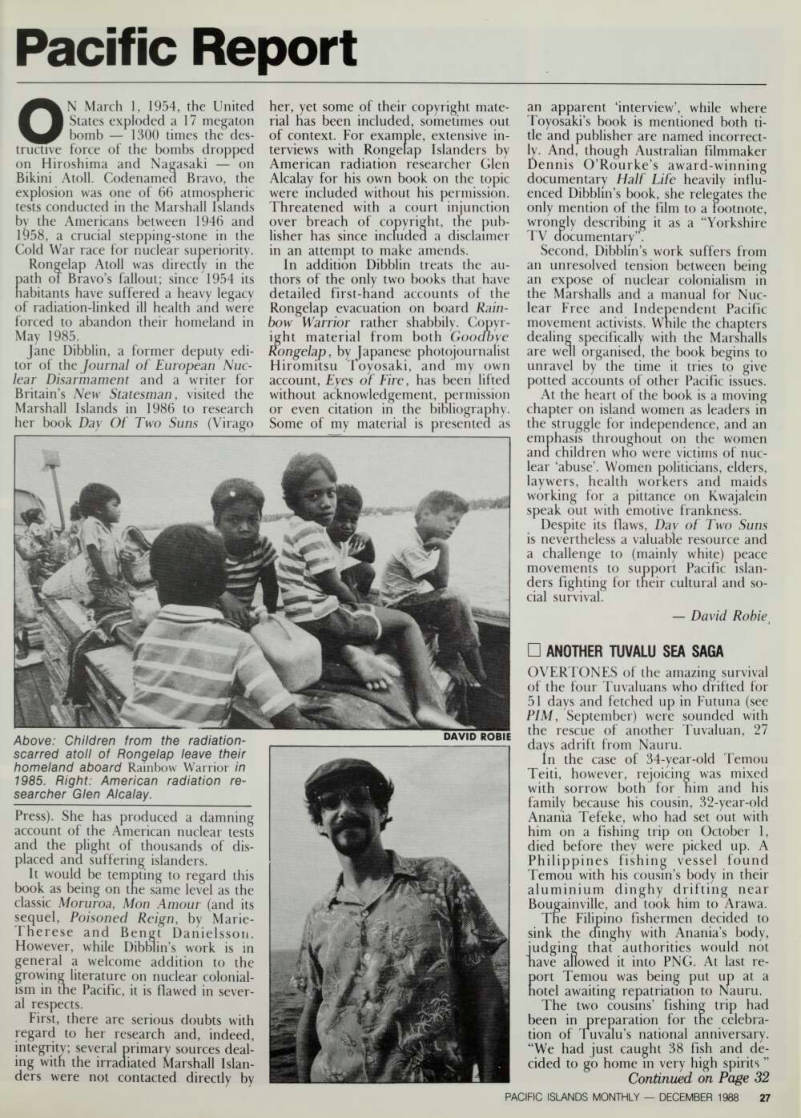
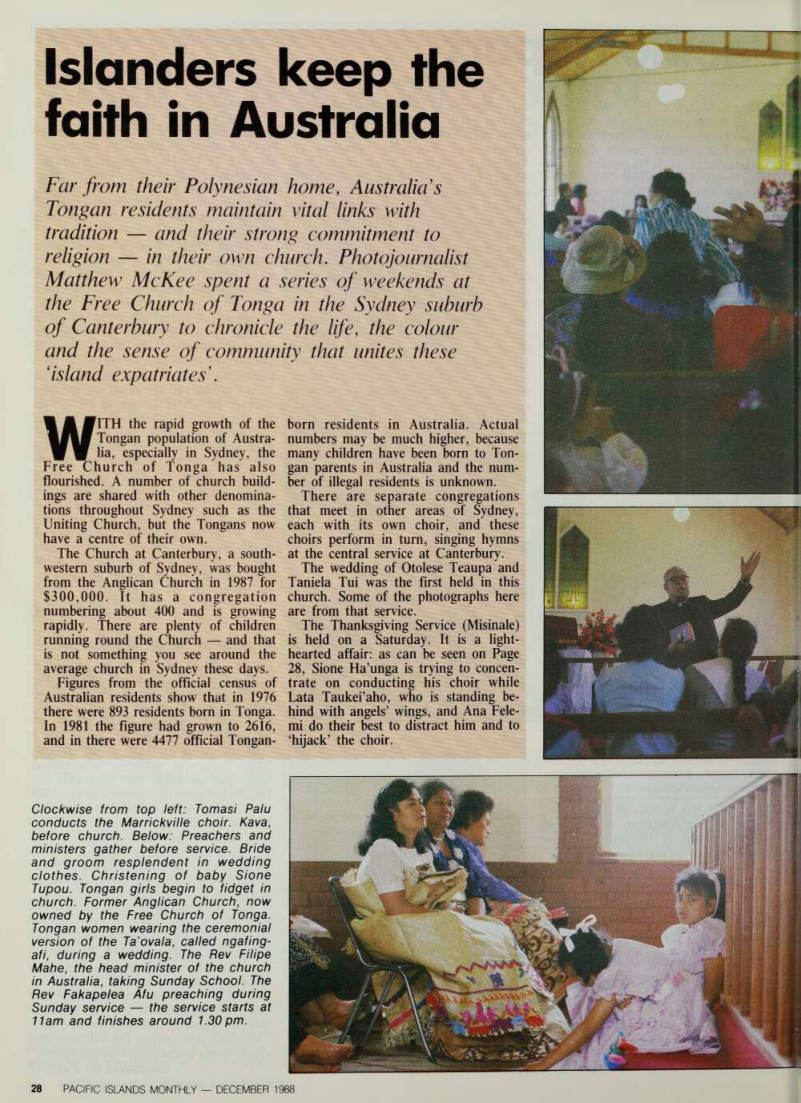
Above: Children from the radiation scarred atoll of Rongelap leave their homeland aboard Rainbow Warrior in 1985. Right: American radiation re searcher Glen Alcalay.
David Robie
he said. But their outboard motor died and they were soon swept away by strong winds and currents. They tried to make a sea anchor with their water-filled petrol tank, but it did not have any effect.
The fishermen did not worry undu ly at first, thinking they would be res cued. “We ate the raw fish we had caught and drank urine mixed with seawater,” Temou said. “We saw three ships during the time we were adrift but they were too far away to notice us. Anania died on October 14.
“I felt lonely and very sorry for him, but I was very weak and could not do much for him. I could not throw him overboard because he was too heavy,” he said.
“It rained once and I could only collect water in a bottle. When that ran out, I went back to drinking sea water mixed with urine. I was weak and did not have very much hope of survival until I saw the fishing boat and started waving.”
□ Kiribati Constitution Decision
A DECISION of major constitutional
significance was delivered by Mr Jus
tice Topping at the High Court in Be tio on November 18. An application
by Opposition member Dr Harry
Tong, seeking an order to restrain the Attorney General, Michael Tekab webwe, from taking part in the pro ceedings of the Maneaba in Maungata bu (House of Parliament) was struck out for want of jurisdiction by the
High Court.
The court held that the Maneaba in Maungatabu had the right to conduct its own proceedings without interfer ence from the courts, and that this was an important part of political free dom. In his judgment, Mr Justice Topping said: “The basis of this Con stitution is the separation of powers.
The Judiciary ought not to interfere in the running of the Legislature and vice versa: the Speaker and Parliament cannot be challenged in their legisla tive capacities. The Kiribati Constitu tion does not limit the power of Par liament as to privilege.”
The decision clarifies the question of parliamentary supremacy and reaf firms the principles of sovereignty of parliament upheld in most other countries.
□ New Role For France
FRANCE is poised to step into a breach between Australia and the small Pacific nations, according to the Paris newspaper Le Monde.
It said France’s reputation in the re gion was benefiting from the resent ment many smaller nations felt to wards Australia’s “police” role. “In the wake of the referendum on the future of New Caledonia, the influence of
France in the South Pacific is being seen in anew light,” a correspondent wrote. “Pilloried not long ago by those Melanesian countries most susceptible to the independence and nationalist movements, Paris is polishing up its
international image.
“The setbacks of Australia whose
role of regional police is challenged
more and more openly play no small part in this change.”
The newspaper said this redistribu tion as power came as South Pacific nations were falling prey to unpre
cedented political tension, particularly
in Melanesian states. With all the coups d’etat, riots and constitutional crises of 1987 and 1988, Melanesia had never before known so much turbulence, Lc Monde said. “Those events have revealed the fragility of these island states, which are economi cally dependent on the outside world and whose stability inherited from the colonial era is starting to crack,”
Citing opposition to Australia’s dis patch of anti-riot gear to Father Wal ter Lini’s Vanuatu Government earlier this year, the newspaper said political troubles in that country could lead to anew balance of power in the region.
Le Monde had also dismissed Father Lini’s criticism at the last South Pacific Forum of France’s peace plan for New Caledonia as “mere rhetoric designed for local consumption”.
□ Us Bans Vanuatu Tuna
THE UNITED States Government has banned the importation of yellowfm tuna caught in the eastern tropical Pacific Ocean from countries that violate US laws protecting marine mammals. The ban is primarily to protect dolphins, which associate with schools of tuna and are often caught in the nets of large tuna vessels.
Strict regulations oblige the Amer ican tuna fleet to use special nets de
signed to prevent dolphins being trap
ped, to undertake rescue operations for dolphins that are caught in nets and not to fish after sunset, when res cue operations would be difficult. It is claimed this has reduced the number of dolphins killed by the US fishing fleet from a very conservative estimate of more than 100,000 in 1976 to around 20,000 in 1987.
Vanuatu is named as a non complier with the US rules, along with Panama, Ecuador and Venezuela. El Salvador and the Soviet Union are already under embargo for failure to meet US requirements.
Voice of America radio said that to sell their tuna catch in the United States, other nations do not have to meet the same strict requirements the US imposes on its own tuna fleet, but they do have to make a comparable effort to reduce marine mammal deaths associated with tuna fishing.