'Profit is not a dirty word'
p. 26 · Read in the full issue
Fiji
That was the message to an employers' conference in Suva last month.
SENIOR management confer ence of the Fiji Employers i Consultative Association was held in Suva in November. Thirty senior representatives of member companies and statutory organisations attended. Sir Eric Neal, deputy chair man of the Westpac Banking Corpora tion, and Mr Rodney Cole, assistant executive director of the Centre for Development Studies of the Australian National University, were guest speak ers. After discussion, delegates sent their observations and recommena tions to the government and in terested private sector groups.
Many of the conference pronounce ments reflect the interests of estab lished business in Fiji. There was a strong feeling, for example, that the Government should not discriminate against Fiji companies in matters of tax and investment concessions.
“Established companies in Fiji that had demonstrated tneir credibility and commitment should be eligible for the same concessions applying to foreign investors,” a communique said.
Self-interest was, in fact, high on the conference agenda: the meeting ex pressed cautious optimism on the part of the commercial sector and a hope for constitutional guarantees of basic individual rights that would promote business confidence. On the other hand, it saw that the traditional Fijian lifestyle focusing on communal values was unhelpful to the personal drive and ambition necessary to achieve the degree of business participation the Government is looking for on behalf
of indigenous Fijians.
If the Government were to provide clear and consistent guidelines for commercial sector activity, the confer ence noted an investment boom is
quite possible despite any political un
certainty that may remain. The meet ing noted with approval that Govern ment has taken a pro-business stance and appears ready to consult on direc
tions. Foreign investmentis especially
welcome in Fiji, and its application should enhance the private enterprise system and promote the healthy de velopment or the profit motive.
The conference working group on confidence, stability and investment found itself beset with conflicting emotional reactions to the continuing political disruption of Fiji. “Most local business people thought a significant measure of confidence would be res-
tored with the adoption of a constitu tion guaranteeing basic rights and freedoms, including those relating to the individual, religion, property own ership and security of business,” the group said. Mr Cole said business can thrive in spite of political upheavals so long as the needs and objectives of the country are spelt out clearly and admi nistered firmly and fairly. Investors must be looked after to the extent they were not confronted with irra tional changes in official policy, which tended to make them nervous.
The conference was also pleased by Mr Cole’s defence of trans-national
corporations: “Certanly Fiji must have
a mechanism for monitoring foreign investment,” he said, “to ensure that conditions attaching to concessions are met, that a genuine contribution is made to development and that local entrepreneurs are not displaced. At the same time, the contribution of
foreign investors in bringing together
skill, capital and foreign market access
must receive unequivocal recognition
for the benefits it can bring to small, resource-poor countries.
“Positive attitudes to foreign invest ment must be adopted at Doth the bureaucratic and political level. Com mercial rates of return on high-risk capital that may have other investment
options should not be looked on with suspicion, but welcomed within clear
and unambiguous guidelines.
“Those invetors with too-high ex pectations should be treated warily and those requesting high levels of
protection discouraged.”
The need for promoting greater understanding and awareness of profit and the profit motive also arose: dele gates felt it was time for profit to come out of the closet’. Profit, they said, was not a dirty word.
The conference did its best to accommodate the need for greater
participation by Fijians in the eco
nomy, but recognised some potent problems. Values and philosophy of life were different. Delegates noted “the difficulties of reconciling a cul ture that stressed communal obliga tions and sharing with a private enter prise culture that encouraged indi vidualism and acquisition”.
Taxation came under the confer ence spotlight ... as well as how taxes were spent. The forms of tax used in Fiji were “not encouraging to indi vidual enterprise” and government was “too large”. Many government en terprises could well be privatised or corporatised. The functions of the
Ports Authority, National Marketing
Authority, Air Pacific, Posts and Tele
communications, the Fiji Broadcasting,
the Public Works Department and the Government Shipyard came in for mention.
Too few people in Fiji paid direct income tax, the deleates thought.
There was a need to broaden the base, , perhaps through the extension of tur nover tax to a value-added type tax that would more equitably distribute the tax burden.
Throughout the conference there was constant reference to the need for the Government not to discriminate
against existing businesses in Fiji in
favour of newly-attracted overseas in
vestors. Long-established companies
could also help in the growth of the economy if trie following measures were implemented: abolition of di vidend withholding tax on commis sions paid to overseas agents; abolition of the advertising turnover tax on
overseas promotion for Fiji products
or services; removal of duty on im ports of all raw materials and packag ing materials to encourage exports; and removal of fringe benefits and other personal taxes. D
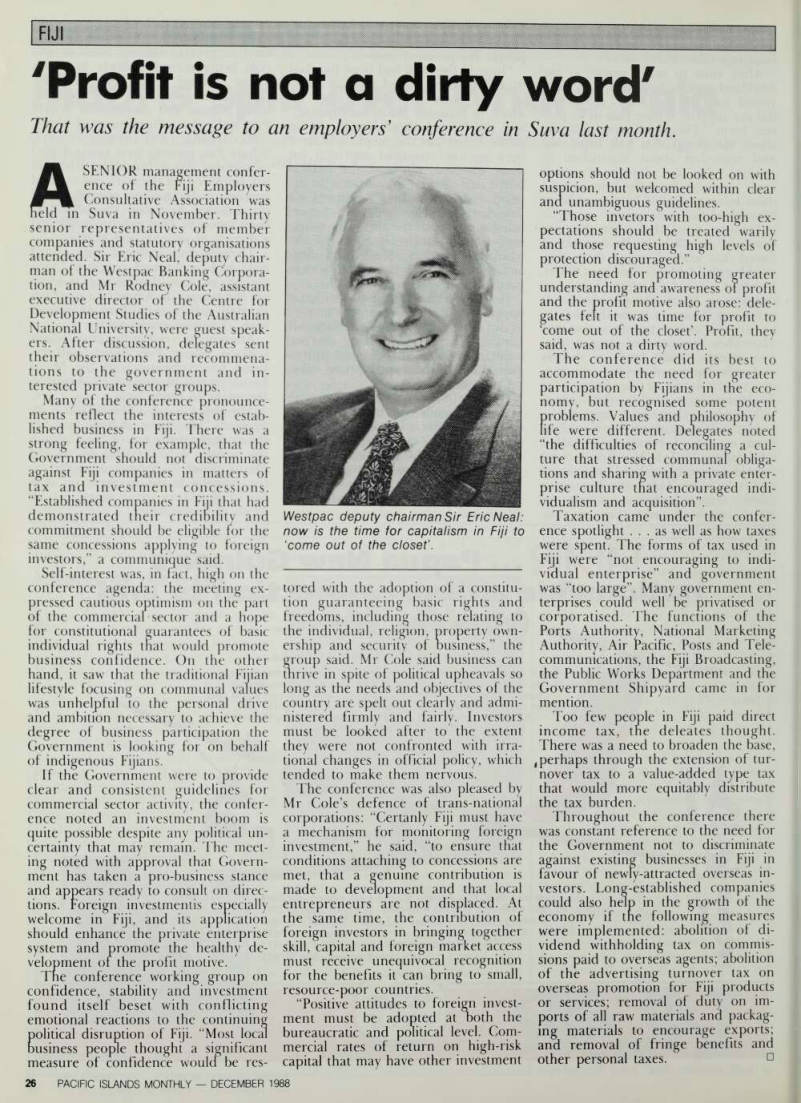
Westpac deputy chairman Sir Eric Neal: now is the time for capitalism in Fiji to ‘come out of the closet'.