A Notion of Readers
pp. 49-50 · Read in the full issue
Tonga s new cosmopolitan attitude reflected in literature. By Ed Rampell
ONE of the many surprising delights the Kingdom of Ton ga offers is a thriving literary scene. This includes a number of news-related publications, correspon dents, poetry, fiction, a bookstore and even a local publishing house. To what does Tonga owe its flourishing
and sophisticated literary life?
“Now it’s reached a point where ale want to read, to find out more, e past it didn’t catch on, but from 1980 people have been dying for in formation, and they want to read more about Tongans,” declares Pesi Fonua, one of the Friendly Islands’ literary lions. Fonua is the publisher of Vava’u Press, which prints Tonga related books and a bilingual, bimonthly magazine. A poet and fic tion writer, he has written a collection of short stories, Sun and Rain , and is at work on a novel.
Matangi Tonga is one of the finest magazines in the Pacific islands today.
Its hard news and feature stories are well written and thoughtful, dealing
with subjects ranging from the history
of Tonga’s constitution and a con troversial proposed hazardous waste
plant to a Rotuman Polynesian prince
seeking secession from Fiji and a Ton gan pro-football player in the St Louis Cardinals team. In journalism or fic-
tion, Pesi Fonua knows his beat his native land. Vava’u Press boasts two computers at its modest offices to en hance the publishing of Matangi Ton ga's six issues a year and the pub lishing house’s fiction and nonfiction
Tongan-linked literature.
The government-owned and oper ated Tonga Chronicle is a weekly newspaper with Tongan and English
editions published by His Majesty’s In
formation Office. Although an organ of the administration, it is not mind less propaganda, and the quality of
the writing is on a par with other Paci fic papers. Feature writer Fuaiapi Sime, tor example, writes with insight and compassion about the needs of the handicapped, alienated youth and the like. The weekly, which has been published since 1964, also employs computers at its Nukualofa offices.
Tonga Today is another indigenous
magazine, privately owned and
printed monthly. It, too, deals with the issues of the day in each bilingual issue. In addition, there are four or so
monthly church publications.
Tonga even has its own, interna
tionally respected novelist, Epeli
Hau’ofa, a satirist and author of Tales of the Tikongs and Kissing the Nederends , perennial sell-outs in Nukualofa. Dr Hau’ofa is currently a professor of Literature at the Uni versity of the South Pacific in Fiji the perfect Pacific locale for any bud ding Pacific Mark Twain. Epeli
Hau’ofa is widely regarded a prime
candidate for author of ‘the Great Oceanic Novel’ and Tonga’s answer to Samoa’s brilliant Albert Wendt.
Many factors have combined to pro duce Tonga’s literary renaissance. One key element is Tonga’s constitution, which has enshrined freedom of speech as a basic civil liberty. Despite some limitations imposed by the
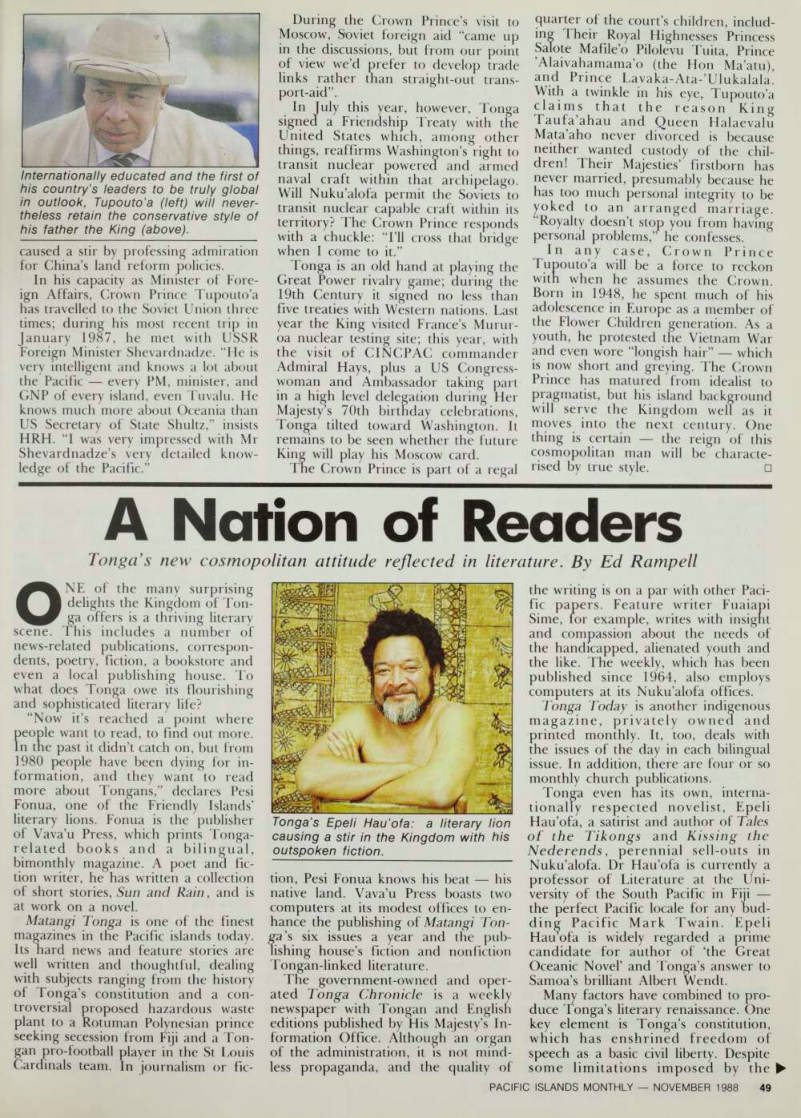
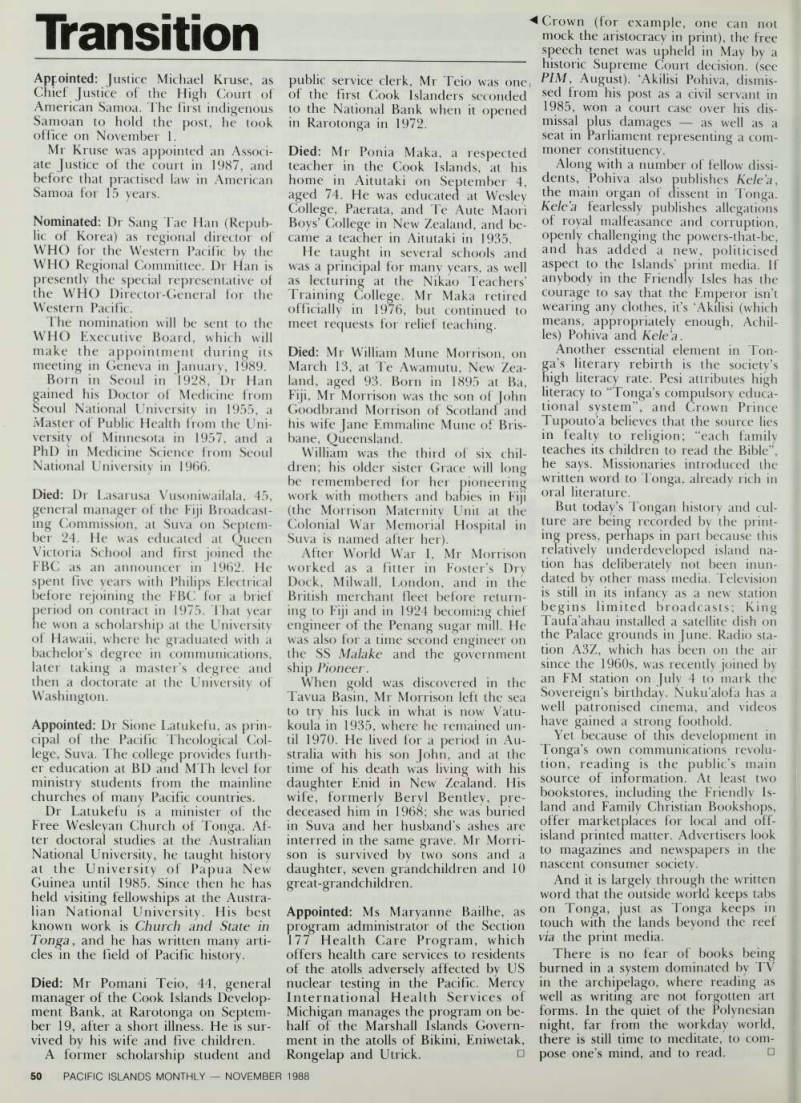
Tonga’s Epeli Hau’ofa: a literary lion causing a stir in the Kingdom with his outspoken fiction.
Transition
Appointed: Justice Michael Kruse, as Chief Justice of the High Court of American Samoa. The first indigenous Samoan to hold the post, he took office on November 1.
Mr Kruse was appointed an Associ ate Justice of the court in 1987, and before that practised law in American Samoa for 15 years.
Nominated: Dr Sang Tae Han (Repub lic of Korea) as regional director of WHO for the Western Pacific by the WHO Regional Committee. Dr Han is
presently the special representative of
the WHO Director-General for the Western Pacific.
The nomination will be sent to the WHO Executive Board, which will make the appointment during its meeting in Geneva in January, 1989.
Born in Seoul in 1928, Dr Han gained his Doctor of Medicine from Seoul National University in 1955, a Master of Public Health from the Uni versity of Minnesota in 1957, and a PhD in Medicine Science from Seoul National University in 1966.
Died: Dr Lasarusa Vusoniwailala, 45, general manager of the Fiji Broadcast ing Commission, at Suva on Septem ber 24. He was educated at Queen Victoria School and first joined the FBC as an announcer in 1962. He spent five years with Philips Electrical before rejoining the FBC for a brief period on contract in 1975. That year ne won a scholarship at the University of Hawaii, where he graduated with a bachelor’s degree in communications, later taking a master’s degree and then a doctorate at the University of
Washington.
Appointed: Dr Sione Latukefu, as prin cipal of the Pacific Theological Col
lege, Suva. The college provides furth
er education at BD and MTh level for ministry students from the mainline churches of many Pacific countries.
Dr Latukefu is a minister of the Free Wesleyan Church of Tonga. Af ter doctoral studies at the Australian
National University, he taught history
at the University of Papua New Guinea until 1985. Since then he has held visiting fellowships at the Austra lian National University. His best known work is Church and State in Tonga, and he has written many arti cles in the field of Pacific history.
Died: Mr Pomani Teio, 44, general manager of the Cook Islands Develop ment Bank, at Rarotonga on Septem ber 19, after a short illness. He is sur vived by his wife and five children.
A former scholarship student and
public service clerk, Mr Teio was one of the first Cook Islanders seconded to the National Bank when it opened in Rarotonga in 1972.
Died: Mr Ponia Maka, a respected teacher in the Cook Islands, at his home in Aitutaki on September 4, aged 74. He was educated at Wesley College, Paerata, and Te Ante Maori Boys’ College in New Zealand, and be came a teacher in Aitutaki in 1935.
He taught in several schools and was a principal for many years, as well as lecturing at the Nikao Teachers’
Training College. Mr Maka retired officially in 1976, but continued to meet requests for relief teaching.
Died: Mr William Mune Morrison, on March 13, at Te Awamutu, New Zea land, aged 93. Born in 1895 at Ba, Fiji, Mr Morrison was the son of John Goodbrand Morrison of Scotland and his wife Jane Emmaline Mune of Bris
bane, Queensland.
William was the third of six chil dren; his older sister Grace will long be remembered for her pioneering work with mothers and babies in Fiji (the Morrison Maternity Unit at the Colonial War Memorial Hospital in Suva is named after her).
After World War I, Mr Morrison worked as a fitter in Foster’s Dry Dock, Milwall, London, and in the British merchant fleet before return ing to Fiji and in 1924 becoming chief engineer of the Penang sugar mill. He was also for a time second engineer on the SS Malake and the government
ship Pioneer.
When gold was discovered in the Tavua Basin, Mr Morrison left the sea to try his luck in what is now Vatu koula in 1935, where he remained un til 1970. He lived for a period in Au stralia with his son John, and at the time of his death was living with his daughter Enid in New Zealand. His
wife, formerly Beryl Bentley, pre
deceased him in 1968; she was buried in Suva and her husband’s ashes are interred in the same grave. Mr Morri son is survived by two sons and a daughter, seven grandchildren and 10
great-grandchildren.
Appointed: Ms Maryanne Bailhe, as program administrator of the Section 177 Health Care Program, which offers health care services to residents of the atolls adversely affected by US nuclear testing in the Pacific. Mercy International Health Services of Michigan manages the program on be half of the Marshall Islands Govern ment in the atolls of Bikini, Eniwetak, Rongelap and Utrick. □
< Crown (for example, one can not mock the aristocracy in print), the free speech tenet was upheld in May by a historic Supreme Court decision, (see , PIM , August). ‘Akilisi Pohiva, dismis sed from his post as a civil servant in 1985, won a court case over his dis missal plus damages as well as a seat in Parliament representing a com
moner constituency.
Along with a number of fellow dissi dents, Pohiva also publishes Kele’a, the main organ of dissent in Tonga.
Kele’a fearlessly publishes allegations
of royal malfeasance and corruption,
openly challenging the powers-that-be,
and nas added a new, politicised aspect to the Islands’ print media. If anybody in the Friendly Isles has the courage to say that the Emperor isn’t wearing any clothes, it’s ‘Akilisi (which
means, appropriately enough, Achil
les) Pohiva and Kele’a.
Another essential element in Ton ga’s literary rebirth is the society’s
nigh literacy rate. Pesi attributes high
literacy to “Tonga’s compulsory educa
tional system”, and Crown Prince Tupouto’a believes that the source lies
in fealty to religion; “each family
teaches its children to read the Bible”, he says. Missionaries introduced the written word to Tonga, already rich in oral literature.
But today’s Tongan history and cul
ture are being recorded by the print ing press, perhaps in part because this
relatively underdeveloped island na
tion has deliberately not been inun dated by other mass media. Television is still in its infancy as a new station
begins limited broadcasts; King
Taufa’ahau installed a satellite dish on the Palace grounds in June. Radio sta tion A3Z, which has been on the air since the 19605, was recently joined by an FM station on July 4 to mark the Sovereign’s birthday. Nukualofa has a well patronised cinema, and videos have gained a strong foothold.
Yet because of this development in Tonga’s own communications revolu tion, reading is the public’s main source of information. At least two bookstores, including the Friendly Is land and Family Christian Bookshops, offer marketplaces for local and off island printed matter. Advertisers look to magazines and newspapers in the nascent consumer society.
And it is largely through the written word that the outside world keeps tabs on Tonga, just as Tonga keeps in touch with the lands beyond the reef via the print media.
There is no fear of books being burned in a system dominated by TV in the archipelago, where reading as well as writing are not forgotten art forms. In the quiet of the Polynesian night, far from the workday world, there is still time to meditate, to com pose one’s mind, and to read. □