Pacific Stamp Box
p. 51 · Read in the full issue
Edited by John Hunter
NEXT year marks the 50th anniversary of the year in which no new stamps were issued. Barry Gentle (one of a growing number critical of the ‘explosion’ in new issues appearing at Australian and other countries’ post office coun ters) made this comment in Sydney’s Sunday Telegraph some time ago, and like him I believe many postal author ities are beginning to feel the pinch as
collectors quit the hobby. Consequent
ly, revenue for philatelic sales is falling alarmingly Australia Post, for ex ample, has experienced a 30 per cent drop and it is likely 1989 will see a smaller number of stamps issued by many countries. Australia Post is fore
casting only 44 issues, compared with
70 for 1988.
This year has, admittedly, been characterised by a number of special events such as Australia’s Bicentenary and the Olympics in South Korea.
However, many agencies have issued far too many stamps for the average collector, who has only a limited amount to spend . . . which has led to a dramatic fall in the number of col lectors and a resulting fall in revenue for postal authorities.
Another effect this has had has been in the investment area of the hobby (see Robin Bromby’s article in Pacific Islands Monthly, October).
Prices haven’t shown the expected in crease since the 1980 crash in the stamp market. Rare material has held its price, but stamp collecting no lon ger offers a gilt-edged method of making money when compared to in vestment in, say, antiques, jewellery or
debenture stock.
I think there is hope in 1989 for a return to stability, sensible stamp issues policies and some recruitment of people to the hobby: and on this subject, Stamp News reports that Au stralia Post has initiated plans to move all its philatelic mail-order operations to Melbourne. The Barrack Street, Sydney Philatelic Sales Office will close and be relocated in the main Sydney
GPO building.
NORFOLK ISLAND released its Christmas issue on September 27: 30c, 42c, 58c and 63c young artists’ im pressions of Norfolk Island. December 6, convict era buildings: 39c pier store; 55c Royal Engineer’s office; 90c old Military Barracks; $1 Commissariat store and new Military Barracks. On February 14 next year, Norfolk Island will release stamps featuring endemic insects: 39c, 55c, 90c and $1 insects found only on Norfolk Island.
PAPUA NEW GUINEA will issue four more stamps in the historic ships series on November 16: It La Boudeuse ; lOt Swallow, 30t Vitiaz ; K 3 Samoa.
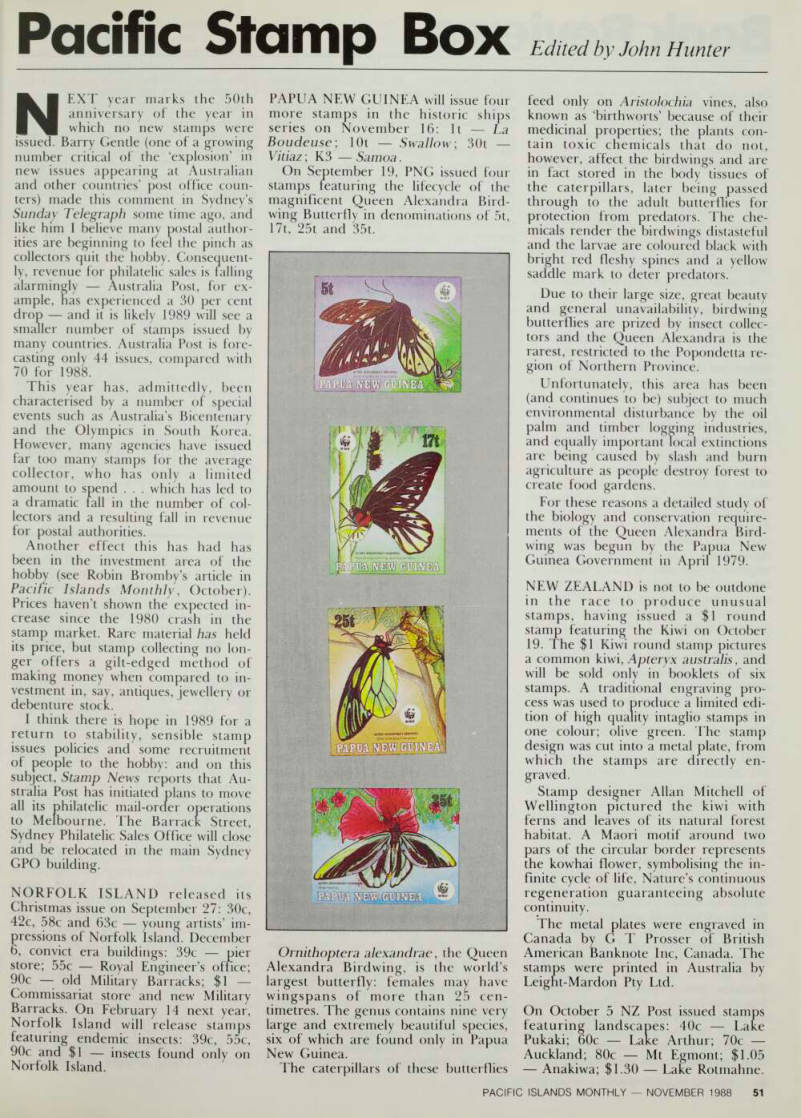
On September 19, PNG issued four stamps featuring the lifecycle of the magnificent Queen Alexandra Bird wing Butterfly in denominations of st, I7t, 25t and 35t.
Ornithoptera alexandrae, the Queen
Alexandra Birdwing, is the world’s largest butterfly: females may have wingspans of more than 25 cen timetres. The genus contains nine very
large and extremely beautiful species,
six of which are found only in Papua New Guinea.
The caterpillars of these butterflies
feed only on Aristolochia vines, also known as ‘birthworts’ because of their medicinal properties; the plants con tain toxic chemicals that do not, however, affect the birdwings and are in fact stored in the body tissues of
the caterpillars, later being passed
through to the adult butterflies for protection from predators. The che micals render the birdwings distasteful and the larvae are coloured black with bright red fleshy spines and a yellow saddle mark to deter predators.
Due to their large size, great beauty
and general unavailability, birdwing
butterflies are prized by insect collec tors and the Queen Alexandra is the rarest, restricted to the Popondetta re gion of Northern Province.
Unfortunately, this area has been (and continues to be) subject to much environmental disturbance by the oil palm and timber logging industries, and equally important local extinctions are being caused by slash and burn
agriculture as people destroy forest to
create food gardens.
For these reasons a detailed study of the biology and conservation require ments of the Queen Alexandra Bird wing was begun by the Papua New Guinea Government in April 1979.
NEW ZEALAND is not to be outdone in the race to produce unusual stamps, having issued a $1 round stamp featuring the Kiwi on October 19. The $1 Kiwi round stamp pictures a common kiwi, Apteryx australis, and will be sold only in booklets of six stamps. A traditional engraving pro cess was used to produce a limited edi tion of high quality intaglio stamps in one colour; olive green. The stamp design was cut into a metal plate, from which the stamps are directly en
graved.
Stamp designer Allan Mitchell of Wellington pictured the kiwi with ferns and leaves of its natural forest habitat. A Maori motif around two pars of the circular border represents the kowhai flower, symbolising the in finite cycle of life, Nature’s continuous
regeneration guaranteeing absolute
continuity.
The metal plates were engraved in Canada by G T Prosser of British American Banknote Inc, Canada. The
stamps were printed in Australia by
Leight-Mardon Pty Ltd.
On October 5 NZ Post issued stamps
featuring landscapes: 40c Lake
Pukaki; 60c Lake Arthur; 70c Auckland; 80c Mt Egmont; $1.05 Anakiwa; $1.30 Lake Rotmahne.