Tonga's Cultured Crown Prince
pp. 48-49 · Read in the full issue
Pacific People
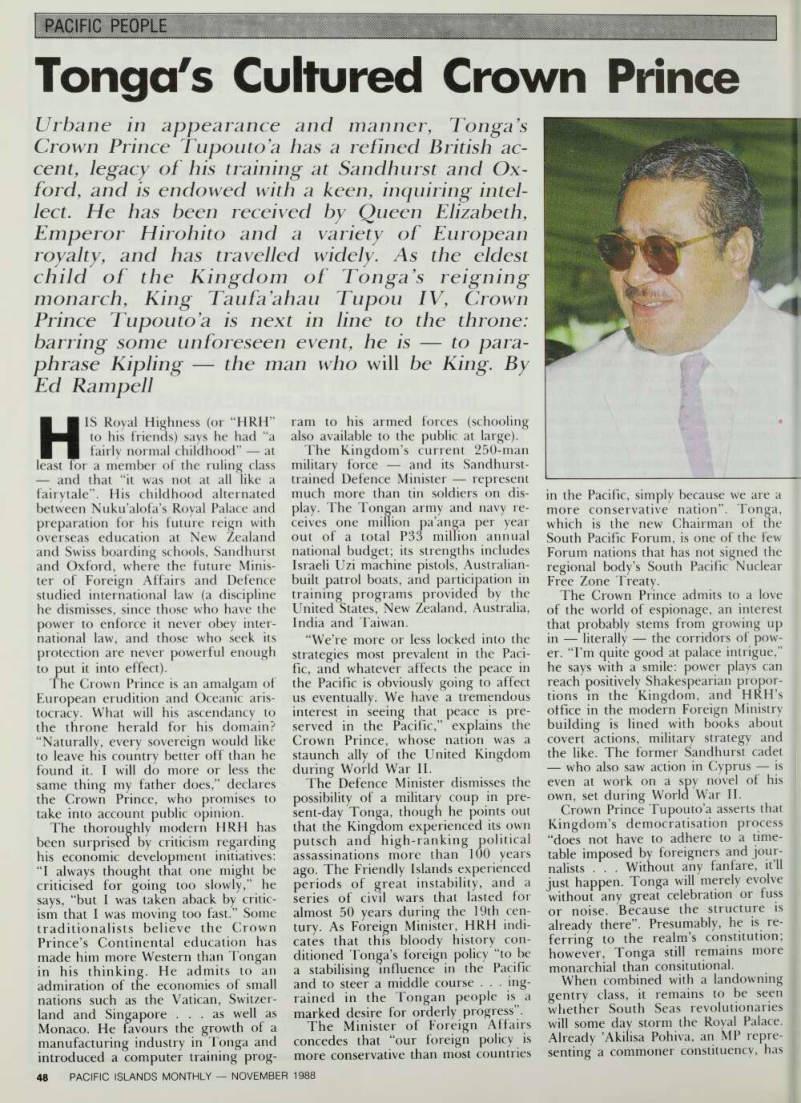
Urbane in appearance and manner, Tonga’s Crown Prince Tupouto’a has a refined British ac cent, legacy of his training at Sandhurst and Ox ford, and is endowed with a keen, inquiring intel lect. He has been received by Queen Elizabeth, Emperor Hirohito and a variety of European royalty, and has travelled widely. As the eldest child of the Kingdom of Tonga’s reigning monarch, King Taufa’ahau Tupou IV, Crown Prince Tupouto’a is next line to the throne: barring some unforeseen event, he is to para phrase Kipling the man who will be King. By
Ed Rampell
I IS Royal Highness (or “HRH”
to his friends) says he had "a
Jj fairly normal childhood” —at
least Tor a member of the ruling class and that “it was not at all like a fairytale”. His childhood alternated between Nukualofa’s Royal Palace and preparation for his future reign with overseas education at New Zealand and Swiss boarding schools, Sandhurst and Oxford, where the future Minis ter of Foreign Affairs and Defence studied international law (a discipline he dismisses, since those who have the power to enforce it never obey inter national law, and those who seek its
protection are never powerful enough
to put it into effect).
The Crown Prince is an amalgam of European erudition and Oceanic aris tocracy. What will his ascendancy to the throne herald for his domain?
“Naturally, every sovereign would like to leave his country better off than he found it. I will do more or less the same thing my father does,” declares the Crown Prince, who promises to take into account public opinion.
The thoroughly modern HRH has
been surprised by criticism regarding
his economic development initiatives: “I always thought that one might be criticised for going too slowly,” he says, “but I was taken aback by critic ism that I was moving too fast.” Some traditionalists believe the Crown Prince’s Continental education has made him more Western than Tongan in his thinking. He admits to an admiration of the economies of small nations such as the Vatican, Switzer land and Singapore ... as well as Monaco. He favours the growth of a
manufacturing industry in Tonga and
introduced a computer training prog
ram to his armed forces (schooling also available to the public at large).
The Kingdom’s current 250-man military force and its Sandhurst trainea Defence Minister represent much more than tin soldiers on dis play. The Tongan army and navy re ceives one million pa’anga per year out of a total P 33 million annual national budget; its strengths includes Israeli Uzi machine pistols, Australian built patrol boats, and participation in
training programs provided by the
United States, New Zealand, Australia, India and Taiwan.
“We’re more or less locked into the strategies most prevalent in the Paci fic, and whatever affects the peace in the Pacific is obviously going to affect us eventually. We have a tremendous interest in seeing that peace is pre served in the Pacific,” explains the Crown Prince, whose nation was a staunch ally of the United Kingdom during World War 11.
The Defence Minister dismisses the possibility of a military coup in pre
sent-day Tonga, though he points out
that the Kingdom experienced its own
putsch and high-ranking political
assassinations more than 100 years ago. The Friendly Islands experienced periods of great instability, and a series of civil wars that lasted for almost 50 years during the 19th cen tury. As Foreign Minister, HRH indi cates that this bloody history con
ditioned Tonga’s foreign policy “to be
a stabilising influence in the Pacific and to steer a middle course . . . ing rained in the Tongan people is a marked desire for orderly progress”.
The Minister of Foreign Affairs concedes that “our foreign policy is more conservative than most countries
in the Pacific, simply because we are a more conservative nation”. Tonga, which is the new Chairman of the South Pacific Forum, is one of the few Forum nations that has not signed the regional body’s South Pacific Nuclear Free Zone Treaty.
The Crown Prince admits to a love of the world of espionage, an interest that probably stems from growing up in literally the corridors of pow er. “I’m quite good at palace intrigue,” he says with a smile: power plays can
reach positively Shakespearian propor
tions in the Kingdom, and HRH’s office in the modern Foreign Ministry building is lined with books about covert actions, military strategy and the like. The former Sandhurst cadet who also saw action in Cyprus is even at work on a spy novel of his own, set during World War 11.
Crown Prince Tupouto’a asserts that Kingdom’s democratisation process “does not have to adhere to a time
table imposed by foreigners and jour
nalists . . . Without any fanfare, it’ll
just happen. Tonga will merely evolve
without any great celebration or fuss or noise. Because the structure is already there”. Presumably, he is re ferring to the realm’s constitution; however, Tonga still remains more monarchial than consitutional.
When combined with a landowning gentry class, it remains to be seen whether South Seas revolutionaries will some day storm the Royal Palace.
Already ’Akilisa Pohiva, an MP repre senting a commoner constituency, has
caused a stir by professing admiration for China’s land reform policies.
In his capacity as Minister of Fore ign Affairs, Crown Prince Tupouto’a has travelled to the Soviet Union three times; during his most recent trip in January 1987, he met with USSR Foreign Minister Shevardnadze. “He is very intelligent and knows a lot about the Pacific every PM, minister, and GNP of every island, even Tuvalu. He knows much more about Oceania than US Secretary of State Shultz,” insists HRH. “I was very impressed with Mr Shevardnadze’s very detailed know ledge of the Pacific.”
During the Crown Prince’s visit to Moscow, Soviet foreign aid “came up in the discussions, but from our point of view we’d prefer to develop trade links rather than straight-out trans
port-aid”.
In July this year, however, Tonga
signed a Friendship Treaty with the
United States which, among other
things, reaffirms Washington’s right to
transit nuclear powered and armed naval craft within that archipelago.
Will Nuku’alofa permit the Soviets to transit nuclear capable craft within its territory? The Crown Prince responds with a chuckle: “I’ll cross that bridge when I come to it.”
Tonga is an old hand at playing the Great Power rivalry game; during the 19th Century it signed no less than five treaties with Western nations. Last year the King visited France’s Murur oa nuclear testing site; this year, with the visit of CINCPAC commander
Admiral Hays, plus a US Congress
woman and Ambassador taking part in a high level delegation during Her
Majesty’s 70th birthday celebrations,
Tonga tilted toward Washington. It remains to be seen whether the future King will play his Moscow card.
The Crown Prince is part of a regal
quarter of the court’s children, includ ing Their Royal Highnesses Princess SaTote Mafile’o Pilolevu Tuita, Prince ’Alaivahamama’o (the Hon Ma’atu), and Prince Lavaka-Ata-’Ulukalala.
With a twinkle in his eye, Tupouto’a claims that the reason King Taufa’ahau and Queen Halaevalu Mata’aho never divorced is because neither wanted custody of the chil dren! Their Majesties’ firstborn has never married, presumably because he has too much personal integrity to be yoked to an arranged marriage.
“Royalty doesn’t stop you from having personal problems,” he confesses.
In any case, Crown Prince Tupouto’a will be a force to reckon with when he assumes the Crown.
Born in 1948, he spent much of his adolescence in Europe as a member of the Flower Children generation. As a youth, he protested the Vietnam War and even wore “longish hair” which is now short and greying. The Crown Prince has matured from idealist to pragmatist, but his island background will serve the Kingdom well as it moves into the next century. One thing is certain the reign of this cosmopolitan man will be characte rised by true style. □
Internationally educated and the first of his country’s leaders to be truly global in outlook, Tupouto’a (left) will never theless retain the conservative style of his father the King (above).