Rusted Memories of War
pp. 32-34 · Read in the full issue
Solomon Islands
David J Haden continues his exploration of Pacific battlegrounds
THE New Georgia Islands, in the Western Province of the Solo mon Islands, are among the most beautiful islands I have had the
privilege of visiting during my Pacific
travels. But not only was I visiting the islands to appreciate their natural beauty; I had also come to retrace some of the World War II history that has made these islands famous. Re minders of war can still be seen from the air; the rusted hulls of landing barges still litter the white beaches and bomb craters dot the lagoons. Even today they are isolated, with roads near main centres and bush tracks forming the only transport links; travel between islands is by canoe.
As the Solair flight approached Munda airstrip on Lambete, I was astounded by the beauty of the many small islands of Vonavona Lagoon.
Some are inhabited, some are empty but all inviting. The towering peak of Rendova Island loomed through the clouds to the right of the aircraft, while below me canoes loaded with
villagers and their supplies plied the
lagoon. Ahead I could see the runway, and from the co-pilot’s seat my thoughts turned to the time when this field was used by the Japanese Zeke pilots; they would have seen the same view 45 years ago.
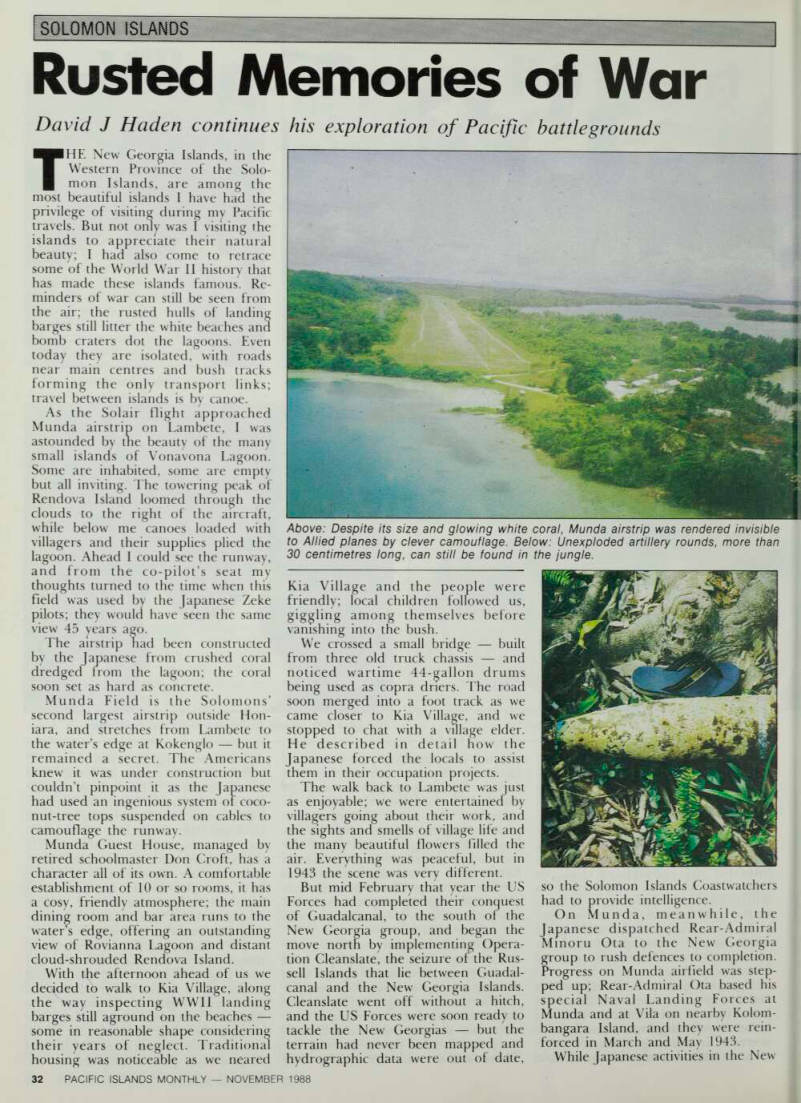
The airstrip had been constructed by the Japanese from crushed coral dredged from the lagoon; the coral soon set as hard as concrete.
Munda Field is the Solomons’ second largest airstrip outside Hon iara, and stretches from Lambete to the water’s edge at Kokenglo but it remained a secret. The Americans knew it was under construction but couldn’t pinpoint it as the Japanese had used an ingenious system of coco nut-tree tops suspended on cables to camouflage the runway.
Munda Guest House, managed by retired schoolmaster Don Croft, has a character all of its own. A comfortable establishment of 10 or so rooms, it has a cosy, friendly atmosphere; the main dining room and bar area runs to the
water’s edge, offering an outstanding
view of Rovianna Lagoon and distant cloud-shrouded Rendova Island.
With the afternoon ahead of us we decided to walk to Kia Village, along the way inspecting WWH landing barges still aground on the beaches some in reasonable shape considering their years of neglect. Traditional housing was noticeable as we neared
Kia Village and the people were friendly; local children followed us, giggling among themselves before vanishing into the bush.
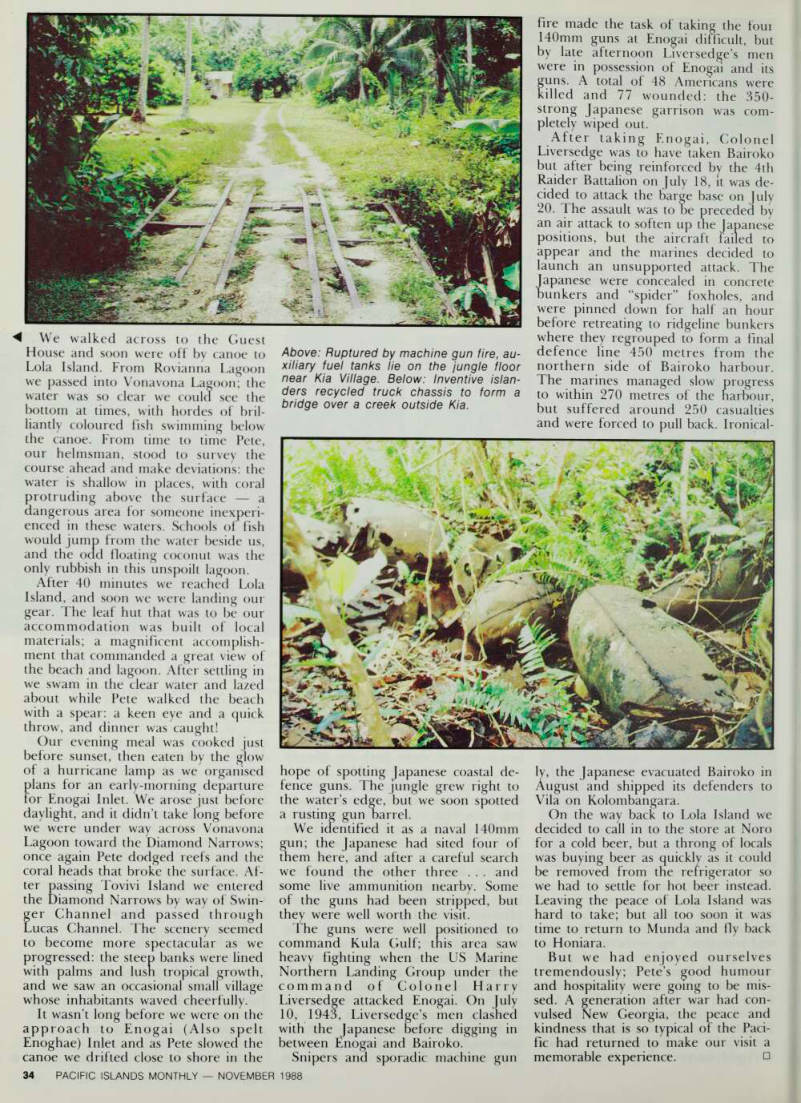
We crossed a small bridge built from three old truck chassis and noticed wartime 44-gallon drums being used as copra driers. The road soon merged into a foot track as we came closer to Kia Village, and we stopped to chat with a village elder.
He described in detail how the Japanese forced the locals to assist them in their occupation projects.
The walk back to Lambete was just as enjoyable; we were entertained by villagers going about their work, and the sights and smells of village life and the many beautiful flowers filled the air. Everything was peaceful, but in 1943 the scene was very different.
But mid February that year the US Forces had completed their conquest of Guadalcanal, to the south of the New Georgia group, and began the
move north by implementing Opera
tion Cleanslate, the seizure of the Rus sell Islands that lie between Guadal canal and the New Georgia Islands.
Cleanslate went off without a hitch, and the US Forces were soon ready to tackle the New Georgias but the terrain had never been mapped and hydrographic data were out of date,
so the Solomon Islands Coastwatchers
had to provide intelligence.
On Munda, meanwhile, the
Japanese dispatched Rear-Admiral
Minoru Ota to the New Georgia group to rush defences to completion.
Progress on Munda airfield was step ped up; Rear-Admiral Ota based his special Naval Landing Forces at Munda and at Vila on nearby Kolom bangara Island, and they were rein forced in March and May 1943.
While Japanese activities in the New
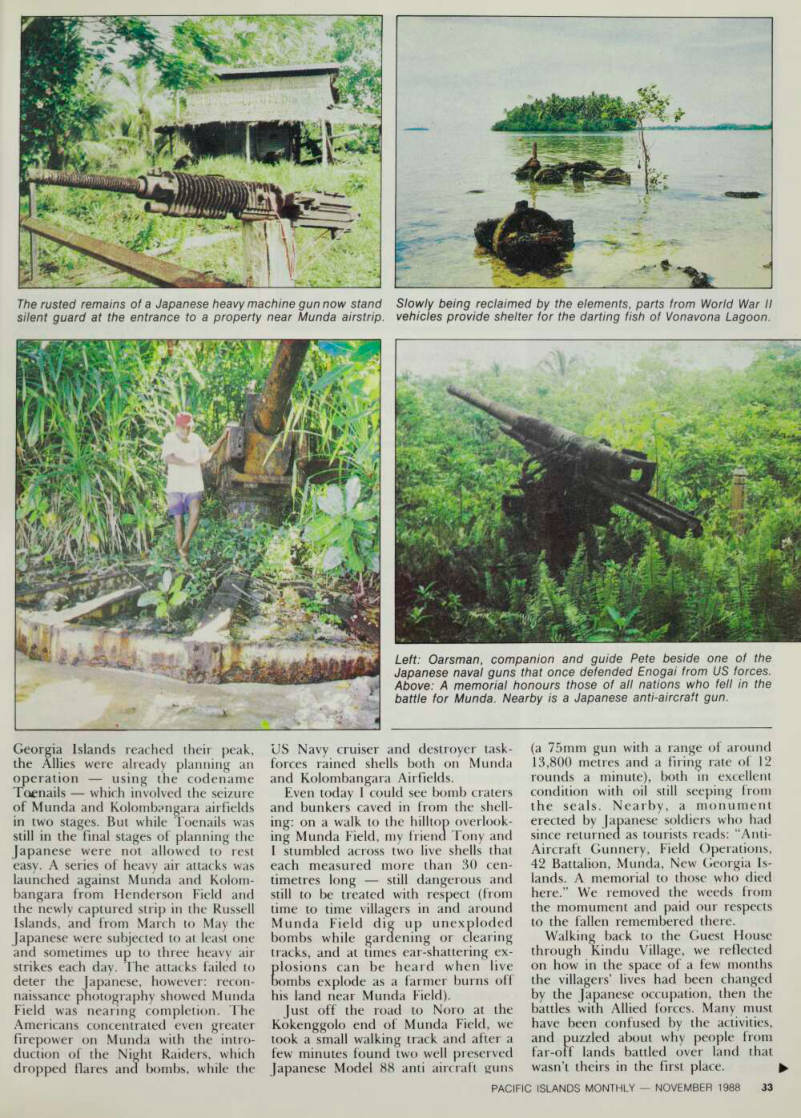
Above: Despite its size and glowing white coral, Munda airstrip was rendered invisible to Allied planes by clever camouflage. Below: Unexploded artillery rounds, more than 30 centimetres long, can still be found in the jungle.
Georgia Islands reached their peak, the Allies were already planning an
operation using the codename
Toenails which involved the seizure of Munda and Kolombangara airfields in two stages. But while Toenails was still in the final stages of planning the Japanese were not allowed to rest easy. A series of heavy air attacks was launched against Munda and Kolombangara from Henderson Field and the newly captured strip in the Russell Islands, and from March to May the Japanese were subjected to at least one and sometimes up to three heavy air strikes each day. The attacks failed to deter the Japanese, however: reamnaissance photography showed Munda Field was nearing completion. The Americans concentrated even greater firepower on Munda with the introduction of the Night Raiders, which dropped flares and bombs, while the
US Navy cruiser and destroyer taskforces rained shells both on Munda and Kolombangara Airfields.
Even today I could see bomb craters and bunkers caved in from the shelling: on a walk to the hilltop overlooking Munda Field, my friend Tony and I stumbled across two live shells that each measured more than 30 centimetres long still dangerous and still to be treated with respect (from time to time villagers in and around Munda Field dig up unexploded bombs while gardening or clearing tracks, and at times ear-shattering explosions can be heard when live bombs explode as a farmer burns off his land near Munda Field).
Just off the road to Noro at the Kokenggolo end of Munda Field, we took a small walking track and after a few minutes found two well preserved Japanese Model 88 anti aircraft guns
(a 75mm gun with a range of around 13,800 metres and a firing rate of 12 rounds a minute), both m excellent condition with oil still seeping from the seals. Nearby, a monument erected by Japanese soldiers who had since returned as tourists reads: “Anti- Aircraft Gunnery, Field Operations, 42 Battalion, Munda, New Georgia Is lands. A memorial to those who died here.” We removed the weeds from the momument and paid our respects to the fallen remembered there.
Walking back to the Guest House through Kindu Village, we reflected on how in the space of a few months the villagers’ lives had been changed
by the Japanese occupation, then the
battles with Allied forces. Many must have been confused by the activities,
and puzzled about why people from
far-off lands battled over land that wasn’t theirs in the first place.
The rusted remains of a Japanese heavy machine gun now stand silent guard at the entrance to a property near Munda airstrip.
Slowly being reclaimed by the elements, parts from World War II vehicles provide shelter for the darting fish of Vonavona Lagoon.
Left: Oarsman, companion and guide Pete beside one of the Japanese naval guns that once defended Enogai from US forces.
Above: A memorial honours those of all nations who fell in the battle for Munda. Nearby is a Japanese anti-aircraft gun.
We walked across to the Guest House and soon were off by canoe to Lola Island. From Rovianna Lagoon we passed into Vonavona Lagoon; the water was so clear we could see the bottom at times, with hordes of bril liantly coloured fish swimming below the canoe. From time to time Pete, our helmsman, stood to survey the course ahead and make deviations: the water is shallow in places, with coral protruding above the surface a dangerous area for someone inexperi enced in these waters. Schools of fish would jump from the water beside us, and the odd floating coconut was the
only rubbish in this unspoilt lagoon.
After 40 minutes we reached Lola Island, and soon we were landing our gear. The leaf hut that was to be our accommodation was built of local
materials; a magnificent accomplish
ment that commanded a great view of the beach and lagoon. After settling in we swam in the clear water and lazed about while Pete walked the beach with a spear: a keen eye and a quick throw, and dinner was caught!
Our evening meal was cooked just before sunset, then eaten by the glow of a hurricane lamp as we organised
plans for an early-morning departure
for Enogai Inlet. We arose just before daylight, and it didn’t take long before we were under way across Vonavona Lagoon toward the Diamond Narrows; once again Pete dodged reefs and the coral heads that broke the surface. Af ter passing Tovivi Island we entered the Diamond Narrows by way of Swin ger Channel and passed through Lucas Channel. The scenery seemed to become more spectacular as we progressed: the steep banks were lined
with palms and lush tropical growth,
and we saw an occasional small village whose inhabitants waved cheerfully.
It wasn’t long before we were on the
approach to Enogai (Also spelt
Enoghae) Inlet and as Pete slowed the canoe we drifted close to shore in the
hope of spotting Japanese coastal de-
fence guns. The jungle grew right to the water’s edge, but we soon spotted a rusting gun barrel.
We identified it as a naval 140 mm gun; the Japanese had sited four of them here, and after a careful search we found the other three . . . and some live ammunition nearby. Some of the guns had been stripped, but they were well worth the visit.
The guns were well positioned to command Kula Gulf; this area saw heavy fighting when the US Marine Northern Landing Group under the command of Colonel Harry
Liversedge attacked Enogai. On July
10, 1943, Liversedge’s men clashed with the Japanese before digging in between Enogai and Bairoko.
Snipers and sporadic machine gun
fire made the task of taking the font 140 mm guns at Enogai difficult, but by late afternoon Liversedge’s men were in possession of Enogai and its guns. A total of 48 Americans were Killed and 77 wounded: the 350strong Japanese garrison was com
pletely wiped out.
After taking Enogai, Colonel
Liversedge was to have taken Bairoko but after being reinforced by the 4th Raider Battalion on July 18, it was de cided to attack the barge base on July 20. The assault was to be preceded by an air attack to soften up the Japanese positions, but the aircraft failed to appear and the marines decided to launch an unsupported attack. The Japanese were concealed in concrete bunkers and “spider” foxholes, and were pinned down for half an hour before retreating to ridgeline bunkers where they regrouped to form a final defence line 450 metres from the northern side of Bairoko harbour.
The marines managed slow progress to within 270 metres of the narbour, but suffered around 250 casualties and were forced to pull back. Ironical-
ly, the Japanese evacuated Bairoko in August and shipped its defenders to Vila on Kolombangara.
On the way back to Lola Island we decided to call in to the store at Noro for a cold beer, but a throng of locals was buying beer as quickly as it could be removed from the refrigerator so we had to settle for hot beer instead, Leaving the peace of Lola Island was hard to take; but all too soon it was time to return to Munda and fly back to Honiara.
But we had enjoyed ourselves
tremendously; Pete’s good humour
and hospitality were going to be mis sed. A generation after war had con vulsed New Georgia, the peace and kindness that is so typical of the Paci fic had returned to make our visit a memorable experience. □
Above: Ruptured by machine gun fire, au xiliary fuel tanks lie on the jungle floor near Kia Village. Below: Inventive islan ders recycled truck chassis to form a bridge over a creek outside Kia.