A Village Opens Its Heart
pp. 30-31 · Read in the full issue
Fiji
Far from the politics of Suva, and even further from their Canadian home, Phyllis and Ted Reeve find warm hospitality in a remote village.
PENIASI strides across the grass, his handshake ready. His friends and relations follow closely; grins and waves converge upon us.
News of our approach has preceded us to Nasau. Peniasi knows we have taken one wrong road muddy enough to defeat our four-wheel drive, and that we were rescued by Eparama from Naviqiri. The village has been watching for our arrival by the right (hair-raising but less muddy) road, with Eparama squeezed beside us in the front seat to guide our way.
My family’s relationship with the vil lage of Nasau, in Bua Province (at the western tip of Vanua Levu) began in 1920 when my grandfather attempted to establish a copra plantation on a native leasehold south of the village.
On our first visit two years ago, my husband Ted and I were greeted like royalty. This time we are old friends.
Ted hurries off to present our yaqona offering to the Chief, while I settle in with Peniasi’s wife Asenaca.
Nasau is about 30 kilometres from the main road linking the ferry wharf at Nabouwalu with the sugar town of Labasa. Villagers make occasional ex cursions outward, but receive very few visitors; the Taiwanese sandalwood buyer is the most frequent. We are the only tourists to appear in a long time five or six years ago, we are told, two surprised young Australians ar rived by motorbike.
Asenaca and Peniasi are young and
speak English readily. The elders shy
ly pretend to speak only Fijian but seem to understand most of our con versation, and Ted’s prowess in the yaqona circle, with his mastery of the
appropriate handclaps and exclama
tions, causes toe young men to roll with mirth a reaction Ted takes for
a compliment.
Asenaca presents Rachieli, the daughter born since our last visit and the apple of everyone’s eye. Her brother Mitieli is three, wide-eyed and lively, On our first meeting, when he was a year and a half old, he kept the adults amused with his imitations of Rambo. That game has since been for gotten, replaced the reggae rhythms expertly beaten out with small fists.
Peniasi sports a red shirt with a pic ture of Major General Rabuka, but we do not talk about politics and the only allusions to current events come in questions about the number and status
of Fiji Indians resident in Canada.
Peniasi and Asenaca displayed a large colour portrait of Prince Charles and family on the wall of their house one of the few in the village made entirely of grass. Since Asenaca is the daughter of the turaga ni koro, her house is a place of some prestige and
a popular gathering place. Women
and children come and go continually, and we cannot tell for certain which children belong to which parents: in deed, if I hadn’t been specifically in troduced to Rachieli and Miti, I would be unsure about them as they pass from hand to hand and from knee to knee. Toddlers too young to be afraid of my paleness collapse as happily on
my lap as anywhere.
Everything happens on the floor, which is covered with clean grass mats (despite our best efforts, Ted and I
continually bring in mud, which clings
to us much more than to anyone else), and meals are a communal effort. Be cause Asenaca is still nursing Rachieli, she is not expected to cook. Her va rious ‘sisters’ at least some of whom are cousins prepare food in the kitchen building, and we are very well fed with fish and wild pork, cassava and breadfruit. Canned meat is consi dered a delicacy, and from time to time someone takes the key to the vil lage store and returns proudly with a tin of corned beef, mackerel or baked
beans. This is Peniasi’s week to keep the store and its key.
Innocence of economic reality some times leads to embarrassing assump tions. The villagers know the cost of a journey to Suva, but think the expense must seem minimal to a city dweller.
In Nasau necessities for survival are at hand. It appears logical that the same should be true in the city: if money is what one needs, then the money must
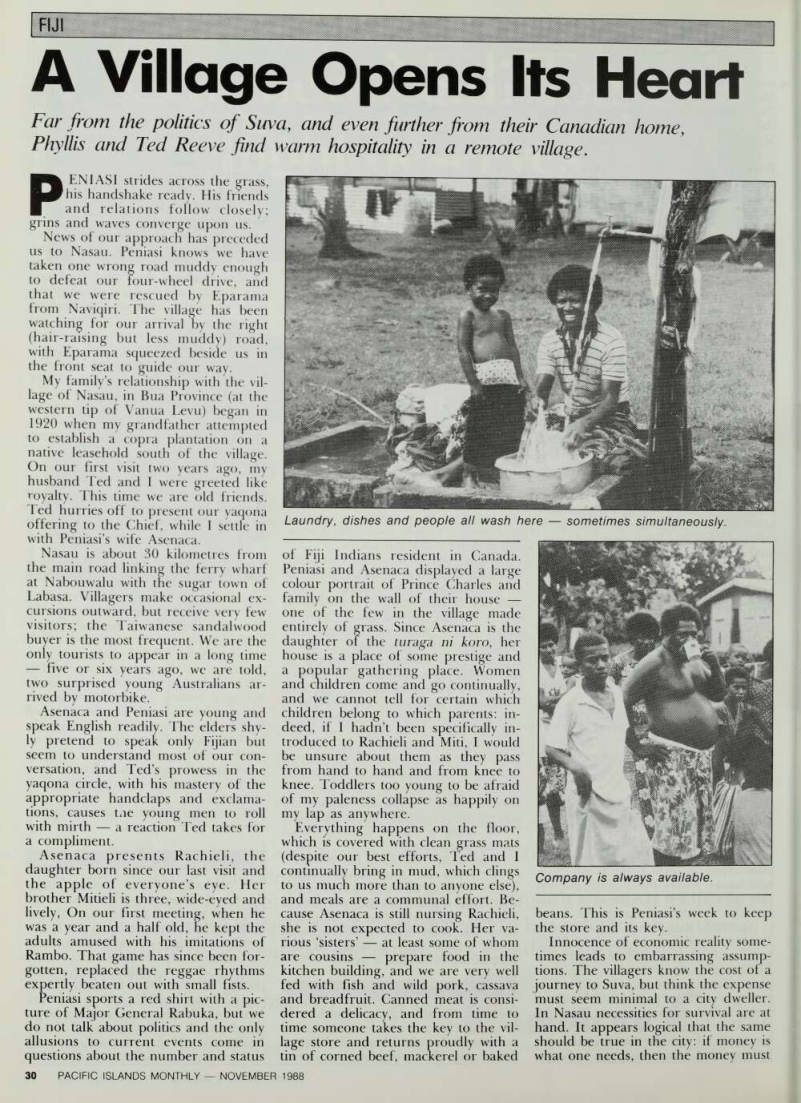
Laundry, dishes and people all wash here sometimes simultaneously.
Company is always available.
be available. We are happy to take Peniasi and the community bank deposit with us to Labasa, but learn to say no to more grandiose requests.
The older children walk a kilometre to the school that serves the three or four villages in Navakasiga District; when Asenaca asks us to send magazines for the children to read, we know it is the adults who want them most. The kids have their schoolbooks, but grownups seize on any
printed material, in Fijian or English,
within reach; newspapers, notes on photographs, even labels on cans and on boxes of film.
Though a public health nurse lives nearby, Peniasi comes with furrowed brow to seek advice from Ted: his father is suffering from a headache so severe it is affecting his entire body, Unsure that his Canadian medical
training can cope with the case, Ted
cautiously dispenses two aspirin. As it
turns out, his prescription may be essential in fortifying the patient to withstand the more elaborate cure provided by his village; while he lies beneath his mosquito net, a file of visi tors drinks his health in yaqona, sings hymns and offers sonorous prayers for his recovery. The treatment con tinues through the night, but at last the patient is asleep and it’s we who
are taking aspirin!
Daybreak is announced by the trumpeting of the conch and the voice of the pastor detailing the day’s tasks as assigned by the turaga ni koro. For a while there is much bustling around the water taps and a scurrying of chil dren, but the day’s work is not oner ous; mainly the provision of food, There will be time for resting from
the strenuous night’s effort.
But when duty calls, all Nasau rises to the occasion. The village’s pride and joy is the new church, an impress ive structure testifying to the glory of God and the dominance of Method ism. To raise money for the church, the villagers sold their fishing boat; how they are almost ready to buy a new one (the money for which has been saved from the sale of sandal wood) that will take them outside the reef into commercial waters, The village’s chainsaw and outboard motor are useful tools, but they are only tools and can be laid aside. Most important to Nasau life are the ties of family and fellowship, the babies to be hugged, the yaqona to be shared, the songs to be sung. In every part of the village, the prevalent sound is the ring of peal after peal of laughter. □
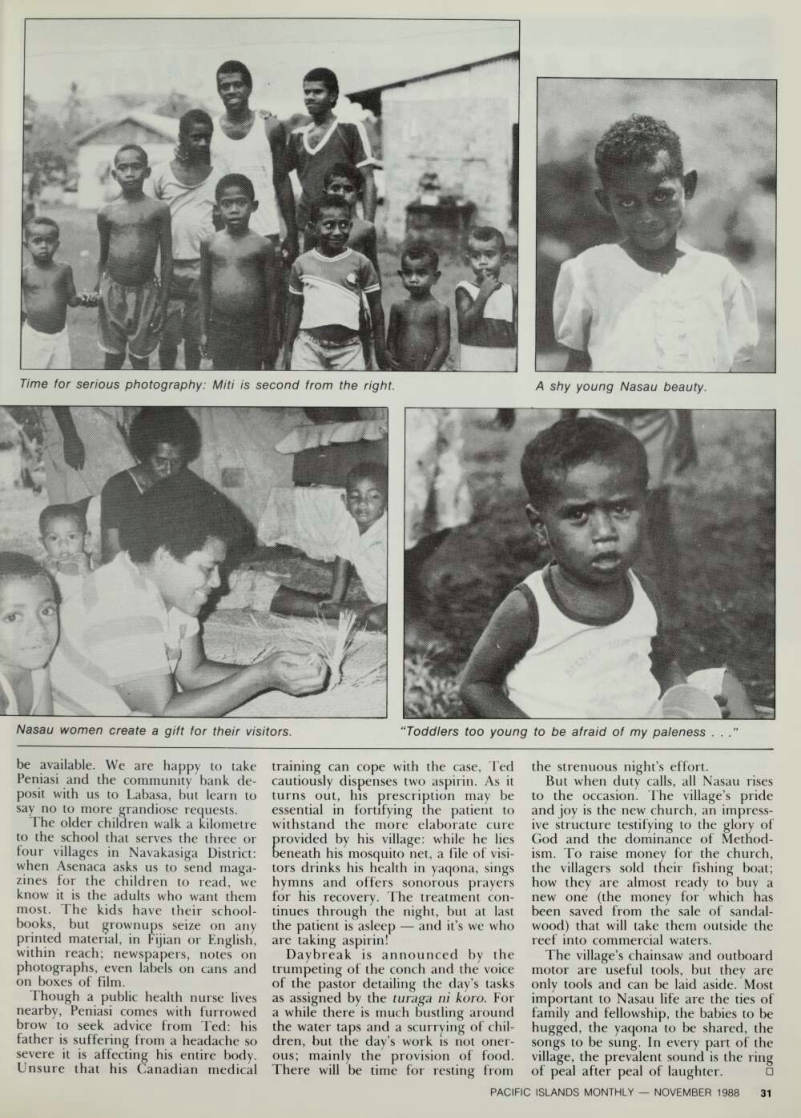
Time for serious photography: Miti is second from the right.
Nasau women create a gift for their visitors.
A shy young Nasau beauty.
“Toddlers too young to be afraid of my paleness