Finance, Banking
pp. 24-29 · Read in the full issue
Robin Bromby examines the present and future of the money market
WHEN the Papua New Guinea
coffee producer Angco Pty
Ltd went to the public recent ly with a K 5 million share float, not only was it badly undersubscribed but with many of the subscriptions in blocks of K2OO or K5OO, such a float became an administrative nightmare.
In a nutshell, that is the Pacific’s
quandary in attempting to expand its
banking and finance sector. Without a
growing indigenous capital market,
banking and finance institutions are li mited in their ability to expand the economies of the small nations. And, because so many of the deposits and loans are for such small amounts (in 1985, the average loan by the Solo mon Islands Development Bank was SSI 1300), institutions are caught with high administrative costs. In Australia and New Zealand, banks have con fronted the question of uneconomic
accounts either by slapping charges on
transactions or actively discouraging
less well-off customers during the America’s Cup races in Australia, the Bank of New Zealand launched a tele vision advertising campaign for its Au stralian operations and ended up by turning away many who applied for accounts. Banks in metropolitan coun tries also have the advantage of many large company accounts to absorb their overheads.
Too often institutions in the South Pacific countries have been overly con servative when investing. There have certainly been comments that large su perannuation funds in Papua New Guinea should be more innovative ab out where they place their money; and
the Vanuatu Co-operative Savings
Bank’s main investments, for example, are by way of bank deposits. By con trast, Western Samoa’s National Provi dent Fund is a major source of long term investment in that country, with about a third of its advances going to the private sector.
The finance sector remains largely dominated by Australian, New Zea land and other foreign owners, and while that has brought considerable benefits for example, the existence of a massive capital base through pa rent companies there have been drawbacks. One has been to transfer Australian or New Zealand thinking to the new institutions.
In a paper on Papua New Guinea’s finance sector, Michael Skully, a senior lecturer in finance at the University of New South Wales, wrote that until
banks in the nation train enough in digenous staff “the banking system must depend on expatriate officers, but it is perhaps unfortunate that prior to the two new bank entries, the foreign staff have been recruited almost exclusively from Australian banks. This has tended to perpetuate the Australian banking mentality with in the local industry and missed an opportunity to add experience from a wide range of national banking sys tems.” As an example, the Common-
wealth Bank still has 100 people on secondment from Australia working with the Papua New Guinea Banking
corporation.
The Commonwealth is the only Australian bank that has reduced its profile in the region, possibly due to it being government-owned and not having the capital resources to expand. Its operations in Papua New Guinea were turned over to the then newly formed PNG Banking Corporation in 1974, but it still owns 51 per cent of Papua New Guinea’s leading merchant bank, Resources and Investment Finance Ltd. Similarlv, its operations in Vanuatu were assumed in 1975 by the Co-operative Savings Bank. The Commonweaith’s major presence is in the Solomon Islands, where it holds 51 per cent of the National Bank of SI.
Westpac (see Pacific Islands Month-
ly, October) operates a subsidiary in Papua New Guinea, while the Austra lian parent has branches in Niue, Cook Islands, Fiji, Solomon Islands, Vanuatu and shares in the national banks of Tuvalu and Kiribati, The National Australia Bank’s only
regional operation is its subsidiary in
Port Moresby, the Bank of South Paci fic (BSP). The ANZ last month (Octo ber) opened an office in Rarotonga, and is a large player in the South Paci fic, with operations in Papua New
Guinea, Fiji, Vanuatu and the Solo mon Islands.
The Bank of New Zealand has perhaps for the same reasons as the Commonwealth in Australia not ex panded to the extent of the Australian commercial banks, and maintains a branch network in Fiji, with shares in the Bank of Western Samoa and the Bank of Tonga.
Two relative newcomers are the latest commercial banks in Papua New Guinea, Indosuez Nuigini Bank and Nuigini-Lloyds International Bank, but both have reportedly found it hard to win a market share from the entrenched operators (just as the many new licensed banks in Australia discovered profits to be elusive) and the PNG Government has now issued guidelines that will make any new
banking entry almost impossible.
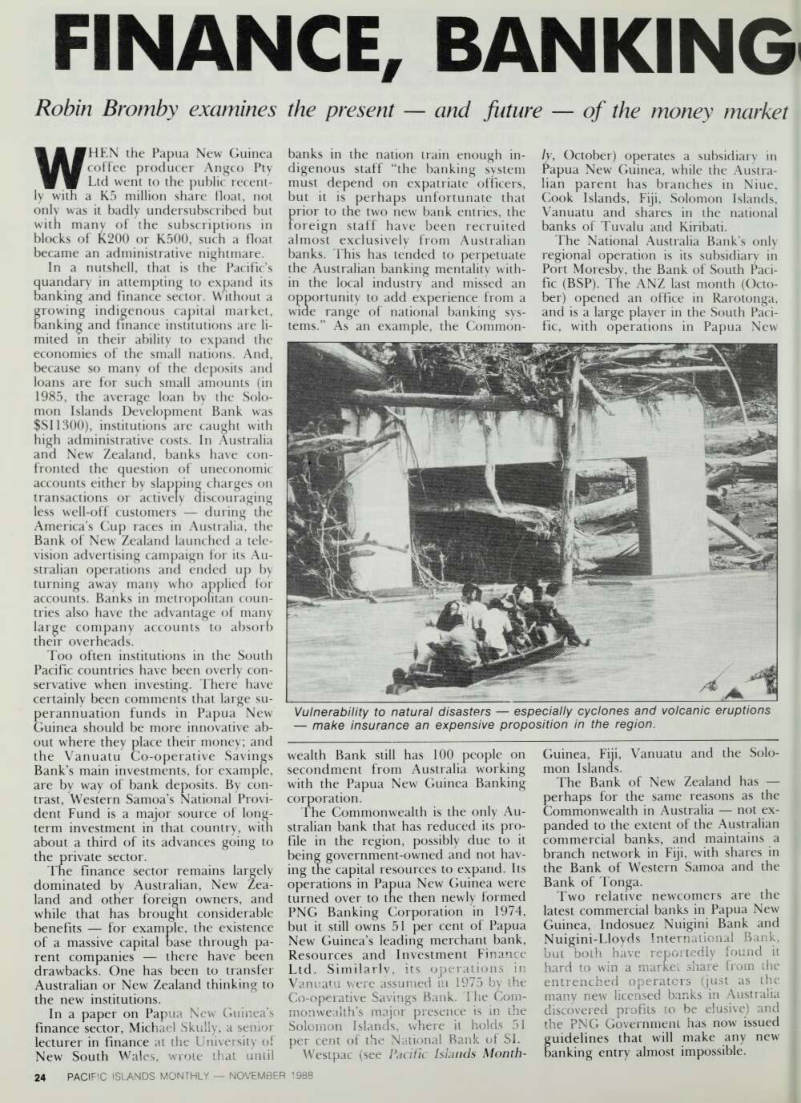
Vulnerability to natural disasters especially cyclones and volcanic eruptions make insurance an expensive proposition in the region.
in the South Pacific.
In the insurance field, again, the old established companies dominate. QBE, with its long affiliation with Burns Philp, is strong in Papua New Guinea, Fiji, Vanuatu and the French territor ies. Its main competitor in the general insurance market is the National In surance Company of New Zealand, which owns tne Southern Pacific In surance Company of Papua New Guinea, National Insurance of Fiji, National Insurance of Cook Islands, its own office in Solomon Islands and 30 per cent of National Pacific Insur ance in Apia . . . which also writes business in Tonga and American Samoa. The region’s business in life insurance is in its infancy in most ter ritories with the exception of Fiji, where the Colonial Mutual commands more than 80 per cent of that market.
The French territories are domin ated by banks partly or wholly owned
by the French Government, and with surplus funds remitted to Paris. The major bank in New Caledonia is the Banque de ITndochine et Suez. Fi nance companies in New Caledonia are linked to the banks and provide loans for real estate, consumer credit and business. Life insurance is mainly controlled by the French companies in that field, though QBE, through a loc al underwriting agent, has a major presence; QBE works through another agency, Arthur Chung, in French
Polynesia.
Papua New Guinea
There is a substantial school of thought in Port Moresby that the country has too many banks already;
the difficulties experienced by Nuigi
ni-Lloyd in moving its share issue would certainly support that. The large branch and agency network maintained by the PNG Banking Cor poration (215 at last count) and West pac provide coverage of most of the country. These banks, together with ANZ and BSP, are deeply involved in trade and finance links with Australia, which gives them a substantial com petitive edge over any newcomers.
The PNG Banking Corporation has vigorously lobbied the government not to issue any more banking licences, arguing that there is already sufficient competition, and it is understood that recent overtures from banking in terests in Singapore and Malaysia have been rebuffed.
Earlier this year the central bank, the Bank of Papua New Guinea, issued new requirements for appli cants for financial institutional li cences, remarking that while new en trants were welcomed, “the increasing
number of applicants, particularly
ones with little established financial background, necessitates a more rigor ous approach to assessment”. It added that tne government’s commitment to public sector spending, the repayment of large offshore commercial debts
and relatively depressed commodity
prices would mean private sector growth would need to he restrained.
At its May meeting the central bank laid down that new banks will have to show they can be self-sufficient within two years, offer services not presently available in PNG and that those ser vices are sought and that it has the capacity international finance markets and can maintain a capital adequacy ratio of 10 per cent of de
posits. Equally stringent requirements
were laid down for other financial in stitutions.
The banks have been affected by the restriction of equity by the central bank, but nevertheless, the major banks turned in comparatively good results. The Bank of South Pacific (87 per cent National Australia, 13 per cent local equity) returned an operat ing profit for the 1987 year of K 1.34 million, and showed increases in de posits and loans of 32.5 per cent and 45.2 per cent respectively. The bank^
◄ has eight branches in PNG, including
Port Moresby.
The PNG Banking Corporation re ported an after tax profit last Decem ber of K 3.02 million, following a loss the previous year. The bank’s annual report noted the costs of maintaining the largest network of branches and agencies in the country, and stressed that to protect profitability it had
adopted new lending guidelines to en
sure there was no repeat of the high number of bad debts; there is a con stant problem with all locally run fi nance institutions in finding skilled staff to properly vet loan applications.
Westpac Bank PNG made an after tax profit of K 2.87 million to September 1987. The bank had pursued a vigor ous lending policy but by June 1987, this had to be curtailed because of a
lack of deposit growth.
The PNG Government has recently been forced to respond to continuing problems with savings and loan societies (which operate along the lines of credit unions); at the end of 1987 there were 119 registered societies in Papua New Guinea, with a total mem bership of 100,000 and of those, 79 societies are either dormant or under
liquidation.
The trend to lend money for con sumption school fees, for example, or household appliances has been increasing and there is a tendency for some of the boards to exercise lax control over officials of the associa tions, so that loans are made without full checking of ability to repay and moneys have not been adequately accounted for. Administrative ex penses for wages, staff benefits and other operational needs have, in many cases, exceeded income, so officials have resorted to members’ savings to make up the shortfall. The situation has been exacerbated in some of the rural savings and loan societies by members not meeting their loan com mitments. On June 17, the central bank issued new investment and lend ing rules aimed at ending this abuse.
The major merchant bank in Papua New Guinea is Resources and Invest ment Finance Ltd (RIFL), jointly own ed by the Commonwealth and PNG
Banking Corporation. It provides the
full range of merchant banking ser
vices including corporate lending,
corporate finance, money market acti vities and underwriting of securities.
In recent years RIFL has been in volved with the flotation of the two new commercial banks and the public
issue by Angco; financing high rise
and unit developments in Port Mores
by, arranging loans and leasing for
helicopters and ships and issuing
guarantees for prospecting licences.
John Enkelaar, the company’s man aging director, told Pacific Islands Monthly that “apart from any other problems one might encounter in Papua New Guinea, finance and equi ty raising for business are somewhat inhibited, due to the fact that there is no stock exchange here; nor is there likely to be for some years because the market is too thin”. The October 1987 crash did not help its prospects. Mr Enkelaar would not comment on
changes that might rectify this situa
tion, but one of the problems for any merchant bank in Papua New Guinea is the level of competition for funds.
The superannuation industry is ab out to take a leap forward now that the government has changed the rules. Previously, companies with 25 or more employees were required to join the National Provident Fund, but under the new regulations all em ployees are to be covered by the scheme. One observer expects this will encourage the arrival of several pri vate superannuation funds.
Papua New Guinea’s major chal lenge will be to devise ways in which innovative new savings schemes can be introduced to provide a wider capital base.
Fiji
The existence of a developed cash economy has meant Fiji has the most advanced savings bank system in the islands. Most people in Fiji have at least one bank account, and banks
have responded by developing good
networks. Westpac has 11 branches, while the Bank of New Zealand and
Bank of Baroda have wide representa tion. The ANZ (whose forebear, the Union Bank, had an office at the old capital of Levuka between 1880 and 1895) returned to Fiji in 1957 and in 1985 acquired the operations in the country of Barclays Bank, giving it nine branches in Fiji.
The banks are currently involved in
stiff competition; depressed business
confidence has left them with more money than borrowers.
The only Fijian bank without fore ign equity is the National Bank of Fiji; “It’s not a great success,” says Michael
Skully. “It really needs some foreign
partner and foreign expertise it would love to have the Common wealth Bank.” The National, which has a large number of small savings accounts, was founded in 1908 and has been variously called the Govern ment Savings Bank and Post Office Savings Bank until assuming its pre sent title in 1976.
In the early 1980 s, after several years of losses, the government had to subscribe more capital.
In 1962 there were about 30 insur ance companies, but most have with drawn over the years. Some left when new legislation was enacted in 1975,
others found operations unprofitable.
As one spokesman for the Australian Mutual Provident Society put it: “We went up there in the 1960 s to write some fire insurance. We burnt our
fingers literally.”
In the life field, Colonial Mutual Life Assurance Society of Australia is the dominating company. The only other active operator (apart from agents who write policies on behalf of
companies not represented in Fiji) is
the Life Insurance Corporation of In dia, a branch of the nationalised Indi
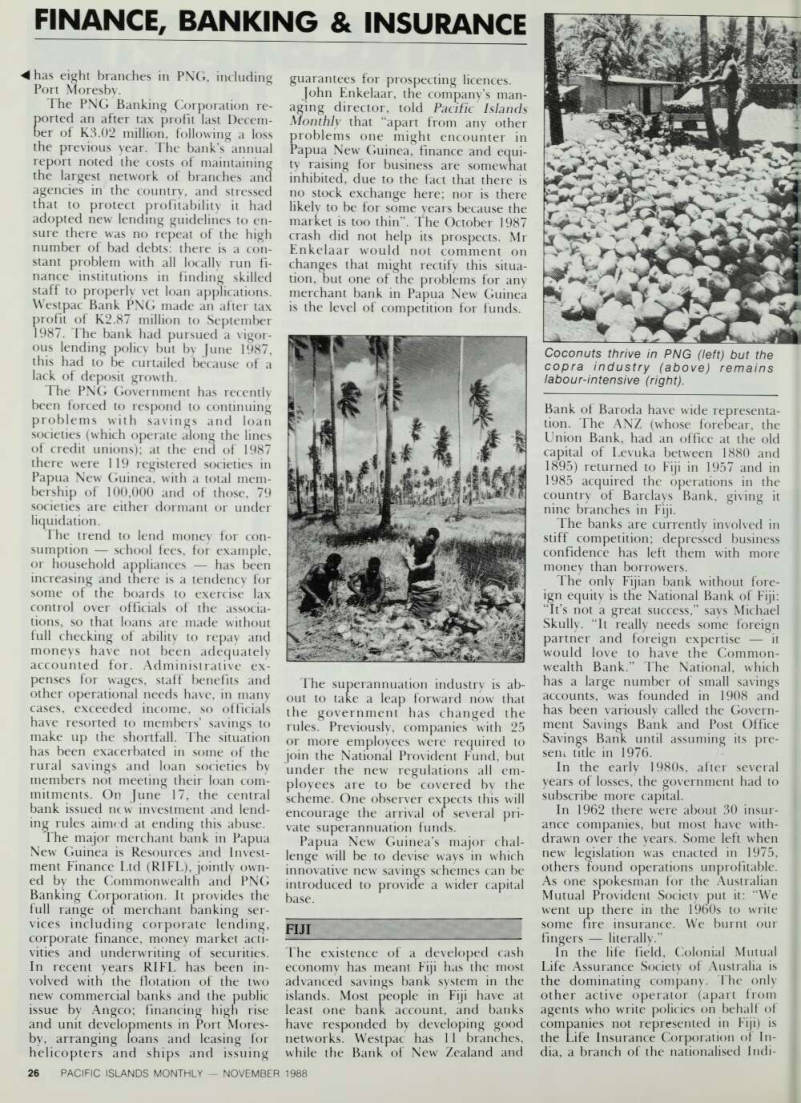
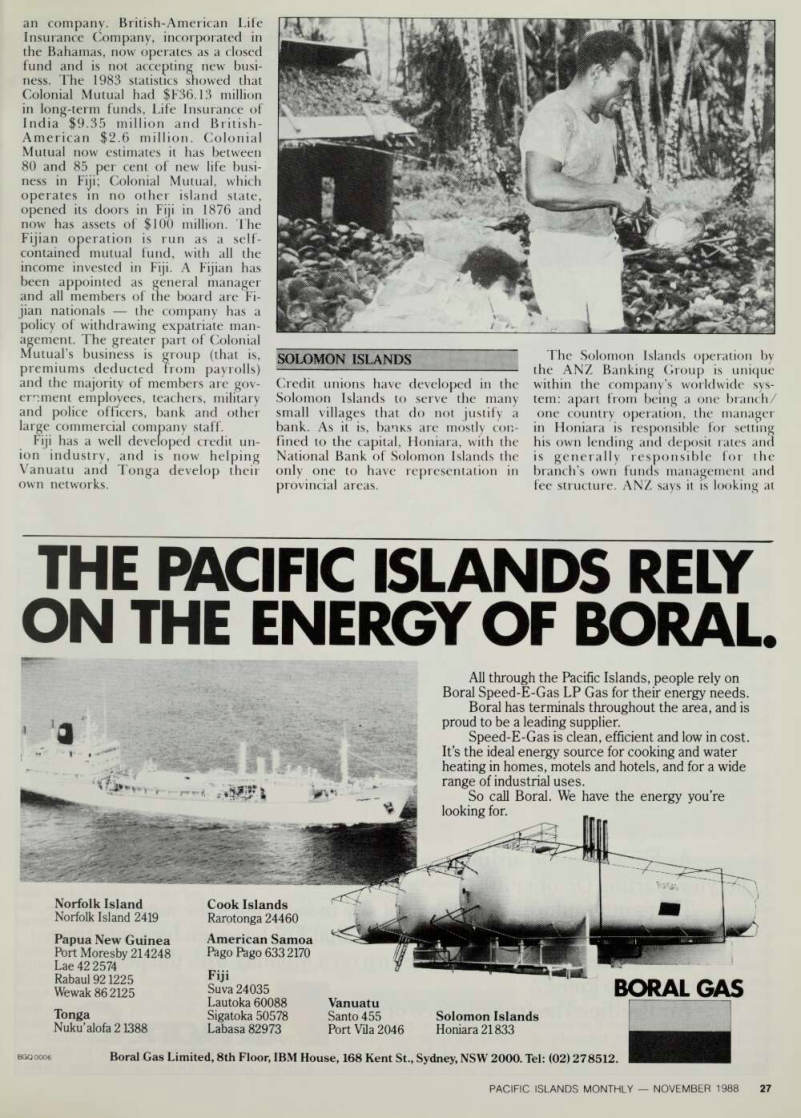
Coconuts thrive in PNG (left) but the copra industry (above) remains labour-intensive (right).
an company. British-American Life
Insurance Company, incorporated in
the Bahamas, now operates as a closed fund and is not accepting new busi ness. The 1983 statistics showed that Colonial Mutual had |F36.13 million in long-term funds. Life Insurance of India $9.35 million and British- American $2.6 million. Colonial Mutual now estimates it has between 80 and 85 per cent of new life busi ness in Fiji; Colonial Mutual, which operates in no other island state, opened its doors in Fiji in 1876 and now has assets of SIOO million. The Fijian operation is run as a self contained mutual fund, with all the income invested in Fiji. A Fijian has been appointed as general manager and all members of the board are Fi jian nationals the company has a
policy of withdrawing expatriate man
agement. The greater part of Colonial Mutual’s business is group (that is,
premiums deducted from payrolls)
and the majority of members are gov
ernment employees, teachers, military
and police officers, bank and other large commercial company staff.
Fiji has a well developed credit un ion industry, and is now helping Vanuatu and Tonga develop their own networks.
Solomon Islands
Credit unions have developed in the Solomon Islands to serve the many small villages that do not justify a bank. As it is, banKs are mostly con fined to the capital, Honiara, with the National Bank of Solomon Islands the only one to have representation in
provincial areas.
The Solomon Islands operation by
the ANZ Banking Group is unique
within the company’s worldwide sys tem: apart from being a one branch/ one country operation, the manager in Honiara is responsible for setting his own lending and deposit rates and is generally responsible for the branch’s own funds management and fee structure. ANZ says it is looking at
4 ways of expanding into rural areas.
Meanwhile, Westpac’s market share in the Solomon Islands has jumped with the acquisition of Hongkong and Shanghai’s branch in Honiara.
At the end of 1987 the National Bank operated six branches and 47 agencies. In a year when the Solomons
experienced depressed world com
modity prices, cyclone damage to cop
ra and palm oil crops and the closure
of the country’s largest logging opera
tion, the bank managed to increase its after tax profit to $51596,185 (the continued decline in new lending re flected a further tightening by the Central Bank of Solomon Islands of private sector domestic credit. The bank still operates with seconded staff from the Commonwealth in Australia.
The Development Bank which, as in most Pacific states, acts as a conduit for funds from development agencies such as the Asian Development Bank has incurred heavy administrative costs by making micro loans, a good proportion of which are arrears. Many loans are out of less than $lOOO and the average is just $l3OO.
Westpac’s subsidiary, AGC Finance,
offers consumer funaing for cars and other items as well as for some agri cultural projects. Insurance is domin ated by the National Insurance Com pany of New Zealand; life insurance is
held mainly by expatriates through
offshore firms. While the National Provident Fund provides superannua tion cover for government, private sector superannuation in the Solo
mons is largely undeveloped.
Tonga
The Bank of Tonga, owned by the government, the Bank of Hawaii, the Bank of New Zealand and Westpac, returned a profit of T 5.427 million before tax for the year ended Decem ber, 1987; a 34 per cent increase on the previous year’s result. The bank’s
largest lending sector is for housing
(37 per cent), though commercial loans at 29 per cent form the fastest growing sector. The Bank of Tonga has invested some 55 per cent of its total assets as term deposits on over seas banks, where the average interest rate achieved was 14.8 per cent. It has agencies throughout the group.
In 1987, the Tonga Development Bank received lines of credit of SUS 2 million from the World Bank and SUSI million from the Asian Develop ment Bank, most of which (in line with government policy) will be chan neled into the private sector. Recently, the Development Bank changed its emphasis of lending away from agri culture and into secondary industry,
tourism and investment: in the past more than half the loans have been for agricultural projects, but about 85 per cent of advances have been for (ess than TlOOO, which has involved the bank in high administrative costs.
The main insurance companies operating in Tonga are New Zealand Insurance, QBE and Commercial Un ion. The government is planning to set up a National Provident Fund to
provide superannuation cover.
Vanuatu
The finance centre in Port Vila, and Vanuatu’s associated maritime regis ter, have been well charted in recent months. The country’s three commer cial banks ANZ, Westpac and In dosuez release no separate figures, but ANZ is clearly the lead player; it swallowed the Barclays operation in 1985, while Westpac took over the branch run by Hong Kong and Shan
ghai Banking Corporation earlier this
year. The withdrawal of the British and Hong Kong banks shows how hard, even in a tax free haven, it is for bankers to make a profit unless they are involved in a major way in the host country’s trade, as are the Austra lian and New Zealand banks.
Barclays was to have been involved in establishing the Commercial Bank of Vanuatu before it decided to move out, but the one troubled institution is
the Vanuatu Co-operative Savings
Bank, which maintains 95 agencies throughout the archipelago. It is the
repository for mainly small savings by
the indigenous population; Michael
Skully, in Financial Institutions and Markets in the South Pacific, shows that the bank’s main investment is by way of placing its money in other banks to earn interest lack of ex pert staff has prevented the Co-op Savings Bank from developing a loan function. In 1985 the bank accumu lated losses of VT 12.43 million, the cost of administering all the small de posits being a major drain on what income was earned.
Nevertheless, the bank has provided in areas the international banks ignore a service that would other wise not exist for the people of
Vanuatu. Similarly, the Development
Bank has been involved in high cost areas, mainly the extending of sub stantial high-risk micro loans.
Western Samoa
Western Samoa has a competitive banking climate but is nevertheless dominated by the Bank of Western Samoa, equally owned by the govern
ment and the Bank of New Zealand.
Its latest figure, to December, 1986, showed a profit of T 992,066 after tax, with deposits showing an overall growth of 23.8 per cent.
The Pacific Commercial Bank (Westpac 41.19 per cent, Bank of Hawaii 41.19, Western Samoa share holders 17.62 per cent) reported an after tax profit to December 1987 of T 276,114 against a background of heavy government regulation, with the exercise of credit restrictions through the commercial banks being a major
plank of economic policy.
Western Samoa’s finance sector saw the development of two other institu tions that reflected the years of rule by New Zealand: the Post Office Sav ings Bank (which grew during the years when the Bank of New Zealand showed no interest in offering in terest-bearing accounts, and which places its investments in bank deposits and government securities) and the Public Trust Office, acting as trustee and guardian it had assets of T 4 million in 1985 and was a major source of long-term housing finance, placing its funds in government secur ities in New Zealand, Western Samoa, Australia and Britain.
The National Provident Fund has assets nearing T4O million; about 40 per cent in government securities, but as much as 30 per cent invested with the private sector.
Kiribati
The Bank of Kiribati is the Republic’s main financial institution (Westpac 51 per cent, Republic of Kiribati 49 per cent). In the year to September 1987, profit was $A791,000 after tax a reduction on the previous year but the bank had to bear the cost of estab lishing a branch on Kiritimati Island.
On the other hand, the bank relied
for its continuing viability on profits
on foreign exchange trading and on
an investment portfolio.
Its annual report said that because of the structure of its international in vestments, the Bank of Kiribati was able to offer its customers attractive rates on their deposits.
Tuvalu
The National Bank of Tuvalu’s latest figures, to December, 1986, show an after tax profit of $A310,387, substan tially up on the previous year. The result was largely due to better returns on overseas investments: just under half of all new lending by the bank during the year was for renovations, conversions and building of new houses in Tuvalu, the rest being large ly advanced for development of new businesses and short term finance for the retail and construction sectors. □