Funafuti Celebrates
pp. 22-23 · Read in the full issue
Tuvalu
Diana McManus reports on Tuvalu’s 10th anniversary of Independence
TUVALUANS throughout the
Pacific celebrated their country’s
10th anniversary of independ
ence in October, but nowhere were the celebrations more joyous than in Tuvalu’s capital of Funafuti.
Formerly part of Britain’s colonial empire, Tuvalu was known as the Ellice Islands and constituted part of the Gilbert and Ellice group. On Octo ber 1 1975, the Ellice Islands sepa rated from the Gilberts and exactly three years later achieved their inde pendence from Britain. Tuvalu has re mained within the Commonwealth as
an independent sovereign state.
The tiny, isolated nation is made up of nine widely dispersed islands, with only about 24 square kilometres of land in total, approximately 8500 peo ple and few natural resources. A de cade of political independence is a landmark for those involved in the pursuit of self-determination and self sufficiency for Tuvalu. The establish ment of a TATI (Tenth Anniversary of Tuvaluan Independence) Commit tee earlier this year, to raise funds as well as national consciousness and pride, was the first of a long list of preparations for this important event.
Raffles, lotteries and auction sales were conducted by the Committee as well as management of donations from well-wishers at home and abroad. As well, all of the island com munities were busy within their own social frameworks organising contribu tions to the celebrations: during the month prior to the festivities Funafuti was engaged in a massive program of
beautification, with public buildings
receiving coats of paint and long
awaited extensions and renovations, as well as new flower beds and fences.
On a more personal scale, househol ders tidied up their gardens, com
pleted outstanding building projects
and penned in pigs and chickens. Out er islanders were ferried to the capital thanks to the timely arrival of the Nivaga 11, Britain’s anniversary aid gift to Tuvalu.
Official guests began arriving from September 28 on additional flights scheduled by Fiji Air, the Royal New Zealand Air Force and the Royal Au stralian Air Force. Guests included His Excellency leremia Tabai, President of Kiribati and his wife, Australian Minis ter of Consumer Affairs Senator Nick Bolkus, New Zealand Minister of Em ployment Phil Goff and his wife, Fi-
jian Minister for Forests Ratu Sir Josaia Tavaiqia and Sir Gaven Donne, Chief Justice of Tuvalu.
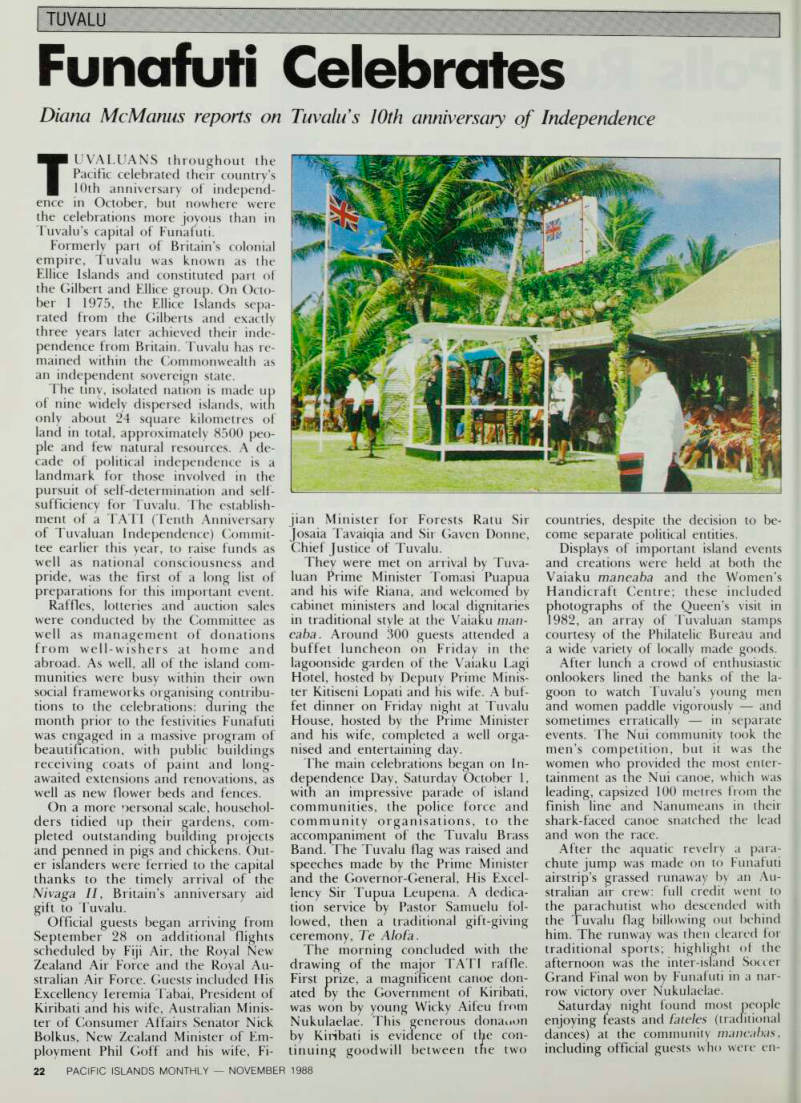
They were met on arrival by Tuvaluan Prime Minister Tomasi Puapua and his wife Riana, and welcomed by cabinet ministers and local dignitaries in traditional style at the Vaiaku maneaba. Around 300 guests attended a buffet luncheon on Friday in the
lagoonside garden of the Vaiaku Lagi
Hotel, hosted by Deputy Prime Minister Kitiseni Lopati and his wife. A buffet dinner on Friday night at Tuvalu House, hosted by the Prime Minister and his wife, completed a well orga-
nised and entertaining day.
The main celebrations began on In-
dependence Day, Saturday October 1,
with an impressive parade of island communities, the police force and
community organisations, to the
accompaniment of the Tuvalu Brass Band. The Tuvalu flag was raised and speeches made by the Prime Minister and the Governor-General, His Excel-
lency Sir Tupua Leupena. A dedica-
tion service by Pastor Samuelu followed, then a traditional gift-giving ceremony, Te Alofa.
The morning concluded with the drawing of the major TATI raffle, First prize, a magnificent canoe donated oy the Government of Kiribati, was won by young Wicky Aifeu from Nukulaelae. This generous donation by Kiribati is evidence of the continuing goodwill between the two
countries, despite the decision to be come separate political entities.
Displays of important island events and creations were held at both the Vaiaku maneaba and the Women’s Handicraft Centre; these included photographs of the Queen’s visit in 1982, an array of Tuvaluan stamps courtesy of the Philatelic Bureau and a wide variety of locally made goods.
After lunch a crowd of enthusiastic onlookers lined the banks of the la goon to watch Tuvalu’s young men and women paddle vigorously and sometimes erratically in separate events. The Nui community took the men’s competition, but it was the women who provided the most enter tainment as the Nui canoe, which was leading, capsized 100 metres from the finish line and Nanumeans in their shark-faced canoe snatched the lead and won the race.
After the aquatic revelry a para chute jump was made on to Funafuti
airstrip’s grassed runaway by an Au
stralian air crew: full credit went to the parachutist who descended with the Tuvalu flag billowing out behind him. The runway was then cleared for traditional sports; highlight of the afternoon was the inter-island Soccer Grand Final won by Funafuti in a nar row victory over Nukulaelae.
Saturday night found most people
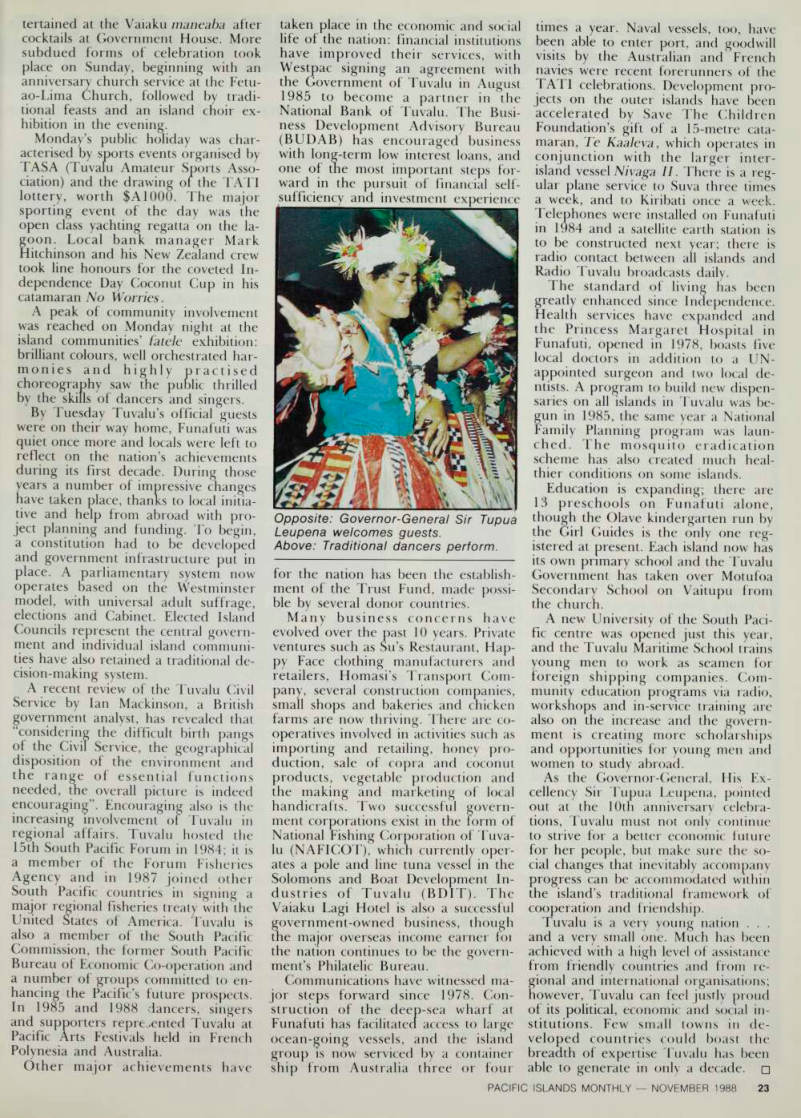
enjoying feasts and fateles (traditional dances) at the community maneabas, including official guests who were en
tertained at the Vaiaku maneaba after cocktails at Government House. More subdued forms of celebration took
place on Sunday, beginning with an
anniversary church service at the Fetu ao-Lima Church, followed by tradi tional feasts and an island choir ex hibition in the evening.
Monday’s public holiday was char
acterised by sports events organised by
TASA (Tuvalu Amateur Snorts Asso ciation) and the drawing of the TATI lottery, worth SAIOOO. The major sporting event of the day was the open class yachting regatta on the la goon. Local bank manager Mark Hitchinson and his New Zealand crew took line honours for the coveted In dependence Day Coconut Cup in his catamaran No Worries.
A peak of community involvement was reached on Monday night at the island communities’ fatele exhibition: brilliant colours, well orchestrated har
monies and highly practised
choreography saw the public thrilled by the skills of dancers and singers.
By Tuesday Tuvalu’s official guests were on their way home, Funafuti was quiet once more and locals were left to reflect on the nation’s achievements during its first decade. During those
years a number of impressive changes
nave taken place, thanks to local initia tive and help from abroad with pro
ject planning and funding. To begin,
a constitution had to be developed and government infrastructure put in place. A parliamentary system now operates based on the Westminster model, with universal adult suffrage, elections and Cabinet. Elected Island Councils represent the central govern ment and individual island communi ties have also retained a traditional de
cision-making system.
A recent review of the Tuvalu Civil Service by lan Mackinson, a British government analyst, has revealed that “considering the difficult birth pangs of the Civil Service, the geographical disposition of the environment and the range of essential functions needed, the overall picture is indeed encouraging”. Encouraging also is the increasing involvement of Tuvalu in regional affairs. Tuvalu hosted the 15th South Pacific Forum in 1984; it is a member of the Forum Fisheries Agency and in 1987 joined other South Pacific countries in signing a major regional fisheries treaty with the United States of America. Tuvalu is also a member of the South Pacific Commission, the former South Pacific Bureau of Economic Co-operation and a number of groups committed to en hancing the Pacific’s future prospects.
In 1985 and 1988 dancers, singers and supporters represented Tuvalu at Pacific Arts Festivals held in French Polynesia and Australia.
Other major achievements have
taken place in the economic and social life of the nation: financial institutions have improved their services, with Westpac signing an agreement with the Government of Tuvalu in August 1985 to become a partner in the National Bank of Tuvalu. The Busi
ness Development Advisory Bureau
(BUDAB) has encouraged business with long-term low interest loans, and one of the most important steps for ward in the pursuit of financial self sufficiency and investment experience
for the nation has been the establish ment of the Trust Fund, made possi ble by several donor countries.
Many business concerns have evolved over the past 10 years. Private ventures such as Su’s Restaurant, Hap py Face clothing manufacturers and retailers, Homasi’s Transport Com pany, several construction companies, small shops and bakeries and chicken farms are now thriving. There are co operatives involved in activities such as
importing and retailing, honey pro
duction, sale of copra and coconut
products, vegetable production and
the making and marketing of local handicrafts. Two successful govern ment corporations exist in the form of National Fishing Corporation of Tuva lu (NAFICOT), which currently oper ates a pole and line tuna vessel in the Solomons and Boat Development In dustries of Tuvalu (EDIT). The Vaiaku Lagi Hotel is also a successful
government-owned business, though
the major overseas income earner foi the nation continues to be the govern ment’s Philatelic Bureau.
Communications have witnessed ma jor steps forward since 1978. Con struction of the deep-sea wharf at Funafuti has facilitated access to large ocean-going vessels, and the island group is now serviced by a container ship from Australia three or four
times a year. Naval vessels, too, have been able to enter port, and goodwill visits by the Australian and French navies were recent forerunners of the TATI celebrations. Development pro jects on the outer islands have been accelerated by Save The Children Foundation’s gift of a 15-metre cata maran, Te Kaaleva , which operates in conjunction with the larger inter island vessel Nivaga 11 . There is a reg ular plane service to Suva three times a week, and to Kiribati once a week.
Telephones were installed on Funafuti in 1984 and a satellite earth station is to be constructed next year; there is radio contact between all islands and Radio Tuvalu broadcasts daily.
The standard of living has been
greatly enhanced since Independence.
Healtn services have expanded and the Princess Margaret Hospital in Funafuti, opened in 1978, boasts five local doctors in addition to a UN appointed surgeon and two local de ntists. A program to build new dispen saries on all islands in Tuvalu was be gun in 1985, the same year a National Family Planning program was laun ched. The mosquito eradication scheme has also created much heal thier conditions on some islands.
Education is expanding; there are 13 preschools on Funafuti alone,
though the Olave kindergarten run by
the Girl Guides is the only one reg istered at present. Each island now has its own primary school and the Tuvalu Government has taken over Motufoa Secondary School on Vaitupu from the church.
A new University of the South Paci fic centre was opened just this year, and the Tuvalu Maritime School trains young men to work as seamen for
foreign shipping companies. Com
munity education programs via radio, workshops and in-service training are also on the increase and the govern ment is creating more scholarships and opportunities for young men and women to study abroad.
As the Governor-General, His Ex
cellency Sir Tupua Leupena, pointed
out at the 10th anniversary celebra tions, Tuvalu must not only continue to strive for a better economic future for her people, but make sure the so cial changes that inevitably accompany progress can be accommodated within the island’s traditional framework of
cooperation and friendship.
Tuvalu is a very young nation . . . and a very small one. Much has been achieved with a high level of assistance from friendly countries and from re
gional and international organisations;
however, Tuvalu can feel justly proud of its political, economic and social in stitutions. Few small towns in de veloped countries could boast the breadth of expertise Tuvalu has been able to generate in only a decade. □
Opposite: Governor-General Sir Tupua Leupena welcomes guests.
Above: Traditional dancers perform.