Delegation Seeks
p. 35 · Read in the full issue
Investment
Delegation Seeks Investment Boost
Fiji works toward ‘hassle-free investment’ to promote its tax-free zone. By Robin Bromby
IN an effort to boost investment, a
high-powered Fijian delegation last
month completed a tour aimed at
convincing businesspeople that Fiji’s
new tax-free zone regulations offer attractions not available elsewhere in the region; it was notable that the Fi jians made a special effort to target Asian investment by hosting seminars
in Hongkong, Seoul, Taipei and Sing
apore before heading for Sydney. In Australia, about 200 potential business investors attended the seminar, the presentation marred only by the need to defuse a reported statement by Fi jian Home Affairs Minister Major- General Sitiveni Rabuka that the threat of closing Australian banks could be one way to change Australian
Government policy.
So far, Fiji has attracted about SF24 million in investment under the tax free zone legislation, the industries covering garment manufacture, cosmetics, textiles, furniture, confec
tionery and prefabricated housing.
The tax-free zones (TFZ) laws allow for a 13-year tax holiday to companies exporting 95 per cent of their produc tion, no tariffs on equipment or raw materials for 13 years and easy repat riation of capital and profits. The de
legation was stressing the availability
of a skilled, English-speaking work force and minimum wage rates (up to $F 1.16 an hour) and access to metro
politan markets under preferential
trade agreements.
The important point about Major- General Rabuka’s reported statement is that it has not been disputed that he did argue that, in certain circumst ances, Fiji could consider withdrawing the licences of Westpac and ANZ Bank. Statements by Finance Minister Josefata Kamikamica and by Trade and Commerce Minister Berenado Vunibobo stressed that Major-General Rabuka’s statement was not govern
ment policy but personal opinion, and
that the interim government guaran teed foreign investment.
While the Home Affairs Minister’s statement caused a brief ruffle in Au stralia, it is important to consider that it was made to a journalism student purportedly interviewing him as an exercise rather than to a reporter seeking an on-the-record statement.
The statement and its publicity seemed not to affect Westpac’s enthu siasm for investment in Fiji. Westpac chief economist Robert Graham offered a very optimistic view of in vestment in Fiji, saying: “While I may have appeared to be bullish, I do real ise that investment in any country car ries its risks as well as opportunities.
But I suggest investors would be fool ish not to explore the opportunities being offered m Fiji.” He said interest rates were relatively attractive and there was a good level of liquidity in the financial system. Mr Graham said there were also Australian institutions that would be interested in offering project finance for Fijian ventures.
While media attention focussed on the presence of Westpac and ANZ in Fiji (which between them are now a fundamental part of the country’s financial system) there are altogether about 100 Australian companies oper ating in the country.
In his speech to the Sydney seminar Trade and Commerce Minister Vuni bobo said he acknowledged the prob lems the Republic had confronted since the political upheavals of 1987, including loss of skilled and profes sional manpower, falling incomes and rising unemployment and a balance of payments reverse.
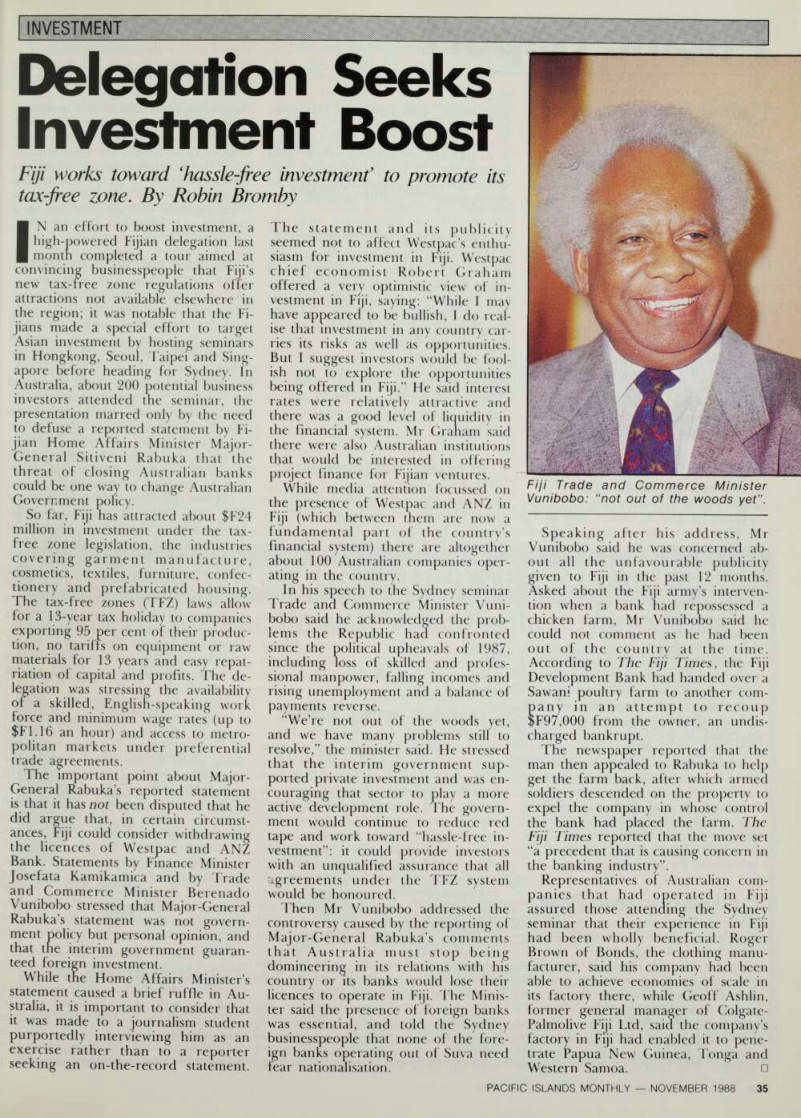
“We’re not out of the woods yet, and we have many problems still to resolve,” the minister said. He stressed that the interim government sup ported private investment and was en couraging that sector to play a more active development role. The govern ment would continue to reduce red tape and work toward “hassle-free in vestment”: it could provide investors with an unqualified assurance that all agreements under the TFZ system would be honoured.
Then Mr Vunibobo addressed the controversy caused by the reporting of Major-General Rabuka’s comments that Australia must stop being domineering in its relations with his country or its banks would lose their licences to operate in Fiji. The Minis ter said the presence of foreign banks was essential, and told the Sydney businesspeople that none of the fore ign banks operating out of Suva need fear nationalisation.
Speaking after his address, Mr Vunibobo said he was concerned ab out ail the unfavourable publicity given to Fiji in the past 12 months.
Asked about the Fiji army’s interven tion when a bank had repossessed a chicken farm, Mr Vunibobo said he could not comment as he had been out of the country at the time.
According to The Fiji Times, the Fiji Development Bank had handed over a Sawani poultry farm to another com pany in an attempt to recoup $F97,000 from the owner, an undis
charged bankrupt.
The newspaper reported that the man then appealed to Rabuka to help get the farm back, after which armed soldiers descended on the property to expel the company in whose control the bank had placed the farm. The Fiji Times reported that the move set “a precedent that is causing concern in
the banking industry”.
Representatives of Australian com
panies that had operated in Fiji
assured those attending the Sydney seminar that their experience in Fiji had been wholly beneficial. Roger Brown of Bonds, the clothing manu facturer, said his company had been able to achieve economies of scale in its factory there, while Geoff Ashlin, former general manager of Colgate- Palmolive Fiji Ltd, saia the company’s factory in Fiji had enabled it to pene trate Papua New Guinea, Tonga and Western Samoa. □
Fiji Trade and Commerce Minister Vunibobo: “not out of the woods yet”.