“Wave Power”
pp. 38-39 · Read in the full issue
Tonga
A World First
Rex Matthews looks at an innovative scheme to provide power for Tonga’s domestic and industrial needs.
ELECTRICITY produced with ab solutely no cost for fuel may soon light homes and drive the wheels of industry in Tonga, where a Norwegian company, Kvaerner Brug A/S, has con tracted to build a wave powered generat ing plant that is hoped to be in operation by the end of 1990.
A ground-breaking ceremony to inau gurate the project was recently held at Makeke, Tongatapu, with the president of the Parliament of Norway, Mr Jo Benkow, and Tonga’s acting Prime Minister, Baron Tuita of ’Utungake, together unveiling a plaque to commemorate the historic development.
Power from the waves of the ocean has long been a dream of those who live by the sea. Engineers and scientists in Britain have been prominent in taking it to real ity, but government funds ran out and the running was taken up by Norway.
Kvaerner Brug A/S has operated a plant on the coast of Norway that converts en ergy from ocean waves into electricity: the power it produces has been fed into the lo cal grid since 1985.
It uses some of the principles recog nised in the British tests and a British designed turbine, but the Norwegians have added their own ingenuity to make the scheme financially viable.
The new generating station, which will cost some T 8 million, will be the first commercial wave powered plant in the world, and while still small in output com pared with conventional stations in larger countries, at 2MW (2 megawatts or 2000 kilowatts) it will be four times the size of the pilot plant in Norway.
Wave power electricity generation has been under serious investigation in the South Pacific for some 15 years, and Tonga has been at the forefront with feasibility studies that indicate economic value in a plant of this capacity. Costs until now have appeared too high in the majority of pro posed schemes, but Kvaerner Brug claims it has advanced to a point where com munities dependent on diesel powered generators can use the system profitably.
Diesel generators will still be required to operate in tandem with the wave ma chine, and can be called on to bear a pro portion of the load according to the weather; too much as well as too little wave activity may shut the plant down.
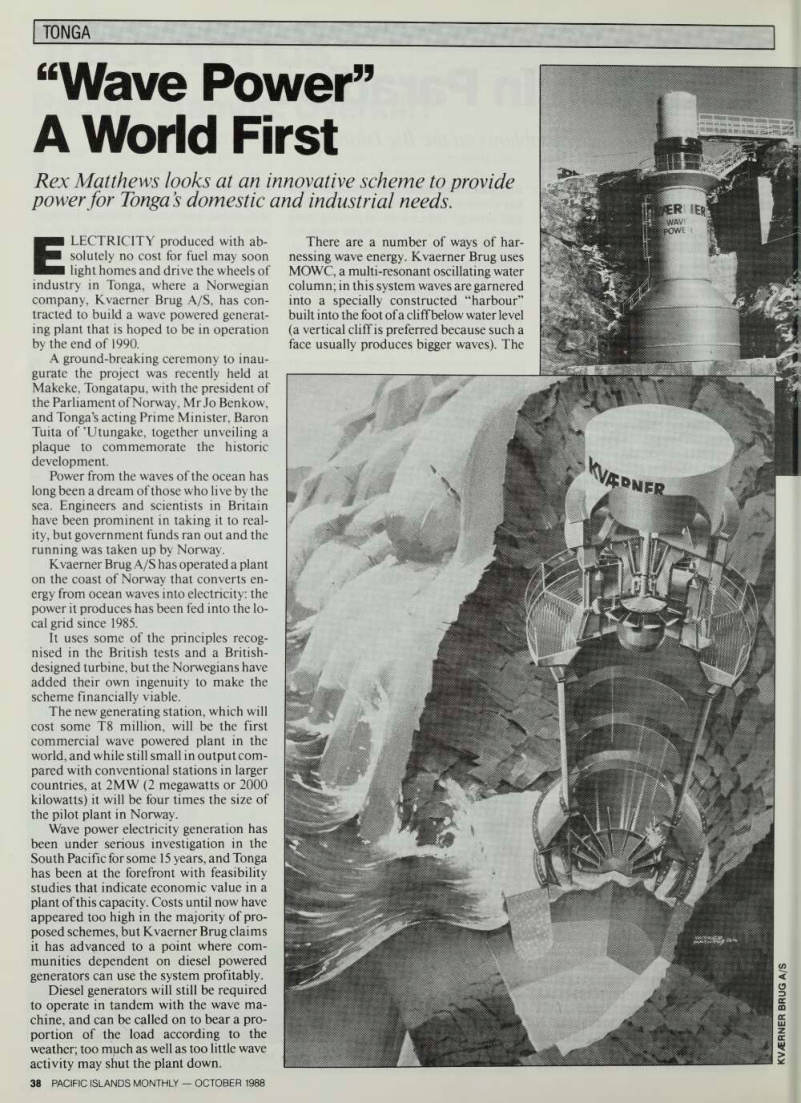
There are a number of ways of har nessing wave energy. Kvaerner Brug uses MOWC, a multi-resonant oscillating water column; in this system waves are garnered into a specially constructed “harbour” built into the foot of a cliff below water level (a vertical cliff is preferred because such a face usually produces bigger waves). The
Kv Aerner Brug A/S
trapped waves rise and fall in an oscilla tion chamber in resonance with the waves outside, pumping air up a steel shaft above and sucking it back on the fall of the wave.
As it flows each way, the air drives a turbine designed so that it turns the same way whichever way the air is flowing. The turbine drives a generator that can pro duce electricity at 660 volts, but because speed will vary according to wave condi tions a voltage rectification system is in stalled to produce an acceptable voltage for feeding into the local supply.
The Norwegian company has entered into an arrangement with the Govern ment of Tonga to help finance as well as to construct the new plant. It also hopes the idea will be attractive to other islands na tions, and is actively promoting the plan in Western Samoa and Fiji. □
“Communities dependent on diesel powered generators can use the system profitably”
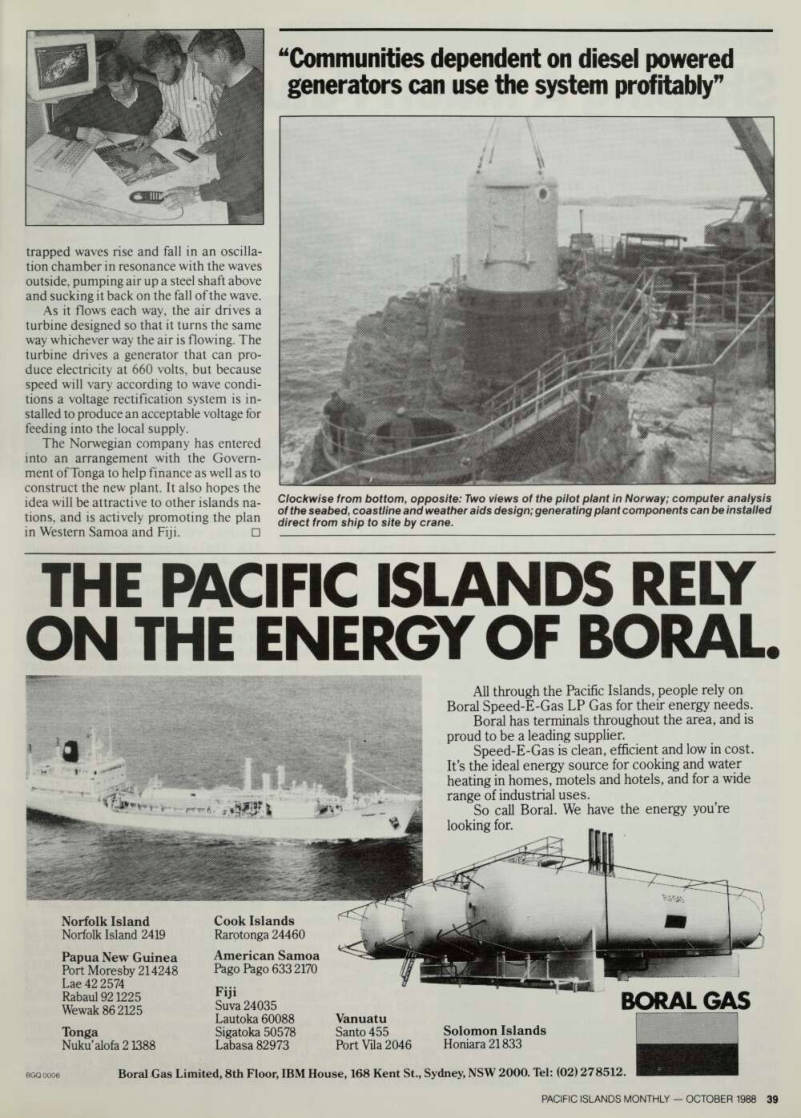
Clockwise from bottom, opposite: Two views of the pilot plant in Norway; computer analysis of the seabed, coastline and weather aids design; generating plant components can be installed direct from ship to site by crane.