Acid Rain In Paradise
p. 37 · Read in the full issue
Hawaii
Natural pollution creates problems on the Big Island.
By Michael Moriarty
THE last place on Earth you would expect to find a problem with acid rain is in Hawaii, far from all in dustrial centres and in the middle of the Pacific. The fact is, however, that the is land of Hawaii is suffering from naturally produced acid rain, a byproduct of vol canic activity. The pristine image of a “pure” Hawaii dims as you see the cloud of volcanic emissions hugging the island: from the air the haze is evident many kilometres out to sea, looking very much like classic urban smog.
The areas most affected are Hilo, the Puna district (on the southeast coast of the island) and the Kona Coast. Hilo and Puna are adjacent to the volcanic activity and are therefore subject to its gaseous emis sions whenever the trade winds fail to sweep them away. The Kona Coast, while on the opposite side of the island from the volcanoes, does not experience trade winds. Standing between the Kona area and the cleansing trades are Mauna Kea (4205 metres), Mauna Loa (4169 metres) and Hualalai (2521 metres).
This “waif creates a still area on the leeward and western flanks of Hualalai and Mauna Loa the Kona Coast. Here the winds depend on the daily heating and nightly cooling of the land. Land temper ature relative to the temperature of the surrounding sea sets up a tidal wind sys tem whereby at night and in the early morning the wind blows from the shore out to sea: during the day, the wind blows in the reverse direction ... and the gases blow back and forth with the winds.
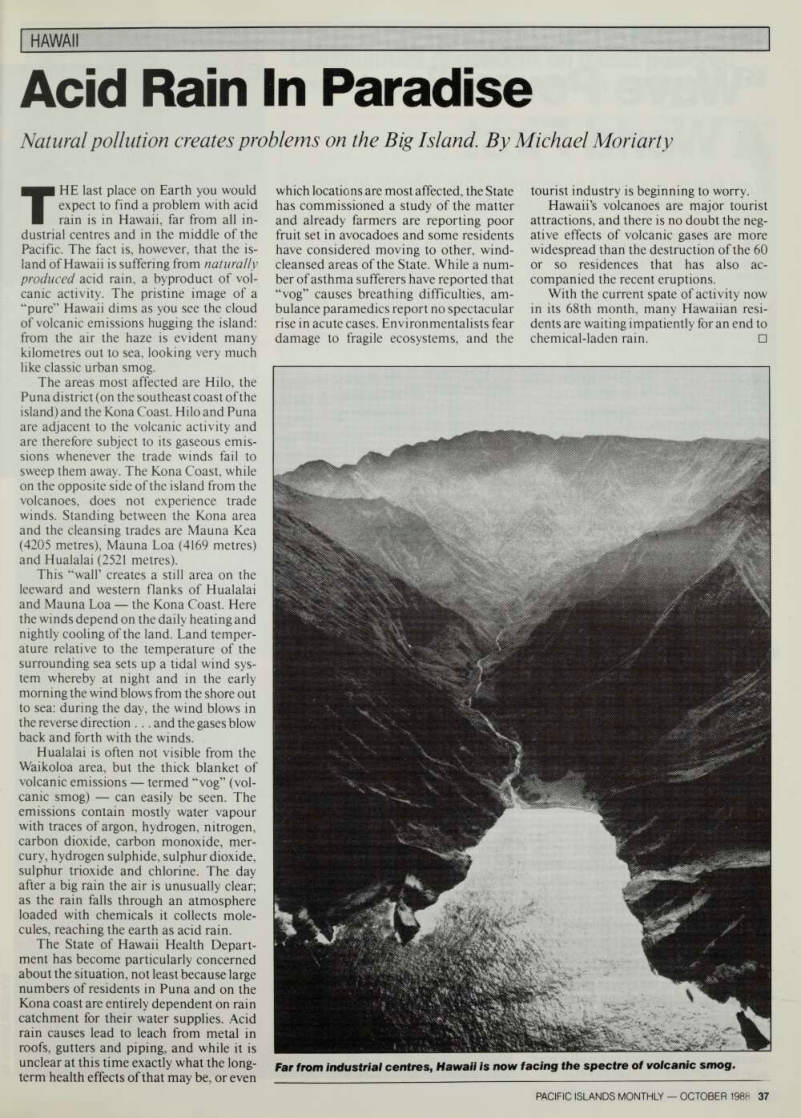
Hualalai is often not visible from the Waikoloa area, but the thick blanket of volcanic emissions termed “vog” (vol canic smog) can easily be seen. The emissions contain mostly water vapour with traces of argon, hydrogen, nitrogen, carbon dioxide, carbon monoxide, mer cury, hydrogen sulphide, sulphur dioxide, sulphur trioxide and chlorine. The day after a big rain the air is unusually clear; as the rain falls through an atmosphere loaded with chemicals it collects mole cules, reaching the earth as acid rain.
The State of Hawaii Health Depart ment has become particularly concerned about the situation, not least because large numbers of residents in Puna and on the Kona coast are entirely dependent on rain catchment for their water supplies. Acid rain causes lead to leach from metal in roofs, gutters and piping, and while it is unclear at this time exactly what the long term health effects of that may be, or even
which locations are most affected, the State has commissioned a study of the matter and already farmers are reporting poor fruit set in avocadoes and some residents have considered moving to other, wind cleansed areas of the State. While a num ber of asthma sufferers have reported that “vog” causes breathing difficulties, am bulance paramedics report no spectacular rise in acute cases. Environmentalists fear damage to fragile ecosystems, and the
tourist industry is beginning to worry.
Hawaii’s volcanoes are major tourist attractions, and there is no doubt the neg ative effects of volcanic gases are more widespread than the destruction of the 60 or so residences that has also ac companied the recent eruptions.
With the current spate of activity now in its 68th month, many Hawaiian resi dents are waiting impatiently for an end to chemical-laden rain. □
Far from industrial centres, Hawaii is now facing the spectre of volcanic smog.