Shaping A Maori Future
pp. 40-42 · Read in the full issue
Pacific People
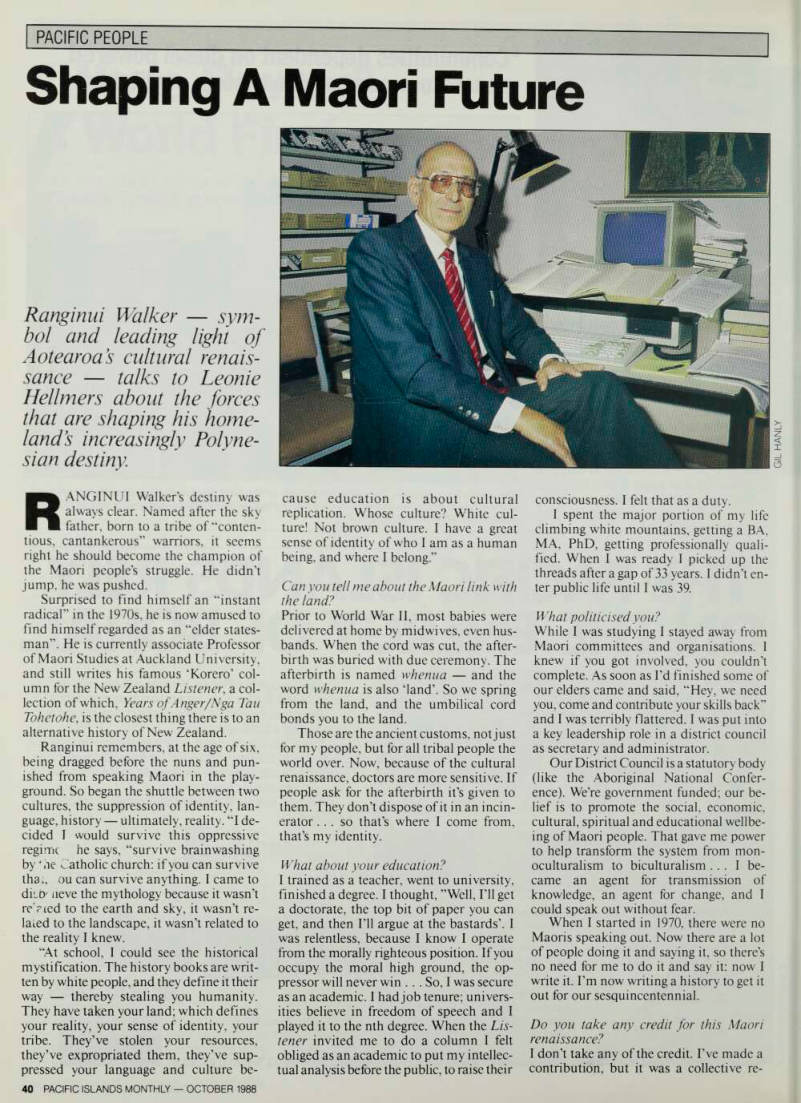
Ranginui Walker sym bol and leading light of Aotearoa’s cultural renais sance talks to Leonie Hellmers about the forces that are shaping his home land’s increasingly Polyne sian destiny.
RANGINUI Walker’s destiny was always clear. Named after the sky father, born to a tribe of “conten tious, cantankerous” warriors, it seems right he should become the champion of the Maori people’s struggle. He didn’t jump, he was pushed.
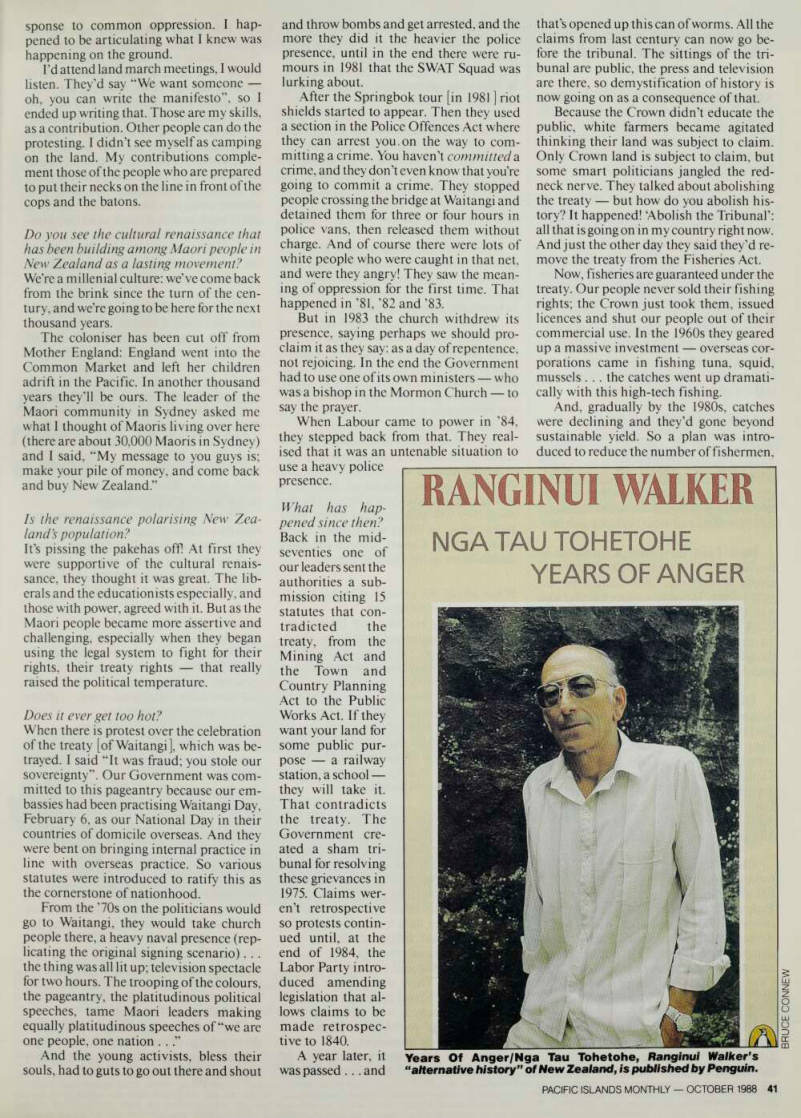
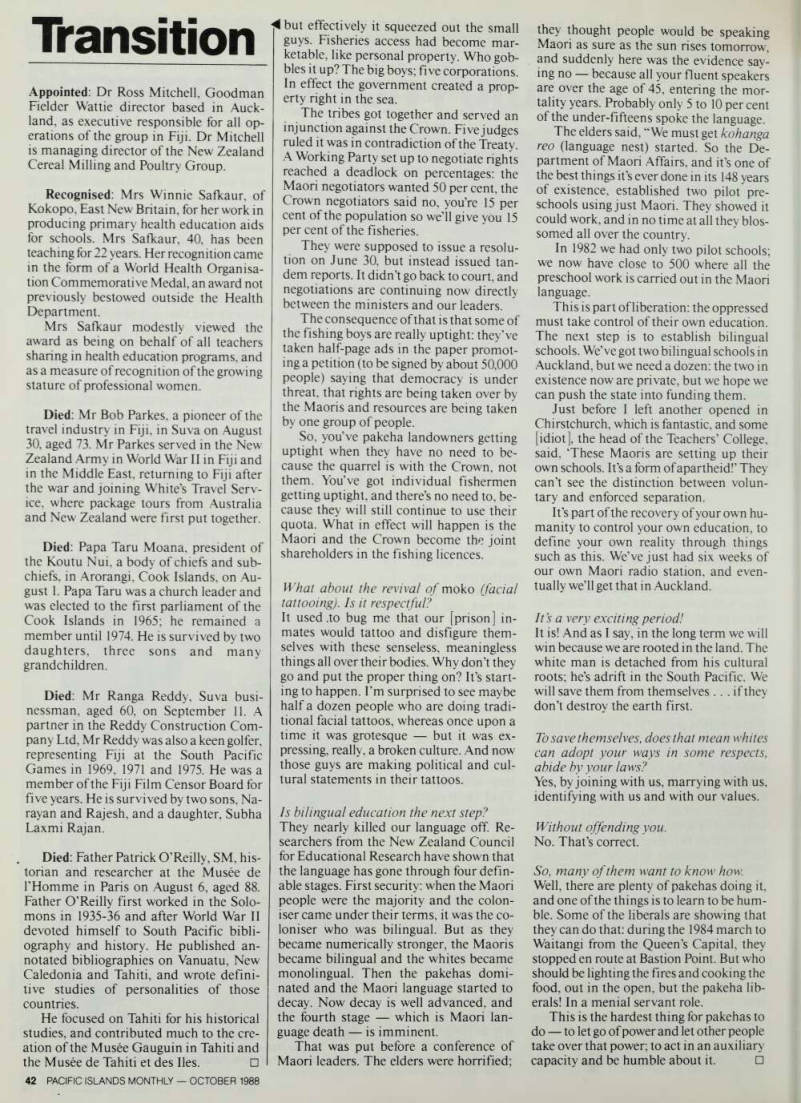
Surprised to find himself an “instant radical” in the 19705, he is now amused to find himself regarded as an “elder states man”. He is currently associate Professor of Maori Studies at Auckland University, and still writes his famous ‘Korero’ col umn for the New Zealand Listener , a col lection of which, Years ofAnger/Nga Tau Tohetohe, is the closest thing there is to an alternative history of New Zealand.
Ranginui remembers, at the age of six, being dragged before the nuns and pun ished from speaking Maori in the play ground. So began the shuttle between two cultures, the suppression of identity, lan guage, history ultimately, reality. “I de cided I would survive this oppressive regime he says, “survive brainwashing by Me Catholic church: if you can survive thai, ou can survive anything. I came to drib' neve the mythology because it wasn’t re>ted to the earth and sky, it wasn’t re lated to the landscape, it wasn’t related to the reality I knew.
“At school, I could see the historical mystification. The history books are writ ten by white people, and they define it their way thereby stealing you humanity.
They have taken your land; which defines your reality, your sense of identity, your tribe. They’ve stolen your resources, they’ve expropriated them, they’ve sup pressed your language and culture be-
cause education is about cultural replication. Whose culture? White cul ture! Not brown culture. I have a great sense of identity of who I am as a human being, and where I belong.”
Can you tell me about the Maori link with the land?
Prior to World War 11, most babies were delivered at home by midwives, even hus bands. When the cord was cut, the after birth was buried with due ceremony. The afterbirth is named whenua and the word whenua is also ‘land’. So we spring from the land, and the umbilical cord bonds you to the land.
Those are the ancient customs, not just for my people, but for all tribal people the world over. Now, because of the cultural renaissance, doctors are more sensitive. If people ask for the afterbirth it’s given to them. They don’t dispose of it in an incin erator ... so that’s where I come from, that’s my identity.
What about your education?
I trained as a teacher, went to university, finished a degree. I thought, ’’Well, I’ll get a doctorate, the top bit of paper you can get, and then I’ll argue at the bastards’. I was relentless, because I know I operate from the morally righteous position. If you occupy the moral high ground, the op pressor will never win ... So, I was secure as an academic. I had job tenure; univers ities believe in freedom of speech and I played it to the nth degree. When the Lis tener invited me to do a column I felt obliged as an academic to put my intellec tual analysis before the public, to raise their
consciousness. I felt that as a duty.
I spent the major portion of my life climbing white mountains, getting a BA, MA, PhD, getting professionally quali fied. When I was ready I picked up the threads after a gap of 33 years. I didn’t en ter public life until I was 39.
What politicised you?
While I was studying I stayed away from Maori committees and organisations. I knew if you got involved, you couldn’t complete. As soon as I’d finished some of our elders came and said, “Hey, we need you, come and contribute your skills back” and I was terribly flattered. I was put into a key leadership role in a district council as secretary and administrator.
Our District Council is a statutory body (like the Aboriginal National Confer ence). We’re government funded; our be lief is to promote the social, economic, cultural, spiritual and educational wellbe ing of Maori people. That gave me power to help transform the system from mon oculturalism to biculturalism ... I be came an agent for transmission of knowledge, an agent for change, and I could speak out without fear.
When I started in 1970, there were no Maoris speaking out. Now there are a lot of people doing it and saying it, so there’s no need for me to do it and say it: now I write it. I’m now writing a history to get it out for our sesquincentennial.
Do you take any credit for this Maori renaissance?
I don’t take any of the credit. I’ve made a contribution, but it was a collective re
sponse to common oppression. I hap pened to be articulating what I knew was happening on the ground.
I’d attend land march meetings, I would listen. They’d say “We want someone oh, you can write the manifesto”, so I ended up writing that. Those are my skills, as a contribution. Other people can do the protesting. I didn’t see myself as camping on the land. My contributions comple ment those of the people who are prepared to put their necks on the line in front of the cops and the batons.
Do you see the cultural renaissance that has been building among Maori people in New Zealand as a lasting movement?
We’re a millenial culture: we’ve come back from the brink since the turn of the cen tury, and we’re going to be here for the next thousand years.
The coloniser has been cut off from Mother England: England went into the Common Market and left her children adrift in the Pacific. In another thousand years they’ll be ours. The leader of the Maori community in Sydney asked me what I thought of Maoris living over here (there are about 30,000 Maoris in Sydney) and I said, “My message to you guys is; make your pile of money, and come back and buy New Zealand.”
Is the renaissance polarising New Zea land’s population?
It’s pissing the pakehas off! At first they were supportive of the cultural renais sance, they thought it was great. The lib erals and the educationists especially, and those with power, agreed with it. But as the Maori people became more aissertive and challenging, especially when they began using the legal system to fight for their rights, their treaty rights that really raised the political temperature.
Does it ever get too hot?
When there is protest over the celebration of the treaty [of Waitangi], which was be trayed. I said “It was fraud; you stole our sovereignty”. Our Government was com mitted to this pageantry because our em bassies had been practising Waitangi Day, February 6, as our National Day in their countries of domicile overseas. And they were bent on bringing internal practice in line with overseas practice. So various statutes were introduced to ratify this as the cornerstone of nationhood.
From the ’7os on the politicians would go to Waitangi, they would take church people there, a heavy naval presence (rep licating the original signing scenario). .. the thing was all lit up; television spectacle for two hours. The trooping of the colours, the pageantry, the platitudinous political speeches, tame Maori leaders making equally platitudinous speeches of “we are one people, one nation ..
And the young activists, bless their souls, had to guts to go out there and shout
and throw bombs and get arrested, and the more they did it the heavier the police presence, until in the end there were ru mours in 1981 that the SWAT Squad was lurking about.
After the Springbok tour [in 1981 ] riot shields started to appear. Then they used a section in the Police Offences Act where they can arrest you.on the way to com mitting a crime. You haven’t committed a crime, and they don’t even know that you’re going to commit a crime. They stopped people crossing the bridge at Waitangi and detained them for three or four hours in police vans, then released them without charge. And of course there were lots of white people who were caught in that net, and were they angry! They saw the mean ing of oppression for the first time. That happened in ’Bl, ’B2 and ’B3.
But in 1983 the church withdrew its presence, saying perhaps we should pro claim it as they say; as a day of repentence, not rejoicing. In the end the Government had to use one of its own ministers who was a bishop in the Mormon Church to say the prayer.
When Labour came to power in ’B4, they stepped back from that. They real ised that it was an untenable situation to
use a heavy police presence.
What has hap pened since then?
Back in the mid seventies one of our leaders sent the authorities a sub mission citing 15 statutes that con tradicted the treaty, from the Mining Act and the Town and Country Planning Act to the Public Works Act. If they want your land for some public pur pose a railway station, a school they will take it.
That contradicts the treaty. The Government cre ated a sham tri bunal for resolving these grievances in 1975. Claims wer en’t retrospective so protests contin ued until, at the end of 1984, the Labor Party intro duced amending legislation that al lows claims to be made retrospec tive to 1840.
A year later, it was passed ... and
that’s opened up this can of worms. All the claims from last century can now go be fore the tribunal. The sittings of the tri bunal are public, the press and television are there, so demystification of history is now going on as a consequence of that.
Because the Crown didn’t educate the public, white farmers became agitated thinking their land was subject to claim.
Only Crown land is subject to claim, but some smart politicians jangled the red neck nerve. They talked about abolishing the treaty but how do you abolish his tory? It happened! ‘Abolish the Tribunal’: all that is going on in my country right now.
And just the other day they said they’d re move the treaty from the Fisheries Act.
Now, fisheries are guaranteed under the treaty. Our people never sold their fishing rights; the Crown just took them, issued licences and shut our people out of their commercial use. In the 1960 s they geared up a massive investment overseas cor porations came in fishing tuna, squid, mussels ... the catches went up dramati cally with this high-tech fishing.
And, gradually by the 1980 s, catches were declining and they’d gone beyond sustainable yield. So a plan was intro duced to reduce the number of fishermen.
but effectively it squeezed out the small guys. Fisheries access had become mar ketable, like personal property. Who gob bles it up? The big boys; five corporations.
In effect the government created a prop erty right in the sea.
The tribes got together and served an injunction against the Crown. Five judges ruled it was in contradiction of the Treaty.
A Working Party set up to negotiate rights reached a deadlock on percentages: the Maori negotiators wanted 50 per cent, the Crown negotiators said no, you’re 15 per cent of the population so we’ll give you 15 per cent of the fisheries.
They were supposed to issue a resolu tion on June 30, but instead issued tan dem reports. It didn’t go back to court, and negotiations are continuing now directly between the ministers and our leaders.
The consequence of that is that some of the fishing boys are really uptight: they’ve taken half-page ads in the paper promot ing a petition (to be signed by about 50,000 people) saying that democracy is under threat, that rights are being taken over by the Maoris and resources are being taken by one group of people.
So, you’ve pakeha landowners getting uptight when they have no need to be cause the quarrel is with the Crown, not them. You’ve got individual fishermen getting uptight, and there’s no need to, be cause they will still continue to use their quota. What in effect will happen is the Maori and the Crown become the joint shareholders in the fishing licences.
What about the revival of moko (facial tattooing). Is it respectful?
It used .to bug me that our [prison] in mates would tattoo and disfigure them selves with these senseless, meaningless things all over their bodies. Why don’t they go and put the proper thing on? It’s start ing to happen. I’m surprised to see maybe half a dozen people who are doing tradi tional facial tattoos, whereas once upon a time it was grotesque but it was ex pressing, really, a broken culture. And now those guys are making political and cul tural statements in their tattoos.
Is bilingual education the next step?
They nearly killed our language off. Re searchers from the New Zealand Council for Educational Research have shown that the language has gone through four defin able stages. First security: when the Maori people were the majority and the colon iser came under their terms, it was the co loniser who was bilingual. But as they became numerically stronger, the Maoris became bilingual and the whites became monolingual. Then the pakehas domi nated and the Maori language started to decay. Now decay is well advanced, and the fourth stage which is Maori lan guage death is imminent.
That was put before a conference of Maori leaders. The elders were horrified;
they thought people would be speaking Maori as sure as the sun rises tomorrow, and suddenly here was the evidence say ing no because all your fluent speakers are over the age of 45, entering the mor tality years. Probably only 5 to 10 per cent of the under-fifteens spoke the language.
The elders said, “We must get kohanga reo (language nest) started. So the De partment of Maori Affairs, and it’s one of the best things it’s ever done in its 148 years of existence, established two pilot pre schools using just Maori. They showed it could work, and in no time at all they blos somed all over the country.
In 1982 we had only two pilot schools; we now have close to 500 where all the preschool work is carried out in the Maori language.
This is part of liberation: the oppressed must take control of their own education.
The next step is to establish bilingual schools. We’ve got two bilingual schools in Auckland, but we need a dozen: the two in existence now are private, but we hope we can push the state into funding them.
Just before I left another opened in Chirstchurch, which is fantastic, and some [idiot], the head of the Teachers’ College, said, These Maoris are setting up their own schools. It’s a form of apartheid!’ They can’t see the distinction between volun tary and enforced separation.
It’s part of the recovery of your own hu manity to control your own education, to define your own reality through things such as this. We’ve just had six weeks of our own Maori radio station, and even tually we’ll get that in Auckland.
It’s a very exciting period!
It is! And as I say, in the long term we will win because we are rooted in the land. The white man is detached from his cultural roots; he’s adrift in the South Pacific. We will save them from themselves ... if they don’t destroy the earth first.
To save themselves, does that mean whites can adopt your ways in some respects, abide by your laws?
Yes, by joining with us, marrying with us, identifying with us and with our values.
Without offending you.
No. That’s correct.
So, many of them want to know how.
Well, there are plenty of pakehas doing it, and one of the things is to learn to be hum ble. Some of the liberals are showing that they can do that: during the 1984 march to Waitangi from the Queen’s Capital, they stopped en route at Bastion Point. But who should be lighting the fires and cooking the food, out in the open, but the pakeha lib erals! In a menial servant role.
This is the hardest thing for pakehas to do to let go of power and let other people take over that power; to act in an auxiliary capacity and be humble about it. □