Pacific Report
p. 29 · Read in the full issue
Nauruans Dying of Wealth
The tiny island nation has some of the world’s richest
and sickest people.
By Michael Field
ACCORDING to a recent survey, some of the world’s richest people are eating themselves to death.
They are thereby answering a question no laboratory experimenter would be al lowed to find out using live subjects what happens when people spend their entire lives living on canned and junk food.
The answer is simple; they end up with one of the world’s highest rates of diabetes and one of the lowest life expectancies an ywhere on the planet.
Providing the grim answer are the 5000 inhabitants of Nauru, which this century has exported 75 million tonnes of phos phate to Australia and New Zealand. In come from the phosphate has given Nauruans one of the world’s highest per capita gross national products.
A report from Melbourne’s Diabetes Institute has spelt out the cost; one in four suffer from the disease.
Nauruan men have a life expectancy of only 54 years, women of 63. They are also prone to gout, high blood pressure and cancer. Many are blind and most families have members with amputated limbs.
Despite having only one 16-kilometre long road on the island, road deaths are the second biggest killer of males in Nauru.
Alcohol is almost always a factor.
The institute has studied Nauru since the 1970 s and researcher Dr Garry Dowse says the reason for the island’s plight is ob
vious. “They have embraced all the worst aspects of Western culture, and none of the good,” he says. Air Nauru and shipping companies keep the island supplied with canned foods, beer, cordial and junk foods.
“They get virtually nothing that is fresh.
They grow nothing of their own, and no Nauruan now knows how to fish”. A year ago he was examining school children and was puzzled by the pink stains most had on their fingers and mouths. It turned out to be jelly crystals, which the children were eating for lunch.
The institute is also critical of the Nau ruan Government of President Hammer de Roburt for dragging its feet on health education. Dr Dowse says a solution might come economically, since phosphate is due to run out within five years.
Nauru, which is now economically stretched, has no co-ordinated plan to handle the steadily growing crisis though the Nauruan Government has been told regularly of the scale of the problem.
“It gets a bit like banging your head against a wall. I don’t know what else we could do about it,” says Dr Dowse.
In human terms the cost of a diet ofjunk is excessive; it’s made worse by Nauruans’ unwillingness to modify their diets, take tablets or use insulin. Blindness as a con sequences is common, as are heart-at tacks and renal failure: the hospital in Nauru has two dialysis machines, a phe-
nomenal number for such a small population.
Diabetes also affects the flow of blood to the limbs, and gangrene leading to am putations is common.
Dr Dowse says it is Utopian to say the fault lies with Westerners for ever having discovered the island at all. “It’s difficult to blame the Nauruans because they can’t be bothered; that’s a bit of a cop-out, too,” he says. “They’re like any people who want what they see on television.” — Dominion Sunday Times
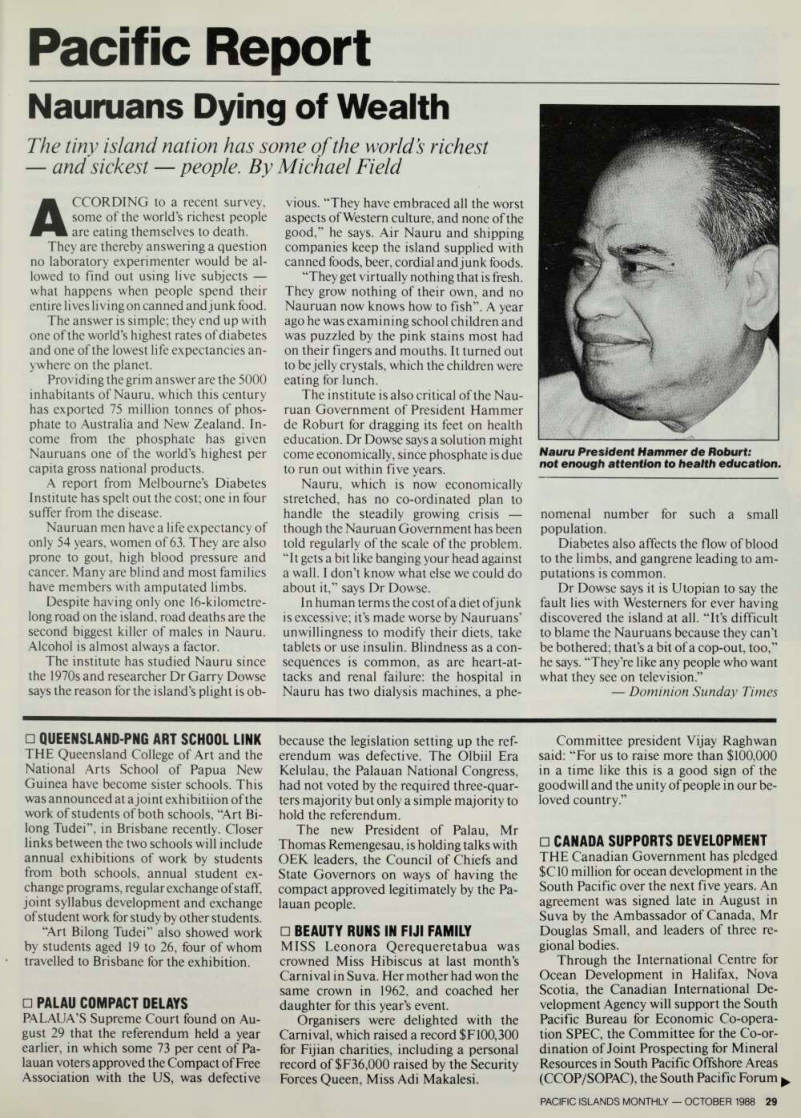
Nauru President Hammer de Roburt: not enough attention to health education.