Bruce Usher/Westpac
pp. 28-31 · Read in the full issue

The Region
Westpac Ahead In Banks “Battle”
Success in Tuvalu breeds regional confidence.
By Robin Bromby
ON October 1, Westpac opened a branch in the Cook Islands. Last year it set up in Niue. Both are ter ritories historically linked with New Zea land, and the moves seem to have caught Westpac’s main competitors, especially the Bank of New Zealand, flat-footed.
In the past two years the Sydney-head quartered bank has established itself as the leading trading bank in the region: it has acquired two other bank operations and against stiffbidding from more than 10 financial institutions landed the con-
tract to manage the SA27 million Tuvalu Trust Fund. The Tuvalu scheme (funded by five aid donor nations, with the money invested to provide enough income to al low a balanced budget in that tiny nation) is being watched carefully by the donors and by aid agencies such as the United Nations: its success may provide a way to help other developing countries. Its man agement is certainly a high-visibility task for Westpac.
The bank is now well established in all but the French-speaking territories of the region, and has no plans to take on the
French banks in their backyard. Its Pacific division is headquartered in Fiji, where Westpac has a full branch network com peting against BNZ and others, including the beleagured Bank of Baroda. Westpac owns 51 per cent of and manages the Bank of Kiribati; owns 40 per cent of the Na tional Bank of Tuvalu; owns 20 per cent and is managing agent of the Bank of Tonga, in partnership with Bank of Ha waii, BNZ and the Tongan Government.
However, Westpac still has a way to go to be on top in Western Samoa, where it holds a share with the Bank of Hawaii and local interests in the Pacific Commer cial Bank in a market dominated by the Bank of Western Samoa (itself half-owned by the Bank of New Zealand).
Earlier this year, Westpac bought out the interests of the Hong Kong and Shang hai Banking Corporation in Suva, Port Vila and Honiara.
In the Solomon Islands, Westpac set up its own branch two years ago but managed to attract only a five per cent market share (the ANZ is a well-established market leader in that country): the purchase of the HK&S office substantially increased Westpac’s market share.
The takeover had the same effect in Vanuatu, where ANZ had earlier swal lowed the Barclays operation.
Papua New Guinea is run as a separate operation throught the 89.9 per cent owned subsidiary, Westpac Bank PNG Ltd, which in 1987 reported total assets of K 235 million and an after-tax profit of K 2.87 million. The PNG operation has more than 20 branches and a number of agencies around the country.
But it is in Tuvalu that Westpac is tak ing its most public role. In mid-1987, the Tuvalu Trust Fund was established with the plan that its income would meet the 8200-strong nation’s recurrent budget def icit. The initial $ A 27 million was made up of $8 million from Australia, $8.2 million from New Zealand, $8.5 million from Britain and $1.6 million by the Tuvaluans themselves, and was topped up by Japan ($700,000) and South Korea ($30,000). The fund was not intended to replace devel opment assistance.
Westpac took control of the fund in September 1987. Its investment strategy was designed to meet Tuvalu’s income needs (this isolated island group’s econ omy is based almost entirely on subsist ence agriculture, small-scale copra production and fishing its lack of in ternal viability has ensured perpetual budget deficits that have been made up
hitherto by aid), but also to maintain the fund’s growth at a rate greater than Aus tralia’s inflation, where much of the in vesting was to be done. This involved placing 60 per cent of the money into government securities and property, the balance going into equities. The shares in turn were chosen on the basis of yield and quality, the intention being that they would show a return of about 20 per cent 5 per cent in dividends, the balance in appre ciation of stock value. The latter part of the strategy foundered with the stockmar ket crash, however, and one published fig ure put Tuvalu’s portfolio losses at about SA3 million. It could have been worse had not the Westpac managers overweighted in terms of fixed securities and gone lighter than intended into equities.
But by June this year, the shares side of the portfolio had regained more ground than anyone had expected after the pre vious October’s holocaust. While other funds joined what was called the “flight to quality”, Westpac (obviously aware that it was in the spotlight on this matter) was already there as far as the Tuvalu Trust Fund was concerned, with holdings in such companies as Brambles, Boral and BHP.
The second stock market shockwave has not eventuated, and the danger of it hap pening is receding with each passing month; the quality Australian industrial stocks are expected to be able to withstand normal market volatility.
Certainly, the appreciation of share values in Australia’s leading industrial this year has been far greater than post-crash expectations, and this has definitely helped all fund managers. While the gen eral market feeling is that most invest ment funds will report negative growth this year, it is understood the Tuvalu fund will have ended the September year with a po sitive result.
The Tuvalu Government has already made two withdrawals from the fund but has not taken up other withdrawal entitle ments, which suggests the investments will eventually achieve the purpose of provid ing enough money for this microstate to run a balanced budget without the need for aid subsidies.
Westpac itself will, no doubt, be re lieved that the fund has come out of 1988 in such good shape. It fought off other in sinuations to gain the management con tract and its record will determine whether the same approach could be used in other small developing countries. Unlike most fund management arrangements, this one is being watched very closely indeed. □
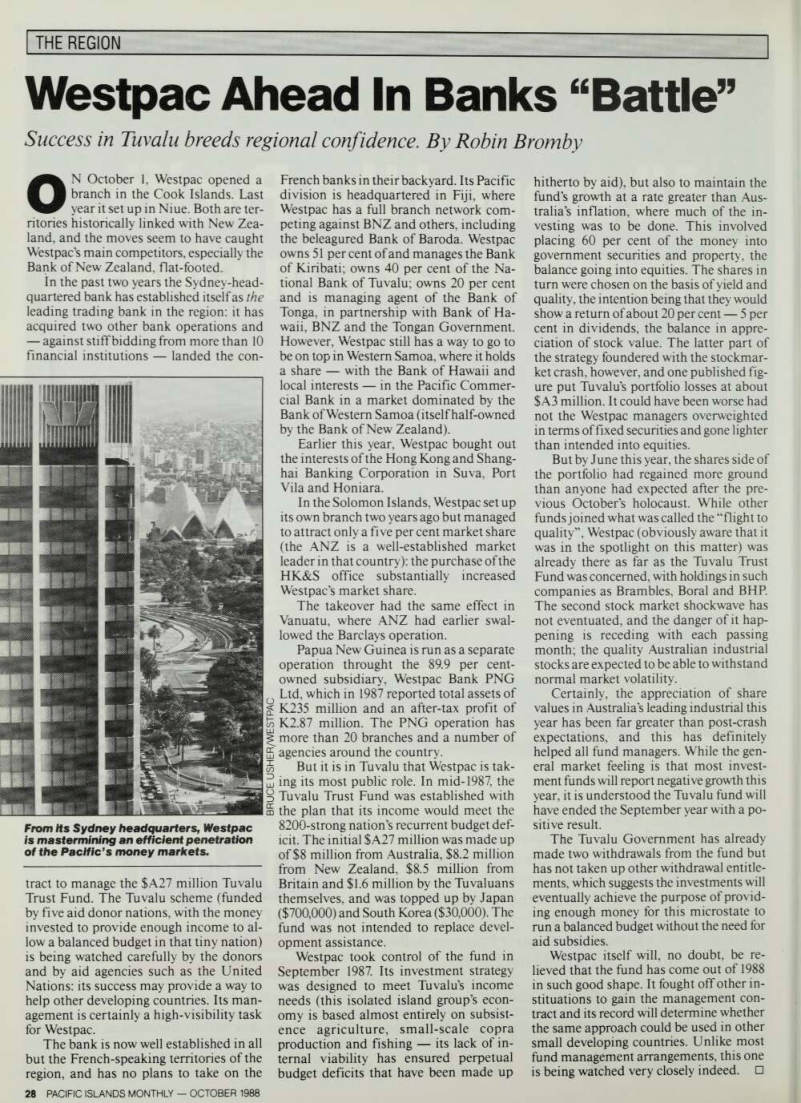
From its Sydney headquarters, Westpac is mastermining an efficient penetration of the Pacific’s money markets.
Bruce Usher/Westpac
□ Queensland-Png Art School Link
THE Queensland College of Art and the National Arts School of Papua New Guinea have become sister schools. This was announced at a joint exhibitiion of the work of students of both schools, “Art Bi long Tudei”, in Brisbane recently. Closer links between the two schools will include annual exhibitions of work by students from both schools, annual student ex change programs, regular exchange of staff, joint syllabus development and exchange of student work for study by other students.
“Art Bilong Tudei” also showed work by students aged 19 to 26, four of whom travelled to Brisbane for the exhibition.
□ Palau Compact Delays
PALAUA’S Supreme Court found on Au gust 29 that the referendum held a year earlier, in which some 73 per cent of Pa lauan voters approved the Compact of Free Association with the US, was defective
because the legislation setting up the ref erendum was defective. The Olbiil Era Kelulau, the Palauan National Congress, had not voted by the required three-quar ters majority but only a simple majority to hold the referendum.
The new President of Palau, Mr Thomas Remengesau, is holding talks with OEK leaders, the Council of Chiefs and State Governors on ways of having the compact approved legitimately by the Pa lauan people.
□ Beauty Runs In Fiji Family
MISS Leonora Qerequeretabua was crowned Miss Hibiscus at last month’s Carnival in Suva. Her mother had won the same crown in 1962, and coached her daughter for this year’s event.
Organisers were delighted with the Carnival, which raised a record $F100,300 for Fijian charities, including a personal record of $F36,000 raised by the Security Forces Queen, Miss Adi Makalesi.
Committee president Vijay Raghwan said: “For us to raise more than SIOO,OOO in a time like this is a good sign of the goodwill and the unity of people in our be loved country.”
□ Canada Supports Development
THE Canadian Government has pledged SCIO million for ocean development in the South Pacific over the next five years. An agreement was signed late in August in Suva by the Ambassador of Canada, Mr Douglas Small, and leaders of three re gional bodies.
Through the International Centre for Ocean Development in Halifax, Nova Scotia, the Canadian International De velopment Agency will support the South Pacific Bureau for Economic Co-opera tion SPEC, the Committee for the Co-or dination of Joint Prospecting for Mineral Resources in South Pacific Offshore Areas (CCOP/SOPAC), the South Pacific Forum
◄ Fisheries Agency (FFA) and the Univer sity of the South Pacific.
The grant continues Canadian support for marine science started in the 19705: Mr Small says “the Canadian contribution will support inshore and offshore fisheries projects, offshore mineral exploration and management, marine transportation, ma rine policy and the protection and pres ervation of the marine environment.”
□ Europe Aids Pacific Culture
THE European Community has given 180,000 ECU (about $A250,000) to the London-based Commonwealth Institute to support its 1988 Pacific Way program.
In collaboration with the South Pacific Bureau for Economic Co-operation and Development (SPEC) the program aims to stimulate cultural development in the re gion and to strengthen ties between Brit ain and the South Pacific.
Pacific Way sponsors cultural events and enables visits by specialists in ecol ogy, education, trade and international affairs between Britain and the Pacific.
Artists and performers will be supported on appearances throughout Europe.
□ Weather Planes Retired
AFTER tests to compare weather fore casts based on information gleaned by sat ellites alone with those from combined satellite and aircraft-gathered informa tion, the US Air Force has abandoned the use of WCI3O aircraft for tracking the
paths of typhoons in the Western Pacific.
Cuts in US budget allocations led to the 54th Weather Reconnaisance Squadron based in Guam being disbanded in 1987.
Typhoon surveillance by aircraft had been conducted from Guam since 1947.
Improved techniques have contributed to satellite sufficiency. A new microwave sensor, for example, enables meteorolo gists to calculate wind speeds on the sur face of the ocean from satellite images.
Cloud water content can be accurately cal culated. Flying aircraft through the eye of the typhoon to discover where it’s headed just isn’t necessary.
□ Salii Suicide Confirmed
MOST Palauans are content to accept (or have no choice in whether to accept) that their late President, Lazarus Salii, did commit suicide on August 20. Lengthy post-mortems were held, extending over a week and a half, without any evidence emerging of another explanation of Salii’s death by gunshot wound.
“It was definitely suicide. It was an un-
fortunate thing to happen, but for most people there is a great feeling of relief,” said Mr Moses Uludong, who is a candidate in the November presidential election, and a witness at the inquest. “With all the viol ence and suspicion of corruption, it is like coming out of a great darknesss.”
□ Australia Supports Kanaks
AUSTRALIAN Foreign Minister Senator Gareth Evans restated Australian support for Kanak independence in New Cale donia during his visit there last month. He met both FLNKS and RPCR leaders, and congratulated them on “a remarkable achievement” in reaching a peace agreement.
□ Samoans For Canberra
WESTERN Samoa has agreed in princi ple to establish a diplomatic mission in Canberra, having had an Australian High Commission in Apia for 10 years. A con sulate in Los Angeles is also intended to be opened when possible.
□ Commission Meets In Cooks
THE South Pacific Conference, the an nual meeting of the 27 members of the South Pacific Commission, is to be held this month in Rarotonga. From October 8 to October 12, the 28th conference will de cide the 1989 work program and budget and also discuss the special theme for 1988: “Health a cause for concern”.
The conference is also expected to look at a proposal for closer co-ordination and co-operation among regional organisa tions and governments and institutions not of the region but active within it.
□ Aids In The Islands
THE World Health Organisation is con sidering funding a short-term plan to pre vent the spread of AIDS in Fiji. Fiji has two known AIDS carriers, both of whom brought the infection from Australia, but no full-blown cases of the disease.
Meanwhile Vanuatu has held an AIDS workshop and the Marshall Islands Government has begun a community ed ucation program. There was an AIDS scare in the Marshalls earlier this year, when a sailor on a visiting American warship was confirmed as an AIDS victim.
□ Pacific Studies Fellowships
FELLOWSHIPS in Pacific cultural stud ies have been announced by the Center for Pacific Islands Studies, University of Ha waii. Two Fellows will be selected for each of the next three years, and given $30,000 each to pursue topics in the areas of con temporary Pacific social movements, Pa cific literature or the interplay of Pacific art and politics.
Each will be expected to work on a book-length manuscript or several major articles on one of the research topics. As well as writing the Fellows may be called upon to give occasional public lectures and take part in some other activities.
□ Eec Funds Boats For Kiribati
TWO 26-metre pole and line fishing ves sels are undergoing final fitting out in Suva before joining the fleet of Kiribati’s na tional fishing company, Te Mautari. The Moaika and Baeao were built by the Fiji Government shipyard for the European Economic Community program intended to help build manufacturing skills and ex perience in aid-receiving countries.
The gift ships, worth about 5F3.4 mil lion, took less than a year to build and are scheduled for delivery this year.
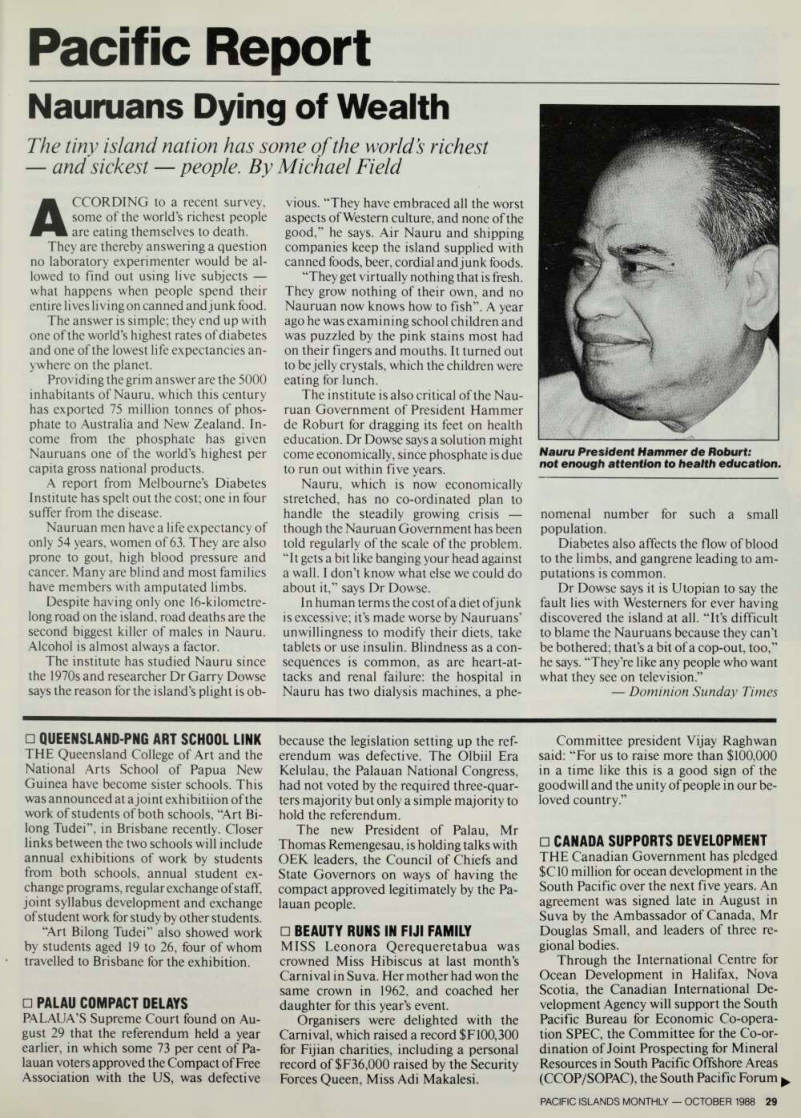
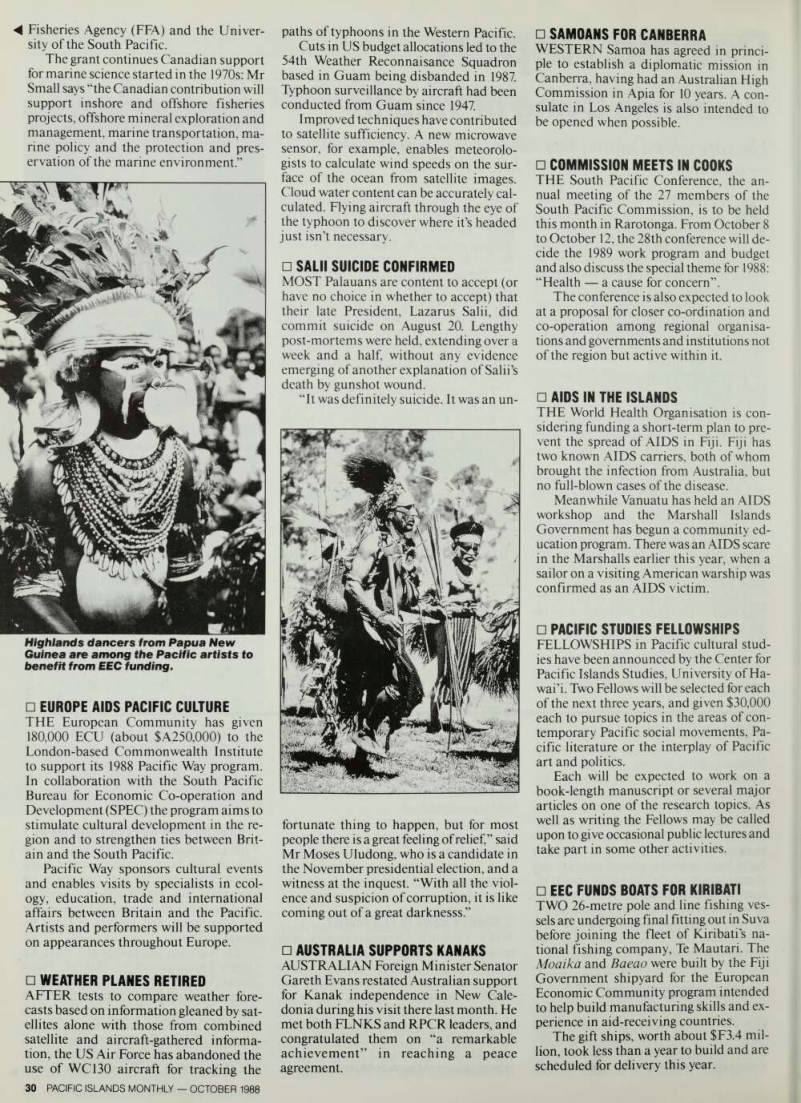
Highlands dancers from Papua New Guinea are among the Pacific artists to benefit from EEC funding.
□ Banaba Mining Prospect
A feasibility study has been agreed on by the Kiribati Government and a Mel bourne-based company, Roche Brothers Ltd, to look into the extraction of the 300,000 to 400,0000 tonnes of phosphate said to be remaining on Banaba, or Ocean Island as it was once named.
The British Phosphate Commissioners gave up mining there in 1979: however, in creased prices for fertiliser and improved mining techniques may make a resump tion worthwhile. Profits would be shared between the Kiribati Government and the company. The Banaban people would re ceive SA7 million a year from the project, and make up most of the workforce.
□ Luxury Cat For Png Cruises
ALL the amenities of a first-class hotel, plus contact with some areas of Papua New Guinea that would otherwise be impossi ble to explore, are offered by Melanesian Discovery Cruises aboard its new cata maran Melanesian Discoverer. The 37.5 metre vessel, built in Fremantle, Western Australia, will be used for a varied itiner ary of cruises from Madang. Each cruise will be flexible enough to take in notable events at points of call such as Siassi, the Trobriand Islands and Milne Bay.
The Melanesian Discover was de signed especially to cope with the open sea
and with conditions on the Sepik, which it will navigate extensively. A jetboat ca pable of carrying 40 passengers on expe ditions away from the main vessel is carried, together with two inflatable boats.
The vessel has 24 twin and double cabins, each with private bath, music sys
tern, television and direct dial interna tional telephone. It has an a la carte restaurant, mid-deck lounge and an ob servation lounge and cocktail bar on the wheelhouse deck, plus other features de signed for the comfort, education and en tertainment of passengers. □
Soon to set a new standard of islands cruising: the Melanesian Discoverer.