Bright Future For Agriculture
pp. 24-26 · Read in the full issue

The Region
New animals, plants and processes give Pacific farmers hope.
By Robin Bromby
WHEN it comes to economic de velopment, agriculture has never quite had the glamorous cachet of some other sectors. Developing new strains or exporting a crop does not carry with it the excitement of buying a new jet for the national airline, laying the foun dation stone for a luxury tourist hotel, or even declaring open a factory .. . paid for by aid funds.
Yet agriculture remains the basic eco nomic activity in the South Pacific, cru cial to the survival of the people of the region’s many small states. And, at last, it’s on the move. Papua New Guinea is pin ning much of its economic development hopes on increasing agricultural produc tion, a new breed of sheep which should provide island nations with a reliable sup ply of mutton is being developed in Fiji and the island nations are looking at bet ter ways to exploit that crop common to them all; the coconut.
Changing attitudes are helping. “Land is no longer a constraint,” says Dr Bob Thistlethwaite, an agricultural advisor with the Australian International Devel opment Assistance Bureau. “Island people are now coping with the land restrictions.”
There is also more attention being paid to quality control: “There’s been too much emphasis in the past on the technical as pects of agriculture and not enough on the marketing. Now these countries are pay
ing much more attention to quality con trol. If they are to compete in the Australian and New Zealand markets, quality is a must,” says Dr Thistlewaite.
This is not to say there aren’t many hurdles to overcome. A recent report com mented on the quality of exports from Tu valu, while another has drawn attention to the problem in Papua New Guinea of get ting landowners to take a long-term view of agriculture rather than quick, easy money attitudes. Both quality and for ward planning will be key elements in im proving Pacific agriculture.
As in so many other aspects of agricul tural production, the nations with the greatest potential are Papua New Guinea and Fiji. Both countries have, by South Pacific standards, large quantities of available land; both have also in recent years committed themselves to expanding this sector. But smaller nations have con siderable room for expansion Tonga, if it can improve the social status of work on the land, or the Solomon Islands, which has made slow progress in this sector.
The importance of agriculture is at tested by the number of people involved: in Tuvalu’s 1979 census, it was shown that every household in the country was en gaged in some form of agricultural ac tivity, with 87 per cent of all households outside Funafuti obtaining cash income from the sale of copra. At the other end of
the population scale, 85 per cent of Papua New Guinea’s population is still engaged in subsistence farming. The PNG Government is naturally placing heavy emphasis on rural development, both to raise living standards in rural areas and to stop the population drift to towns. The policy outlined in Parliament last year by then Minister of Agriculture and Live stock Gai Duwabane is essentially still the official stance. In a review of government activity to help farmers, Mr Duwabane noted changes that are either under way or planned: • The establishment of the Coffee Re search Institute and the Coconut Re search Institute. The former will test and breed appropriate rust-resistant and high yield varieties, and it is expected the proc ess of converting to new varieties will take five years. Similarly, the latter institute is working to introduce coconut varieties that resist pests and provide a higher yield. • Major palm oil projects have begun in West New Britain and Milne Bay; further large developments are due for New Ire land and Oro provinces. Exports have been increasing to India, the world’s largest consumer of palm oil. • The Government is funding a project designed to improve the marketing of vil lage grown produce, particularly from the Highlands, which will help reduce de pendence on imported food.
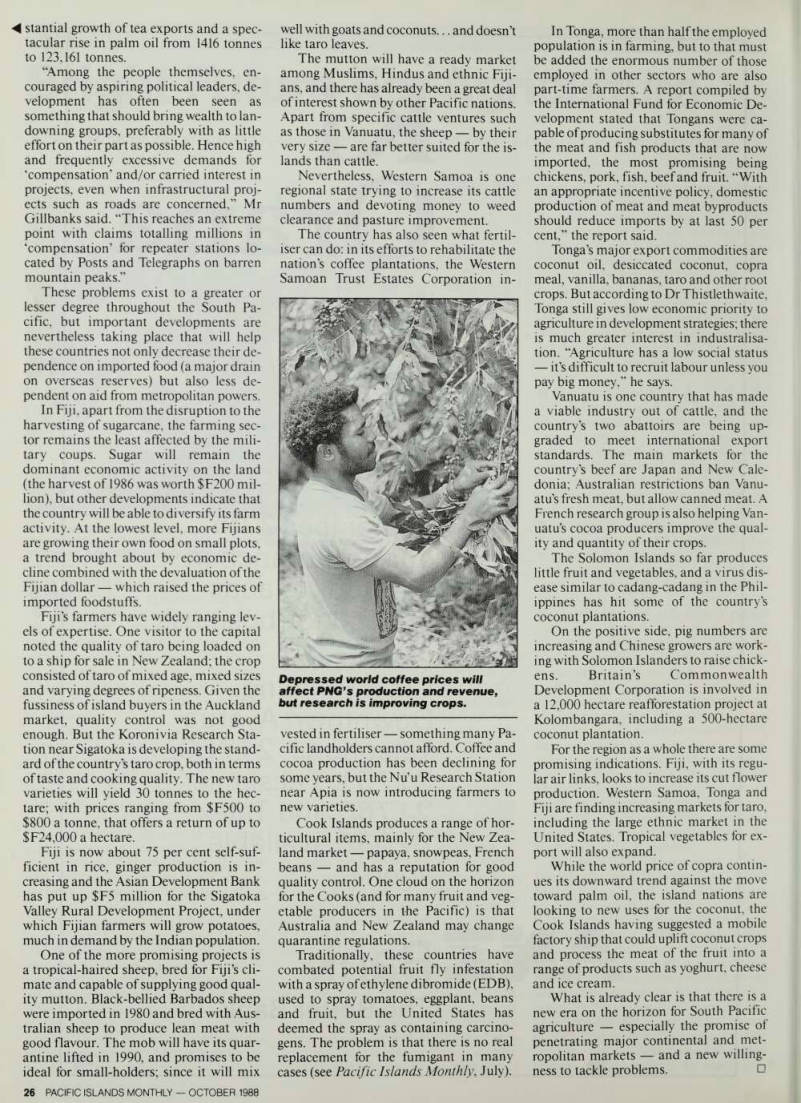
Port Moresby now protects growers against low commodity prices on the world market; copra, palm oil, coffee and cocoa are all affected by world prices and in 1986, for example, the government acted to pre vent the copra growers’ fund running out of money. Expectations for the rest of 1988 are for continuing depressed prices for cof fee: the need to stockpile around K 25 mil lion worth of coffee over 1988 is anticipated to will have a contractionary affect on the Highlands and Lae regions.
But for all the Government’s efforts, farm development in Papua New Guinea has not been all good news. In an address to a recent investment seminar in Can berra, Port Moresby businessman Roger Gillbanks of Kina Gillbanks and Co said the growth of the export cash crop sector in PNG (from which most rural people draw a proportion of their cash incomes) had been unspectacular. The country ex ported 36,769 tonnes of coffee in 1975, but had increased this to only 40,607 tonnes by 1985. Comparative figures for the same years showed a drop in cocoa and rubber exports, a slight increase for copra, sub-^
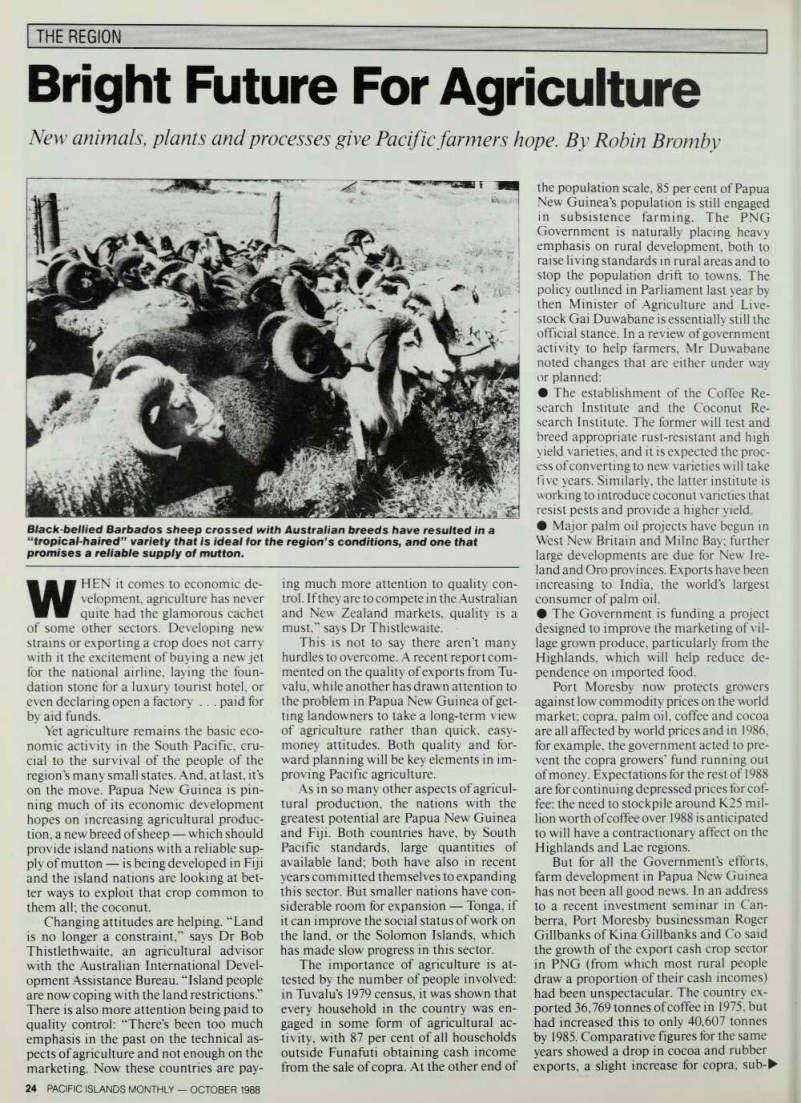
Black-bellied Barbados sheep crossed with Australian breeds have resulted in a “ tropical-haired” variety that is ideal for the region’s conditions, and one that promises a reliable supply of mutton.
◄ stantial growth of tea exports and a spec tacular rise in palm oil from 1416 tonnes to 123,161 tonnes.
“Among the people themselves, en couraged by aspiring political leaders, de velopment has often been seen as something that should bring wealth to lan downing groups, preferably with as little effort on their part as possible. Hence high and frequently excessive demands for ‘compensation’ and/or carried interest in projects, even when infrastructural proj ects such as roads are concerned,” Mr Gillbanks said. “This reaches an extreme point with claims totalling millions in ‘compensation’ for repeater stations lo cated by Posts and Telegraphs on barren mountain peaks.”
These problems exist to a greater or lesser degree throughout the South Pa cific, but important developments are nevertheless taking place that will help these countries not only decrease their de pendence on imported food (a major drain on overseas reserves) but also less de pendent on aid from metropolitan powers.
In Fiji, apart from the disruption to the harvesting of sugarcane, the farming sec tor remains the least affected by the mili tary coups. Sugar will remain the dominant economic activity on the land (the harvest of 1986 was worth SF2OO mil lion), but other developments indicate that the country will be able to diversify its farm activity. At the lowest level, more Fijians are growing their own food on small plots, a trend brought about by economic de cline combined with the devaluation of the Fijian dollar which raised the prices of imported foodstuffs.
Fiji’s farmers have widely ranging lev els of expertise. One visitor to the capital noted the quality of taro being loaded on to a ship for sale in New Zealand; the crop consisted of taro of mixed age, mixed sizes and varying degrees of ripeness. Given the fussiness of island buyers in the Auckland market, quality control was not good enough. But the Koronivia Research Sta tion near Sigatoka is developing the stand ard of the country’s taro crop, both in terms of taste and cooking quality. The new taro varieties will yield 30 tonnes to the hec tare; with prices ranging from SFSOO to $BOO a tonne, that offers a return of up to $F24,000 a hectare.
Fiji is now about 75 per cent self-suf ficient in rice, ginger production is in creasing and the Asian Development Bank has put up SFS million for the Sigatoka Valley Rural Development Project, under which Fijian farmers will grow potatoes, much in demand by the Indian population.
One of the more promising projects is a tropical-haired sheep, bred for Fiji’s cli mate and capable of supplying good qual ity mutton. Black-bellied Barbados sheep were imported in 1980 and bred with Aus tralian sheep to produce lean meat with good flavour. The mob will have its quar antine lifted in 1990, and promises to be ideal for small-holders; since it will mix
well with goats and coconuts... and doesn’t like taro leaves.
The mutton will have a ready market among Muslims, Hindus and ethnic Fiji ans, and there has already been a great deal of interest shown by other Pacific nations.
Apart from specific cattle ventures such as those in Vanuatu, the sheep by their very size are far better suited for the is lands than cattle.
Nevertheless, Western Samoa is one regional state trying to increase its cattle numbers and devoting money to weed clearance and pasture improvement.
The country has also seen what fertil iser can do: in its efforts to rehabilitate the nation’s coffee plantations, the Western Samoan Trust Estates Corporation in-
vested in fertiliser something many Pa cific landholders cannot afford. Coffee and cocoa production has been declining for some years, but the Nu’u Research Station near Apia is now introducing farmers to new varieties.
Cook Islands produces a range of hor ticultural items, mainly for the New Zea land market papaya, snowpeas, French beans and has a reputation for good quality control. One cloud on the horizon for the Cooks (and for many fruit and veg etable producers in the Pacific) is that Australia and New Zealand may change quarantine regulations.
Traditionally, these countries have combated potential fruit fly infestation with a spray of ethylene dibromide (EDB), used to spray tomatoes, eggplant, beans and fruit, but the United States has deemed the spray as containing carcino gens. The problem is that there is no real replacement for the fumigant in many cases (see Pacific Islands Monthly , July).
In Tonga, more than half the employed population is in farming, but to that must be added the enormous number of those employed in other sectors who are also part-time farmers. A report compiled by the International Fund for Economic De velopment stated that Tongans were ca pable of producing substitutes for many of the meat and fish products that are now imported, the most promising being chickens, pork, fish, beef and fruit. “With an appropriate incentive policy, domestic production of meat and meat byproducts should reduce imports by at last 50 per cent,” the report said.
Tonga’s major export commodities are coconut oil, desiccated coconut, copra meal, vanilla, bananas, taro and other root crops. But according to Dr Thistlethwaite, Tonga still gives low economic priority to agriculture in development strategies; there is much greater interest in industralisa tion. “Agriculture has a low social status it’s difficult to recruit labour unless you pay big money,” he says.
Vanuatu is one country that has made a viable industry out of cattle, and the country’s two abattoirs are being up graded to meet international export standards. The main markets for the country’s beef are Japan and New Cale donia; Australian restrictions ban Vanu atu’s fresh meat, but allow canned meat. A French research group is also helping Van uatu’s cocoa producers improve the qual ity and quantity of their crops.
The Solomon Islands so far produces little fruit and vegetables, and a virus dis ease similar to cadang-cadang in the Phil ippines has hit some of the country’s coconut plantations.
On the positive side, pig numbers are increasing and Chinese growers are work ing with Solomon Islanders to raise chick ens. Britain’s Commonwealth Development Corporation is involved in a 12,000 hectare reafforestation project at Kolombangara, including a 500-hectare coconut plantation.
For the region as a whole there are some promising indications. Fiji, with its regu lar air links, looks to increase its cut flower production. Western Samoa, Tonga and Fiji are finding increasing markets for taro, including the large ethnic market in the United States. Tropical vegetables for ex port will also expand.
While the world price of copra contin ues its downward trend against the move toward palm oil, the island nations are looking to new uses for the coconut, the Cook Islands having suggested a mobile factory ship that could uplift coconut crops and process the meat of the fruit into a range of products such as yoghurt, cheese and ice cream.
What is already clear is that there is a new era on the horizon for South Pacific agriculture especially the promise of penetrating major continental and met ropolitan markets and a new willing ness to tackle problems. □
Depressed world coffee prices will affect PNG’s production and revenue, but research is improving crops.