Arts... Or Politics?
pp. 20-23 · Read in the full issue
Austrlia
September’s Fifth Festival of Pacific Arts emerged as an uncomfortable compromise between tradition and realpolitik. By Leonie Hellmers
■ T could have been yet another ** I little blackfella festival the I beating of the drums, the shaking of the hips, the flowers in the hair. But the lids are being thrown off things now: Pa cific people have got to wake up!” said Shi reen Malamoo, co-ordinator for the Cultural Forum at last month’s Fifth Fes tival of Pacific Arts in Townsville, Queensland.
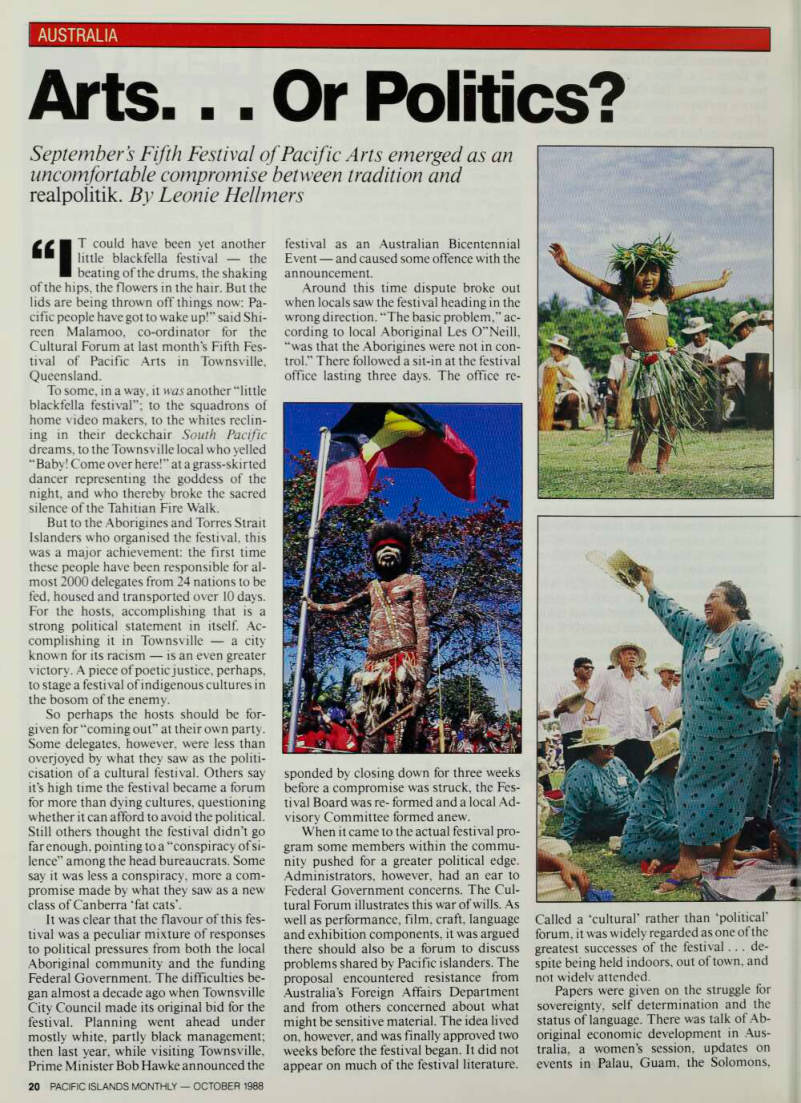
To some, in a way, it was another “little blackfella festival”; to the squadrons of home video makers, to the whites reclin ing in their deckchair South Pacific dreams, to the Townsville local who yelled “Baby! Come over here!” at a grass-skirted dancer representing the goddess of the night, and who thereby broke the sacred silence of the Tahitian Fire Walk.
But to the Aborigines and Torres Strait Islanders who organised the festival, this was a major achievement; the first time these people have been responsible for al most 2000 delegates from 24 nations to be fed. housed and transported over 10 days.
For the hosts, accomplishing that is a strong political statement in itself. Ac complishing it in Townsville a city known for its racism is an even greater victory. A piece of poetic justice, perhaps, to stage a festival of indigenous cultures in the bosom of the enemy.
So perhaps the hosts should be for given for “coming out” at their own party.
Some delegates, however, were less than overjoyed by what they saw as the politi cisation of a cultural festival. Others say it’s high time the festival became a forum for more than dying cultures, questioning whether it can afford to avoid the political.
Still others thought the festival didn’t go far enough, pointing to a “conspiracy of si lence” among the head bureaucrats. Some say it was less a conspiracy, more a com promise made by what they saw as a new class of Canberra Tat cats’.
It was clear that the flavour of this fes tival was a peculiar mixture of responses to political pressures from both the local Aboriginal community and the funding Federal Government. The difficulties be gan almost a decade ago when Townsville City Council made its original bid for the festival. Planning went ahead under mostly white, partly black management; then last year, while visiting Townsville, Prime Minister Bob Hawke announced the
festival as an Australian Bicentennial Event and caused some offence with the announcement.
Around this time dispute broke out when locals saw the festival heading in the wrong direction. “The basic problem,” ac cording to local Aboriginal Les CTNeill, “was that the Aborigines were not in con trol.” There followed a sit-in at the festival office lasting three days. The office re-
sponded by closing down for three weeks before a compromise was struck, the Fes tival Board was re- formed and a local Ad visory Committee formed anew.
When it came to the actual festival pro gram some members within the commu nity pushed for a greater political edge.
Administrators, however, had an ear to Federal Government concerns. The Cul tural Forum illustrates this war of wills. As well as performance, film, craft, language and exhibition components, it was argued there should also be a forum to discuss problems shared by Pacific islanders. The proposal encountered resistance from Australia’s Foreign Affairs Department and from others concerned about what might be sensitive material. The idea lived on, however, and was finally approved two weeks before the festival began. It did not appear on much of the festival literature.
Called a ‘cultural’ rather than ‘political’ forum, it was widely regarded as one of the greatest successes of the festival.. . de spite being held indoors, out of town, and not widely attended.
Papers were given on the struggle for sovereignty, self determination and the status of language. There was talk of Ab original economic development in Aus tralia, a women’s session, updates on events in Palau, Guam, the Solomons,
Aboriginal deaths in custody, terrorism and colonisation.
On the other hand it seems the Aus tralian Government, having put up the money, wanted less and less to do with the festival. One organiser spoke bitterly of the Government’s “patronising air about the Pacific.. .We had ministers and presi dents from the Pacific here. Hawke showed for the opening, but no [Australian] min isters, Federal or State, saw fit to grace the
proceedings.” Festival staffer Jean Wes terhout pointed out that “previous festi vals had the entire nation working behind them. But in Australia there are different orientations all through the country: in Perth, for example, they associate with the Atlantic peoples. There is no unity, and the festival was perceived as a fringe activity.”
It was certainly regarded as such by most of the Australian media.
One incident seemed to some observ ers symbolic of a “white Australian” atti tude to the entire festival. The Tahitian Fire Walk was a first outside Tahiti and a logistical triumph for all concerned, re quiring transport of sacred stones, plants and idols, strict “protocol” involving full audience co- operation, and extreme con centration from the High Priest, Ray mond Graffe. Graffe summoned the elements and controlled them. He not only
crossed the burning stone oven himself, but guided more than 200 of the audience across as well.
The crowd was filled with a sense of awe and wonder . . . then this incredible cere mony concluded with a fireman from the Queensland Fire Brigade lugging out a huge hose and quenching the rocks. Where Tahitians walk the fire, it seems, Queen slanders are there to put it out.
When it came to dialogue, many dele gates were unhappy with what they saw as attempts to politicise the festival. One representative claimed the organisation had used the festival to buy support.
“They’re asking Guam to voice support without knowing all the problems: the pol itics of the Bicentennial have got into the wheels of the Festival,” he said.
“We’ve all got problems in the Pacific, “but they’re not the aims and issues I see
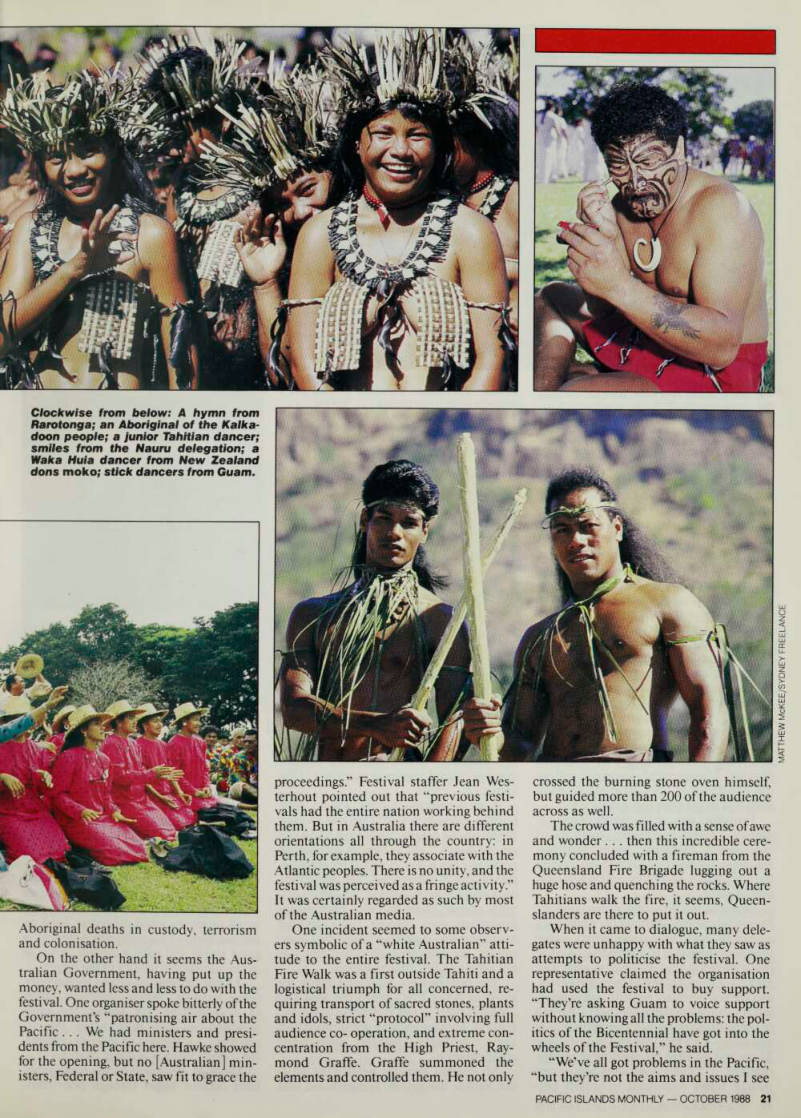
Clockwise from below: A hymn from Rarotonga; an Aboriginal of the Kalka doon people; a junior Tahitian dancer; smiles from the Nauru delegation; a Waka Huia dancer from New Zealand dons moko; stick dancers from Guam.
◄ being put to the fore here; it’s those of a in dividual country.”
Certainly the closing ceremony saw a mass of Aboriginal flags overwhelm all others. The red, black and yellow flags formed a tight circle as a didgeridoo sounded and the handover to the Cook Is landers, who are hosting the next Festival in 1992, took place. The formation broke only after other delegations began running the length of the field with their own flags aloft. The award for the clumsiest political message of the festival must, however, go to New Caledonia, whose delegation per formed (with no apparent enthusiasm) an obscure French opera while dressed in tri colour flag laplaps.
The stated aim of the festival was to “maximise cultural exchange between the Australian and Pacific participants” and to “increase the general public’s awareness and understanding of these indigenous cultures”; wonderful aims that were var iously obscured by the organisation of the festival. Accommodation was scattered far and wide, not centralised as originally planned. Management says many nations did not RSVP in time, or at all. So plan ning was made even more difficult.
Transport was, in the words of one or ganiser, “a real nightmare”, with all of Townsville’s available buses shuttling endlessly between accommodation and festival venues as well as continuing nor mal operations.
Seven of the 10 venues were open-air (beautiful one day, difficult the next), with August in Townsville considerably cooler than anywhere else in the Pacific. Add to this a program that in the first week saw each day’s events planned the night before, and the problems are not difficult to imag ine. As one delegation leader said, “We had to keep ourselves ready for performance at any time all together and out of town.
There was no time for meeting other del egations ...” The second week was better, though buses continued to collect per-
formers immediately they had finished a performance, denying them the chance of meeting other delegates or members of the audience.
A spokesperson for the Papua New Guinea delegation said, “We had to keep the lid on our people. We almost had a riot on our hands”; led to believe they would perform once a day, it was three days be fore they were summoned. “We weren’t the only people under-utilised,” the PNG del egate added. There had also been disap pointment over canoes. The festival organisers had suggested PNG bring some canoes; the delegate replied that this was not practical, but finally agreed.
Ten canoes were built and ready for shipping when PNG heard the idea had been scrapped —just four weeks before the festival. The canoes were not shipped, but their builders rightly demanded compensation.
Mr Perefoti Tamatai, head of the West ern Samoa delegation, sympathised that
“anything of this magnitude has to expect problems,” but expressed disenchant ment with a number of administrative foul-ups. Again the transport problem surfaced; doubling up with another group en route, the Western Samoans waited, barely clad, in the cold for two hours. A number of them caught flu.
“I expect better from an advanced country such as Australia,” said Mr Ta matai. Having led all four previous West ern Samoan festival delegations, he pointed out that transport had always been available. During this festival he re-
quested a bus for a sightseeing tour of Townsville. He was refused; the request was “outside the need of the festival”. The delegation hired its own bus. A request for food to demonstrate traditional cooking was also refused “too much bother for the bureaucrats,” he said.
Mr Tamatai’s problem was not being able to speak directly to administration.
“So-called liaison officers were used as a cushion between us and them. It was very frustrating.” There was a surprising total of 70 liaison officers, 28 protocol officers and 10 media liaison officers. One Maori delegate expressed his disgust loudly and publicly by comparing the Festival’s high profile security and abundance of Ab original flags with “a Nuremburg rally”.
The Western Samoa representative took pains to point out that these were small problems amid otherwise good re lations. Most of the problems were met in good spirit, and with a sincere desire to avoid similar difficulties in the future.
As one delegate observed sorrowfully, these festivals “repeat problems rather than consulting. It’s always the same downfall not fully using the re sources ... If there is an interim commit tee, I don’t think it is doing its duty.”
Sadly, in Townsville’s case small prob lems became larger through poor com
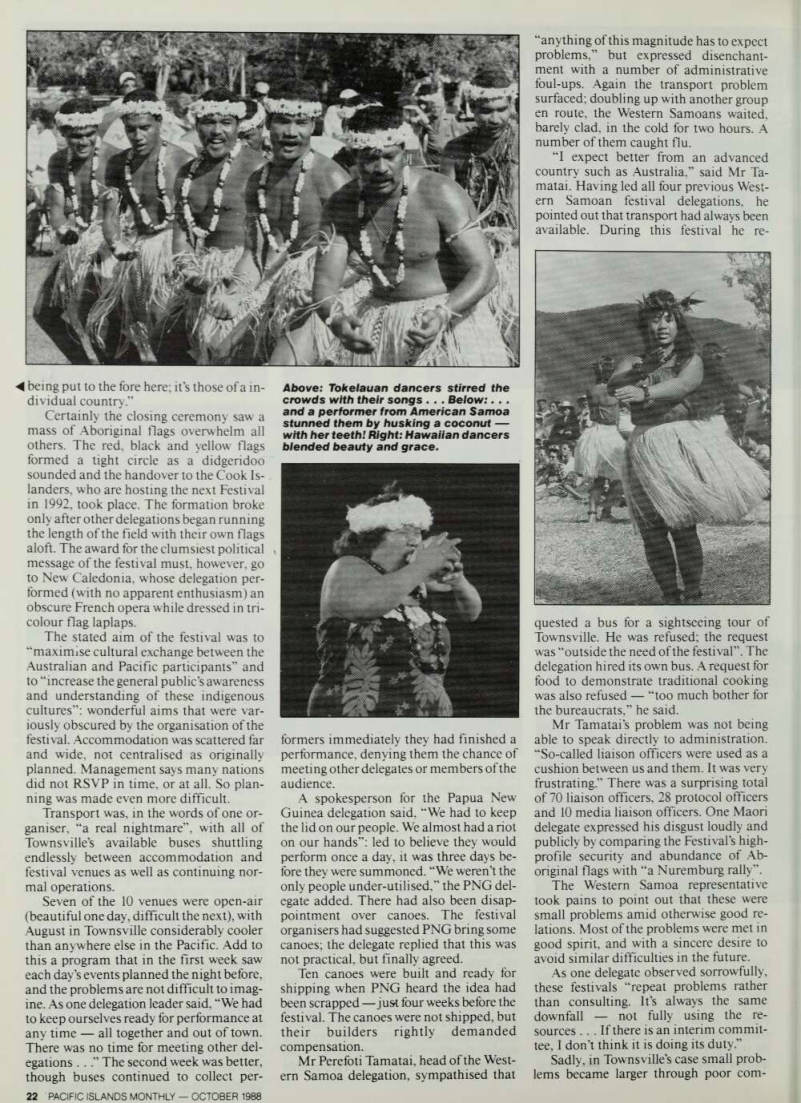
Above: Tokelauan dancers stirred the crowds with their songs... Below:... and a performer from American Samoa stunned them by husking a coconut with her teeth! Right: Hawaiian dancers blended beauty and grace.
munication. Local media and the festival body were not the greatest of partners; Townsville’s major radio stations showed more interest in royal babies and govern ment squabbles in Canberra than in any thing local. The Townsville Bulletin (notorious for printing in the same issue four different starting times for the same Australia Day event) did its best, too; not one festival advertisement was run cor rectly, and the opening details were left out altogether. Criticisms, however, miracu lously appeared immediately.
Neither was advance publicity gener ated by the Festival of the best: interna tional and interstate media, especially those who arrived for the second week only to find a few days left, were disgruntled to find festival dates had been changed.
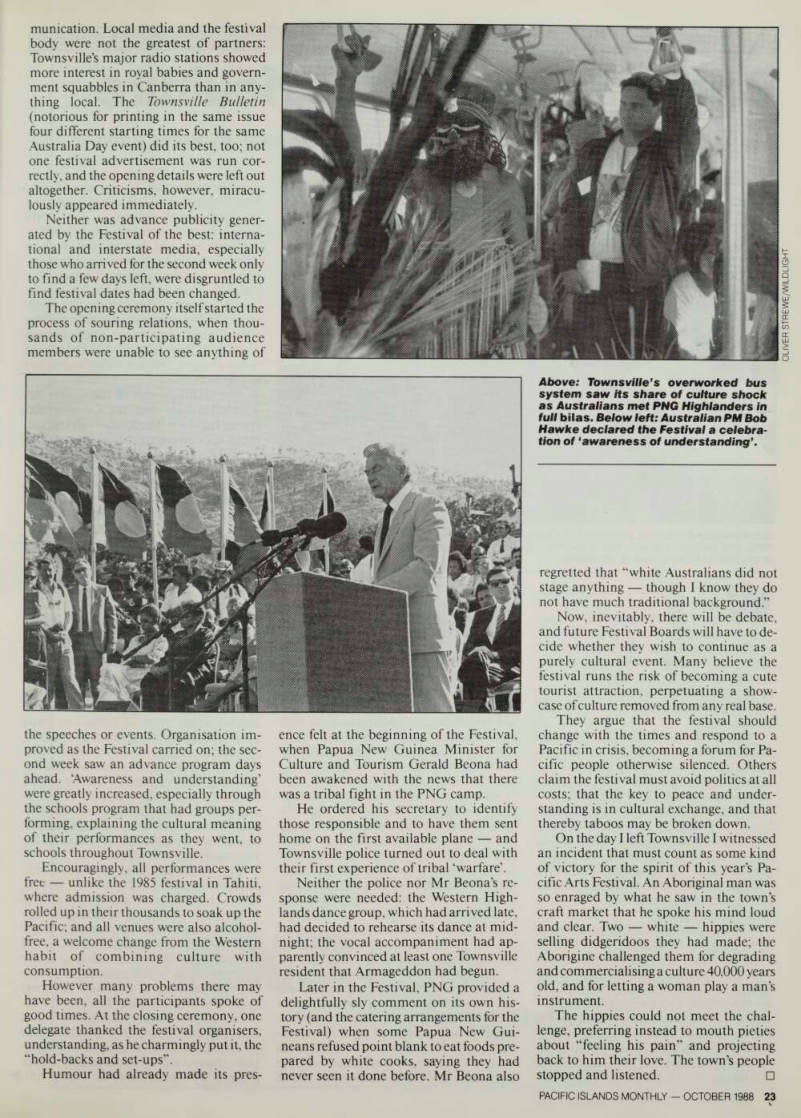
The opening ceremony itself started the process of souring relations, when thou sands of non-participating audience members were unable to see anything of
the speeches or events. Organisation im proved as the Festival carried on; the sec ond week saw an advance program days ahead. ‘Awareness and understanding’ were greatly increased, especially through the schools program that had groups per forming, explaining the cultural meaning of their performances as they went, to schools throughout Townsville.
Encouragingly, all performances were free unlike the 1985 festival in Tahiti, where admission was charged. Crowds rolled up in their thousands to soak up the Pacific; and all venues were also alcohol free, a welcome change from the Western habit of combining culture with consumption.
However many problems there may have been, all the participants spoke of good times. At the closing ceremony, one delegate thanked the festival organisers, understanding, as he charmingly put it, the “hold-backs and set-ups”.
Humour had already made its pres
ence felt at the beginning of the Festival, when Papua New Guinea Minister for Culture and Tourism Gerald Beona had been awakened with the news that there was a tribal fight in the PNG camp.
He ordered his secretary to identify those responsible and to have them sent home on the first available plane and Townsville police turned out to deal with their first experience of tribal ‘warfare’.
Neither the police nor Mr Beona’s re sponse were needed: the Western High lands dance group, which had arrived late, had decided to rehearse its dance at mid night; the vocal accompaniment had ap parently convinced at least one Townsville resident that Armageddon had begun.
Later in the Festival, PNG provided a delightfully sly comment on its own his tory (and the catering arrangements for the Festival) when some Papua New Gui neans refused point blank to eat foods pre pared by white cooks, saying they had never seen it done before. Mr Beona also
regretted that “white Australians did not stage anything though I know they do not have much traditional background.”
Now, inevitably, there will be debate, and future Festival Boards will have to de cide whether they wish to continue as a purely cultural event. Many believe the festival runs the risk of becoming a cute tourist attraction, perpetuating a show case of culture removed from any real base.
They argue that the festival should change with the times and respond to a Pacific in crisis, becoming a forum for Pa cific people otherwise silenced. Others claim the festival must avoid politics at all costs; that the key to peace and under standing is in cultural exchange, and that thereby taboos may be broken down.
On the day I left Townsville I witnessed an incident that must count as some kind of victory for the spirit of this year’s Pa cific Arts Festival. An Aboriginal man was so enraged by what he saw in the town’s craft market that he spoke his mind loud and clear. Two white hippies were selling didgeridoos they had made; the Aborigine challenged them for degrading and commercialising a culture 40,000 years old, and for letting a woman play a man’s instrument.
The hippies could not meet the chal lenge, preferring instead to mouth pieties about “feeling his pain” and projecting back to him their love. The town’s people stopped and listened. □
Above: Townsville’s overworked bus system saw Us share of culture shock as Australians met PNG Highlanders in full bilas. Below left: Australian PM Bob Hawke declared the Festival a celebra tion of ‘awareness of understanding’.