Japan
pp. 25-26 · Read in the full issue
A special report from Alan Goodall in Tokyo on how the new spirit of internationalism is propelling Japan now the worlds richest nation south to the islands.
TEN or twenty at a time they step off the plane, all smiles and bows, cameras around their necks and travellers’ cheques bulging from pockets.
In an orderly queue they pile aboard the tourist bus, chatting gaily among them selves. At the best resort hotel on the is land they form a protective circle in the lobby while their tour guide the only real English speaker among them handles the check-in formalities.
Within half an hour they are back from their rooms, standing in line for the bus to take them on a pre-packaged, chaperoned, completely cocooned look at their Pacific holiday destination. All three days of it.
A few days later the Japanese tourists fly out, happily loaded with souvenirs and lightened of many yen, though less well in formed about the country than if one of the “locals” had taken charge.
Nothing is about to change except the change those holiday makers are bringing to the investment climate. The Japanese are determined to become inter nationally minded, and within a few years 10 million a year will be travelling abroad: already earning the highest incomes in the world, they are spending more of it on travel... and they expect the best.
The Pacific will continue to be their fa vourite destination, led by Hawaii and fol lowed by Australia. New Zealand is rapidly gaining favour, then Tahiti, Fiji and New Caledonia; as they shed old inhibitions more Japanese are stopping off at other is lands, but don’t expect them to break the group habit and immerse themselves, however briefly, in your culture.
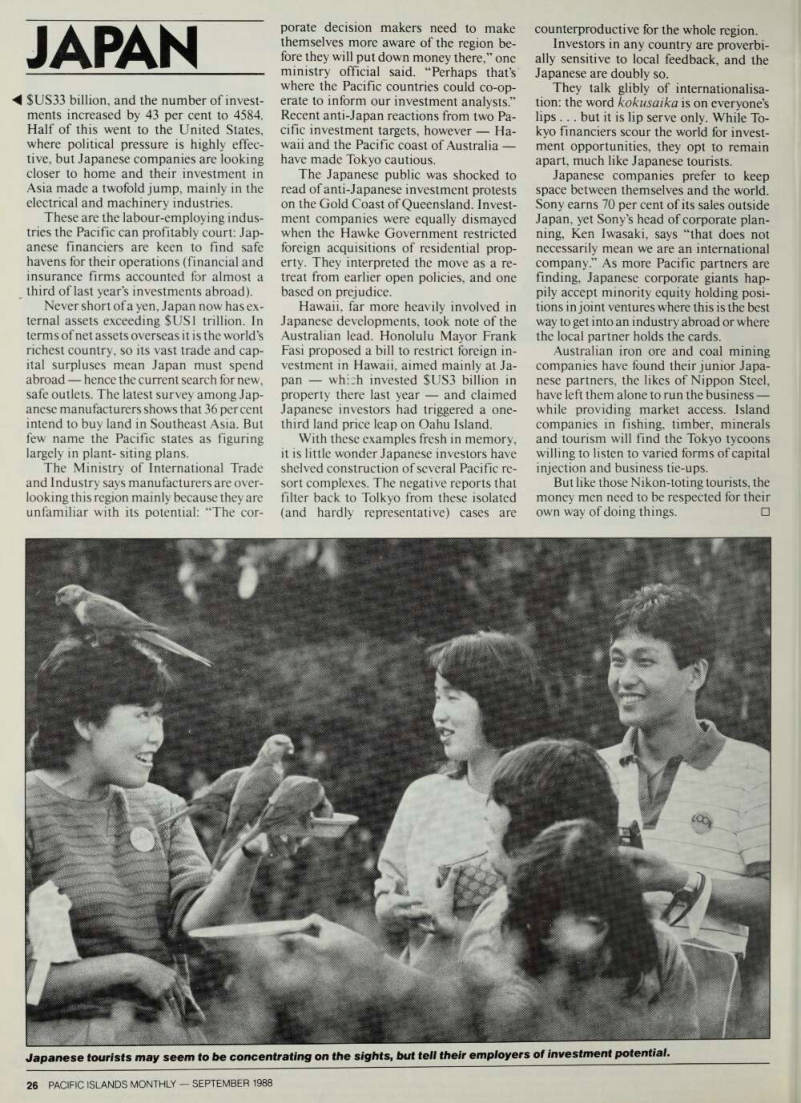
Expecially do not underestimate the Japanese tourist. He may seem to be wear ing blinkers as well as dark glasses, but he is absorbing more than the sunshine. He is the vanguard of investment.
Japanese tourism developers such as Tokyu, Seibu, Keio and Fujita are opening up more and more resorts because the first
few breakaway Japanese travellers to visit the “new” Pacific countries returned sing ing the praises of the natural attractions.
The big Tokyo hoteliers will, in line with the pattern they set in Hawaii, be followed by Japanese service industries.
Shimizu and Kumagai Gumi and other Japanese construction companies build the resorts, then turn to roads, airports and ports. They respond not only to local calls but also to reports of potential earning
‘The Japanese yen and Japanese production costs are becoming too high for their own good”
from numbers of Japanese travellers.
Toyota, Nissan, Honda, Daihatsu and other auto makers are looking to extend their highly competitive business on every road. National, Sony, Sharp and the other mass producers of consumer electronics not only want to sell more abroad; they also need new production bases where costs are lower than in Japan.
The same goes for the more advanced electronics, computer and telecommuni cations equipment makers such as NEC and Fujitsu: they need offshore producers as well as consumers.
Service industry companies follow the flag. Department stores such as Daimaru, Isetan and Yoahan and supermarkets such as Jusco and Daiei have already spread to Southeast Asia and, their opportunities at home limited, are looking to bring Japa
nese retailing techniques to the Pacific.
Toshiba, Mitsubishi Electric and NEC have also brought significant employment and technology training opportunities to people in Southeast Asia: again, part of the look-abroad fever sweeping Japan and again. Pacific peoples can gain as plant operatives as well as consumers.
Japanese manufacturers follow the tracks of Japanese tourists, setting up off shore production plants at an unprece dented pace, for one simple reason. The Japanese yen and Japanese production costs are becoming too high for their own good. Japan lives by exporting and it’s no use trying to export if the cars and TV sets are too expensive for the world to buy.
On top of that, the US and the Euro pean Community have imposed barriers to protect their own industries, forcing Japanese companies to locate there to dodge import tariffs. At the same time, South Korea and Taiwan are grabbing world markets with their cheaper textiles, cars and electronic goods.
The Japanese are thus being forced to become true internationalists, and must learn to accommodate themselves to pro ducing goods within the markets they want to reach. In the case of the Pacific, Tokyo’s response to this real dilemma can be most beneficial in the economy-building of countries offering stability and personnel.
Japanese tourists are already bringing back glowing reports of life in Pacific countries.
Company loyalists, they are telling their senior executives of the pools of educated labour ready to be trained in machine as sembly, of regular shipping and air serv ices linking Pacific Rim markets.
Japanese consensus-making is slow but effective: when Tokyo decides to move into Pacific manufacturing and service indus tries, it will do the job well.
Direct overseas investment by Japa nese corporations in the business year to March soared 50 per cent to a record ►
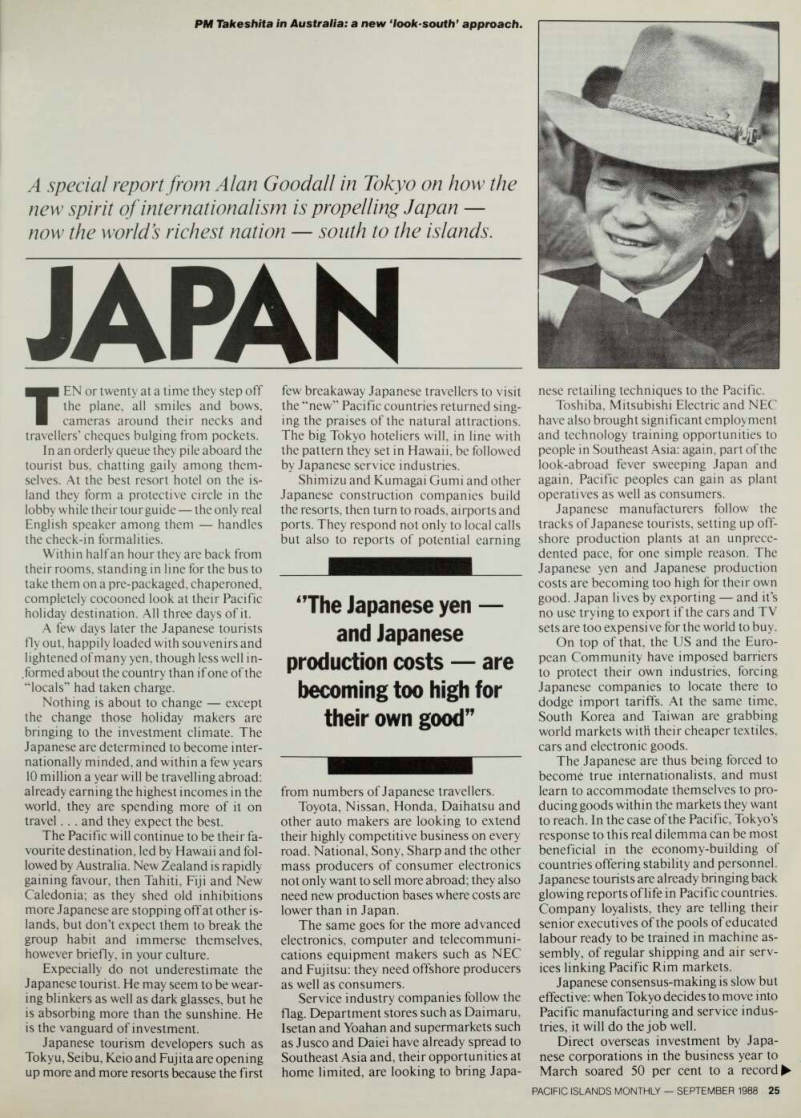
PM Takeshita in Australia: a new ‘look-south’ approach.
M SUS 33 billion, and the number of invest ments increased by 43 per cent to 4584.
Half of this went to the United States, where political pressure is highly effec tive, but Japanese companies are looking closer to home and their investment in Asia made a twofold jump, mainly in the electrical and machinery industries.
These are the labour-employing indus tries the Pacific can profitably court: Jap anese financiers are keen to find safe havens for their operations (financial and insurance firms accounted for almost a third of last year’s investments abroad).
Never short of a yen, Japan now has ex ternal assets exceeding SUSI trillion. In terms of net assets overseas it is the world’s richest country, so its vast trade and cap ital surpluses mean Japan must spend abroad hence the current search for new, safe outlets. The latest survey among Jap anese manufacturers shows that 36 percent intend to buy land in Southeast Asia. But few name the Pacific states as figuring largely in plant- siting plans.
The Ministry of International Trade and Industry says manufacturers are over looking this region mainly because they are unfamiliar with its potential: “The cor
porate decision makers need to make themselves more aware of the region be fore they will put down money there,” one ministry official said. “Perhaps that’s where the Pacific countries could co-op erate to inform our investment analysts.”
Recent anti-Japan reactions from two Pa cific investment targets, however Ha waii and the Pacific coast of Australia have made Tokyo cautious.
The Japanese public was shocked to read of anti-Japanese investment protests on the Gold Coast of Queensland. Invest ment companies were equally dismayed when the Hawke Government restricted foreign acquisitions of residential prop erty. They interpreted the move as a re treat from earlier open policies, and one based on prejudice.
Hawaii, far more heavily involved in Japanese developments, took note of the Australian lead. Honolulu Mayor Frank Fasi proposed a bill to restrict foreign in vestment in Hawaii, aimed mainly at Ja pan wh::h invested SUS 3 billion in property there last year and claimed Japanese investors had triggered a one third land price leap on Oahu Island.
With these examples fresh in memory, it is little wonder Japanese investors have shelved construction of several Pacific re sort complexes. The negative reports that filter back to Tolkyo from these isolated (and hardly representative) cases are
counterproductive for the whole region.
Investors in any country are proverbi ally sensitive to local feedback, and the Japanese are doubly so.
They talk glibly of internationalisa tion; the word kokusaika is on everyone’s lips . . . but it is lip serve only. While To kyo financiers scour the world for invest ment opportunities, they opt to remain apart, much like Japanese tourists.
Japanese companies prefer to keep space between themselves and the world.
Sony earns 70 per cent of its sales outside Japan, yet Sony’s head of corporate plan ning, Ken Iwasaki, says “that does not necessarily mean we are an international company.” As more Pacific partners are finding, Japanese corporate giants hap pily accept minority equity holding posi tions in joint ventures where this is the best way to get into an industry abroad or where the local partner holds the cards.
Australian iron ore and coal mining companies have found their junior Japa nese partners, the likes of Nippon Steel, have left them alone to run the business while providing market access. Island companies in fishing, timber, minerals and tourism will find the Tokyo tycoons willing to listen to varied forms of capital injection and business tie-ups.
But like those Nikon-toting tourists, the money men need to be respected for their own way of doing things. □
Japanese tourists may seem to be concentrating on the sights, but tell their employers of investment potential.