Aid For The “Home Town”
pp. 28-29 · Read in the full issue
Japan learns to start talking to its regional neighbours.
PAST follies haunt Tokyo as it pre pares to become the largest aid do nor to the Pacific and the most active cultural-political influence there in the foreseeable future.
Lost good intentions still* linger: a Ja pan-gifted fishing boat moored in a Tu valu lagoon, the local fishermen too poor to fuel it; a refrigeration plant standing empty in Truk awaiting repairs from Jap anese technicians. But Tokyo is deter mined its new aid program for Micronesia, Melanesia and Polynesia will succeed on a region-planned and project co-ordi nated basis .. . though any success for is land recipients remains subject to Japan’s global ambivalence in asserting politically its financial might.
Japan is definitely coming, bearing gifts and careful to avoid past mistakes, but with deliberate urgency to fill what it sees as a dangerous Great Powers vacuum. The look-south strategy is being delayed, how ever, by Government inexperience in dealing with the diverse islands and by ri valry among Tokyo bureaucrats. A new report has called on Prime Minister No buro Takeshita to smarten wasted aid funding with a dynamic program aimed at shoring up Pacific political stability. “The island states have been in turmoil due to political instability, growing nationalism and external intervention,” the report claims. “The resumption of peace and or der is urgently desired. Japan must re spond to Pacific island nations’ expectations on a broader scale.”
The report, unwrapped by Tokyo Uni versity international relations professor Akio Watanabe, has been taken up by the chief adviser to the Foreign Affairs Min istry, Dr Saburo Okita. Dr Okita, retired as foreign minister, is Tokyo’s diplomatic troubleshooter and an expert on relations with the South Pacific.
Behind the scenes he is reshaping Ja pan’s post-World War II policy of benign neglect of the South Pacific. He will use the Watanabe Report to augment a global strategy Tokyo is drawing up for aid to 1992: the wider plan calls for a five-year transition in which Japan asserts itself with regard to growing trade protectionism and swelling debts among poor nations.
In the Pacific, the first area to feel the new change will be the closest, Microne sia, where Japanese-descended islanders live in what was once a Japanese colony.
Papua New Guinea and other nations with potential in natural resources, notably oil. are also on the short list.
Tokyo’s leave-well-enough-alone atti tude of the past was in part due to preoc cupation with immediate strategic
concerns in the Korean Peninsula, China and the Soviet Union, partly to the Japa nese attitude to World War II (the “Pacific War”), and partly to the islands having few of the resources on which the Japanese economic miracle feeds. Now young, globally minded Japanese are saying it’s time to start talking to the neighbours.
Most Japanese hold a perception of contented islanders living blissfully in a tropical paradise: a view reinforced by planeloads of Japanese tourists island hopping to the luxury resort hotels of Guam and Tahiti with a quick once-over
of Fiji to round off a six day vacation.
The official view is little more percep tive, as witness recent attempts at gener osity. Japan gave an SA2 million refrigeration plant to Truk to upgrade its fishing industry to export status: the fridge broke down and nobody could fix it.
Tuvalu got a Japanese fishing launch, but could not afford to fuel it. When last heard of, it was tied up at a jetty.
Contrast this as a chastened Tokyo Government is now doing with what Tuvalu itself wants: a Trust Fund suffi cient, on an interest yield of 10 per cent, to finance half its budget. Japan kicked in $A500,000 last October.
Tokyo is having to rethink both the size and effect of the 1.4 per cent of its official development aid given to Oceania. The change stems only remotely from reports of Japan-made and installed radio sta tions standing silent: the rethink is being forced by the realisation that the Pacific is
no longer a sleepy lagoon. Fishing treaties negotiated by the Soviet Union, a coup in Fiji, separatist activity in New Caledonia and point-scoring over a South Pacific nu clear-free zone have galvanised official thinking. The Fiji coup was the final push: the Watanabe Report talks of “native re sistance to the Anglo-Saxon democratic establishment” and cites US and Aus tralian failure to settle the Fiji dispute as proof of “a loss of political influence over former colonies.”
“What happened in Algeria and Indo china is about to happen again in New Ca ledonia,” it warns. “This will possibly involve French Polynesia, including Tahiti.
“The US handling of Kiribati fishing rights demonstrated America’s lack of diplomatic attention in the South Pacific.”
What the report’s authors find notable about Soviet Union manoeuvres is the wedge the Russians appear to have driven between the US, Australia and New Zea land. The USSR has intimated the issue of US surveillance stations at Pine Gap and Northwest Cape in Australia and “US- Australian military manoeuvres” should be included on the agenda of US-Soviet disarmament talks, they report.
The New Zealand-US standoff on nu clear vessel port visits “caused a split in the ANZUS pact and a diplomatic wind fall for the Soviet Union”. The Soviets have scored further diplomatic points by claims of support for the anti-nuclear stance of Pacific island nations.
Libyan aid to the New Caledonian in dependence movement “to get back at France for the lost civil war in Chad” also worries the report compilers, who warn also of pro-Libyan groups operating in Vanuatu. “Japan can no longer pretend not to see its neighbours’ difficulties,” Profes sor Watanabe concludes. “These nations expect more from Japan than other de veloped nations in asserting independ ence from former rulers.”
Not since World War II ended the dream of a Greater East Asia Co-Prosper ity Sphere has Japan become as attentive to its southern neighbours: “The Asia- Pa cific region is the home town where Japan lives,” sighs the Watanabe Report, bor rowing PM Takeshita’s election slogan ‘home town rebuilding’. The home town, however, is about to see the return of a lot of former inhabitants.
The Kuranari Doctrine expounded by then Foreign Minister Kuranari on his South Pacific swoop in January 1987 sig nalled the change of heart. Australian PM Bob Hawke told Mr Takeshita in Tokyo later that year that Australia would wel come a greater Japanese presence in the
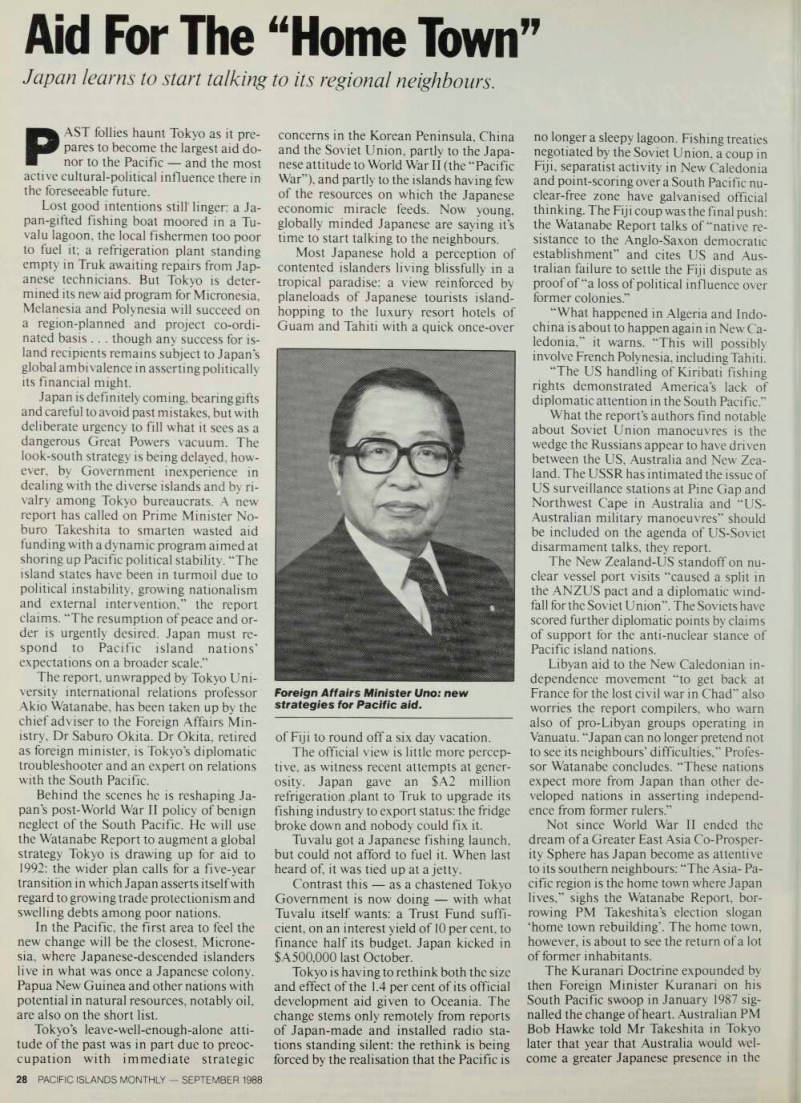
Foreign Affairs Minister Uno: new strategies for Pacific aid.
region. Successive US Administrations have stressed Japan’s counterbalance to the Soviet push into the Pacific.
But what the new Pacific countries want, say the Tokyo policymakers, “is not the same as they expect from Western na tions, including former colonial rulers.”
Tokyo has hardly been renowned abroad for its largesse to date. Japan could, as the world’s largest supplier of invest ment capital, easily be the biggest ben efactor of needy countries. It isn’t, though it will become the largest ODA (official development assistance) donor this year.
Given the economic decline of the US and the rocketing appreciation of the yen, this is not surprising. Actually, the share of Japan’s grants to developing countries (47 per cent) and the grant element (74 per cent) are among the lowest of all donor countries, both well below the averages of 81 and 91 per cent.
Add total official aid and private out flows, and Japan jumps to first among the lender/donors SUSII billion in 1985, the latest year for comparisons. Yet much pri vate and some public financing is tied to trade, and international critics sneer at gifts that return dividends to the Japanese car and electronics makers. Even the foreign ministry’s latest ODA annual report re peats world doubts on whether Japan’s aid really helps. These doubts heightened after reports of huge kickbacks from Japanese traders to the Marcos regime before it was ousted from the Philippines.
Two thirds of Tokyo aid goes to Asia; and half of that to Southeast Asia, where trade prospects look strongest. Long-ne glected Oceania has recently been getting boosts, however, and the flow doubled in 1986 to SASS million. Fiji got the largest slice sB million followed by Papua New Guinea, Western Samoa, Kiribati, the Solomons, Tuvalu and Vanuatu.
But the Watanabe Report questions the efficacy of this aid, given piecemeal at the recipients’ requests and often to build up local projects such as fishing industries. It
insists on a regional, long-term approach: one avenue would be to expand the proven developer, the Asian Development Bank, into an Asia-Pacific Development Bank.
With the Pacific covering a third of the earth’s surface, the change-makers de plore a “hole in the communications net work” and call for transport and telecommunications links through the is lands to Asia. “The solution is to promote multilateral assistance to the whole region rather than bilateral aid between an island and an advanced nation as a joint project” with other donor countries.
Australia and New Zealand’s system of quotas on aid spent under the eye of lo cally stationed diplomats appeals greatly to the Watanabe reformers, because To kyo’s gifts are attenuated by the conflict ing self-interests of ministries.
The ministries of finance and foreign affairs thrash out the budget for nine tenths
of official aid but the bureaucrats of an other 13 ministries insist on having their say, too. “We must make Japanese offi cials understand the conditions of the South Pacific,” says one of the report com pilers, Dr Izumi Kobayashi. Director of the Institute of Pacific Studies at Gunma University, Dr Kobayashi adds: “And we must prepare against under-utilisation of funds among recipient countries by get ting more involved there.”
When Japan decides to play catch-up, it plays hard. Nobody need underestimate the apparent new determination to in volve itself in South Pacific affairs.
How soon will the Rising Sun again wave over palm-fringed beaches? Right now, Tokyo’s foreign aid policymakers are more preoccupied with getting better headlines overseas as anti-apartheid stalwarts. Sud denly finding itself South Africa’s largest trade partner, Tokyo is bending over back wards to donate to roads and bridges in southern African countries bordering the home of apartheid.
Yet there is no doubt that much advice given by the sweeping Watanabe Report will set a commendable pace for the poli cymakers. The US has urged Japan to shoulder more of the regional defence bur den, and Washington reads no threat in the Kuranari Doctrine. Canberra and Wel lington have also signalled approval.
To its near north within eyesight, in fact Japan confronts the Soviet Union and all the military vigilance that entails.
To the near west stands the armed-to-the teeth Korean Peninsula, and beyond that China. Little wonder, then, that Tokyo, having rediscovered to the south an as-yet relatively peaceful zone, should decide its wealth can be put to advantage here. □
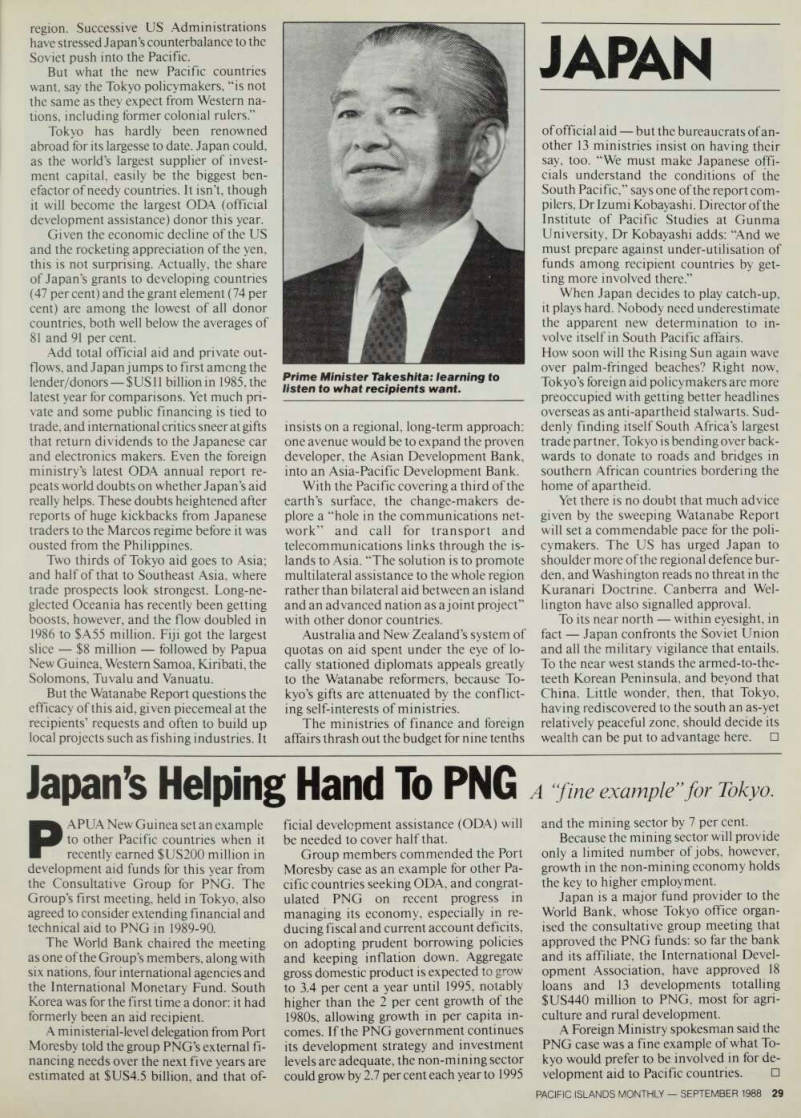
Prime Minister Takeshita: learning to listen to what recipients want.