Oceania’s Canoes Honoured
pp. 22-23 · Read in the full issue
Hawaii
A new museum pays tribute to the Pacific’s most famous vessels.
By Rodney Smith
HONOLULU is joining the growing number of Pacific maritime centres that are redeveloping their waterfronts, but the crowning jewel of Honolulu Harbour’s rebirth will be the Pacific Canoe Museum, the first facility of its kind in the world.
Its setting on the shores of the historic, bustling Honolulu Harbour will distin guish the museum and the Hawaii Mari time Centre from purely recreational waterfront developments in the United States, which tend to be too far removed from working harbours to do more than simulate activity.
In contrast, the Hawaii Maritime Centre will offer visitors opportunities to see, hear, and feel a busy port going about its everyday affairs as they learn about the history of Hawaii. The Canoe Museum is scheduled to open this month at the Mar itime Centre’s Pier 7 facility, and will fea ture models and full- sized canoes both replicas and originals, from museum and private collections around the world that represent the traditional canoe-build ing skills of indigenous Pacific cultures from Australia and Asia to the furthest reaches of Melanesia, Polynesia and Mi cronesia. As well as exhibits covering dif ferent canoe types there will be displays of canoe-building tools and materials; hull, sail and paddle design; fishing; traditional weather forecasting; non-instrument nav igation; religious ceremonies attendant on canoe-building, launching and use; weap ons; canoeing skills; and canoe-related items such as clothing and voyaging foods.
The Maritime Centre is also collecting books, materials, documents and photo graphs of island canoes and canoe-related matters. On completion, the library and archival collection will constitute the first centralised resource for both casual and serious research into canoe-related mari time technology.
The canoe has always been the nucleus of culture in the South Pacific; “It is the most important artifact in Pacific island cultures. The canoe provided the vehicle for the greatest human dispersal of all time, and so revered were canoes that in some cultures, such as the Maori of New Zea land, people traced their lineage to the canoe in which their ancestors arrived,” according to a spokesman for the Centre.
One of the oldest water craft known to man has left an uncommon legacy across the Pacific, settling every habitable island in Oceania centuries before Western man ventured out of sight of land. It is to this
uncommon heritage that the Hawaii Maritime Centre Canoe Museum is dedicated, The voyaging canoe is the embodiment of a people and culture whose origin and survival were tied to a delicate balance between a capricious sea and the finite resources of island sanctuaries. An ingenious concoction of wood, sap, fibre and leaves. perfected by centuries of life and death interaction with an unforgiving sea, the voyaging canoe stands as a supreme testament to the Pacific islanders’ resourcefulness and spirit, to their singular harmony with the environment.
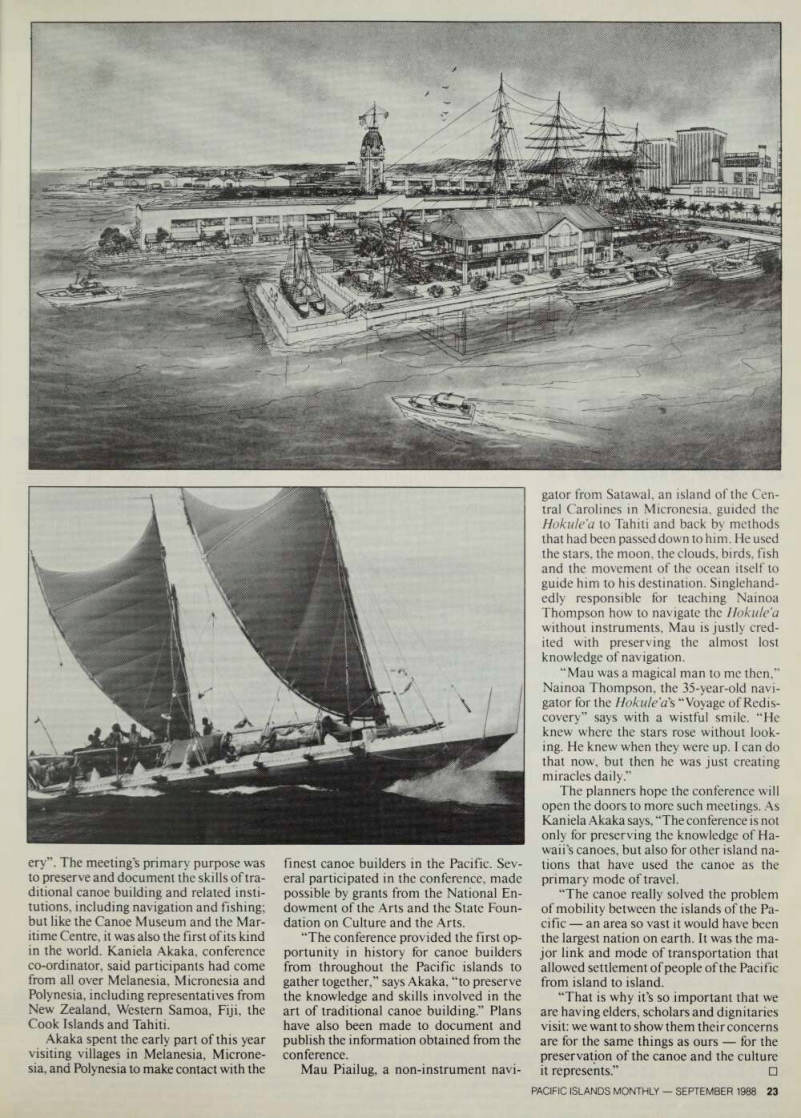
The Hokule’a is one of the dominant cultyre symbols of modern Oceania; a world-famous performance-accurate replica of an ancient double-hulled Polynesian voyaging canoe that will take pride of place in the museum’s waterborne fleet.
When not on expedition or in use as a “floating classroom”, Hokule’a will be moored at Pier 7 adjacent to the Museum which itself will be housed in Kalakaua Boat House, named in honour of a club owned and operated by King David Kalakaua last century. The building will have extensive exhibit areas and a three-storey lobby patterned after the skylighted courtyards of old Honolulu.
Inside will be almost 35 exhibits show-
ing the ocean’s role in Hawaiian life, in cluding displays of passenger ships, European explorers, the naval history of Hawaii, whaling, seaplanes, immigrants, surfing, windsurfing, non-instrument navigation and ocean life such as sharks, whales and turtles.
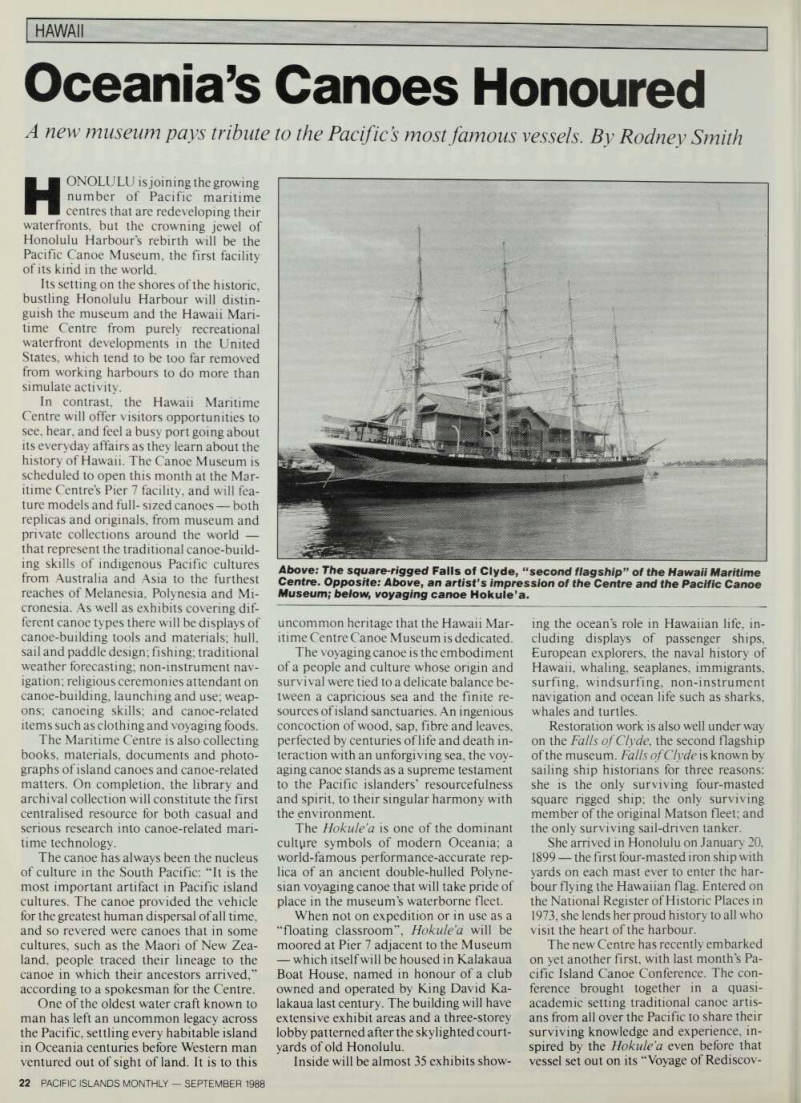
Restoration work is also well under way on the Falls of Clyde , the second flagship of the museum. Falls of Clyde is known by sailing ship historians for three reasons: she is the only surviving four-masted square rigged ship; the only surviving member of the original Matson fleet; and the only surviving sail-driven tanker.
She arrived in Honolulu on January 20, 1899 the first four-masted iron ship with yards on each mast ever to enter the har bour flying the Hawaiian flag. Entered on the National Register of Historic Places in 1973, she lends her proud history to all who visit the heart of the harbour.
The new Centre has recently embarked on yet another first, with last month’s Pa cific Island Canoe Conference. The con ference brought together in a quasi academic setting traditional canoe artis ans from all over the Pacific to share their surviving knowledge and experience, in spired by the Hokule’a even before that vessel set out on its “Voyage of Rediscov-
Above: The square-rigged Falls of Clyde, “second flagship” of the Hawaii Maritime Centre. Opposite: Above, an artist’s impression of the Centre and the Pacific Canoe Museum; below, voyaging canoe Hokule’a.
ery”. The meeting’s primary purpose was to preserve and document the skills of traditional canoe building and related institutions, including navigation and fishing; but like the Canoe Museum and the Maritime Centre, it was also the first of its kind in the world. Kaniela Akaka, conference co-ordinator, said participants had come from all over Melanesia, Micronesia and Polynesia, including representatives from New Zealand, Western Samoa, Fiji, the Cook Islands and Tahiti.
Akaka spent the early part of this year visiting villages in Melanesia, Micronesia, and Polynesia to make contact with the
finest canoe builders in the Pacific. Sev eral participated in the conference, made possible by grants from the National En dowment of the Arts and the State Foun dation on Culture and the Arts.
“The conference provided the first op portunity in history for canoe builders from throughout the Pacific islands to gather together,” says Akaka, “to preserve the knowledge and skills involved in the art of traditional canoe building.” Plans have also been made to document and publish the information obtained from the conference.
Mau Piailug, a non-instrument navi
gator from Satawal, an island of the Cen tral Carolines in Micronesia, guided the Hokule’a to Tahiti and back by methods that had been passed down to him. He used the stars, the moon, the clouds, birds, fish and the movement of the ocean itself to guide him to his destination. Singlehand edly responsible for teaching Nainoa Thompson how to navigate the Hokule’a without instruments, Mau is justly cred ited with preserving the almost lost knowledge of navigation.
“Mau was a magical man to me then,”
Nainoa Thompson, the 35-year-old navi gator for the Hokule’a' s “Voyage of Redis covery” says with a wistful smile. “He knew where the stars rose without look ing. He knew when they were up. I can do that now, but then he was just creating miracles daily ”
The planners hope the conference will open the doors to more such meetings. As Kaniela Akaka says, “The conference is not only for preserving the knowledge of Ha waii’s canoes, but also for other island na tions that have used the canoe as the primary mode of travel.
“The canoe really solved the problem of mobility between the islands of the Pa cific an area so vast it would have been the largest nation on earth. It was the ma jor link and mode of transportation that allowed settlement of people of the Pacific from island to island.
“That is why it’s so important that we are having elders, scholars and dignitaries visit: we want to show them their concerns are for the same things as ours for the preservation of the canoe and the culture it represents.” □