Tourism’s ‘Way Ahead’
p. 20 · Read in the full issue
Fiji
Tourism conventioneers gather to plan the future.
By Firoz Shaheem
THE delegates’ kit for last month’s Fiji Tourism Convention had this message on the cover from Minis ter for Tourism David Pickering; “If you are involved in Fiji tourism, I urge you to come to Fiji for this important and timely convention”. Given the knocks suffered by Fiji after the withdrawal of Continental and Japan Airlines from Nadi services, it was generally viewed as a convention that had to chart a way ahead for the indus try... hence the theme “The Way Ahead”.
What appears to be the way ahead is a need to promote regional tourism, using Fiji as the region’s hub, and beefing up the Fiji Visitors Bureau to play a leadership role in the promotion of Fiji as a holiday destination. The task is now to follow through on thfc issues that emerged from three days of talks and discussions.
The concept, mechanics and market ing of regional tourism took up a good part of the convention’s time. The Tourism Council of the South Pacific (TCSP) was established some two years ago as a re gional inter-government organisation to co-ordinate tourism development and marketing for the South Pacific: member countries are Fiji, American Samoa, Cook Islands, Kiribati, Niue, Papua New Guinea, Solomon Islands. Tahiti, Tonga, Tuvalu. Vanuatu and Western Samoa, and three days before the convention proper began representatives from all 13 nations met to approve a memorandum of under standing giving TCSP status as an inter government organisation.
TCSP Project Manager John Ya coumis put up a strong submission for re gional promotion, saying market trends to last year showed that Americans boosted their share of total traffic to the South Pa cific from about 13 per cent in 1984 to 22 per cent in 1986, while Canadians in creased theirs from 5 to 6 per cent. The United States’ share grew from below 15 per cent in 1984 to 27 per cent in 1986, while the Canadian market share in creased from 7 to 9 per cent.
Mr Yacoumis said the second major trend was a dramatic development in the opposite direction. The Australian mar ket was declining steadily, losing about 9 per cent of its relative share of arrivals in the region. Australians made up more than 43 per cent of all foreign visitors to Fiji in 1984, but their numbers dropped to 33.5 per cent in 1986, with 15,000 fewer Aus tralian visitors in 1986 than in 1984. The New Zealand market fluctuated widely and showed no real growth.
The conclusion was that while South
Pacific countries would continue to de pend for much of their tourist income on Australia and New Zealand, they had to develop new markets in North America, Japan and Western Europe. Australia and New Zealand would continue to be “bread and butter” in their own right, Mr Ya coumis said, but they would also be gate ways for long-haul markets through their growing attractiveness as international destinations.
But to tap new markets he warned, it is necessary to take into account their travel patterns and perception of the South Pa-
cific. The traditional short- haul markets of Australia and New Zealand are essen tially single-destination travel markets with long average stays North America and western Europe, on the other hand, generate mostly multi-destination and stopover trips with short average stays.
According to the TCSP, regional pro motion is vital first because most island countries cannot afford to mount individ ual promotion campaigns. Second, in North America and Europe the region is perceived as the destination area, so has to be promoted as a whole. Fiji, which is intended to be the hub of the system, will benefit from increased awareness of the South Pacifiers a destination, savings in promotion and growth of new markets.
The concept drew some opposition from the hotel sector, with talk of Fiji los ing its own image in a regional strategy, and that tourists visiting other South Pacific destinations might expect Fijian stand ards and come away disappointed.
The Fiji Visitors Bureau presented a draft of its new three-year strategic plan.
which calls for streamlining its structure, giving it a “mission”, changing its name to the Fiji Islands Tourist Authority and a host of other features. The name change suggestion also drew some opposition, mainly in connection with the word “Au thority’. It was felt ‘Visitors Bureau’ would better reflect the theme of bringing visi tors to Fiji.
The FVB’s strategic plan will be con sidered again in October; there appears to be a general desire for it to work but it needs money. The convention heard of prospects for inc/eased government fund ing (a “monumental jump”, according to FVB chairman David Williams) and Tourism Minister Pickering also spoke of government support for the industry.
Air Pacific, optimisitic about its new weekly Tokyo service beginning at the end of October, says the service has great po tential to increase the airline’s revenue base. It is looking at conservative seat fac tors in the first financial year, but says it may have underestimated if it achieves the level of traffic anticipated by a Fiji Government delegation that recently vis ited Japan. Ernie Dutta, the airline’s di rector of passenger marketing, said arrangements had been made with Japa nese wholesalers for Fiji packages, most of which were already in the market. Air Pa cific had initially sought to enter the mar ket under a seat-sharing arrangement with Japan Airlines, but though a number of discussions took place, Mr Dutta said, no clear decision had come from JAL and JAL’s withdrawal from Fiji largely influ enced the decision to launch the service.
Delegates also heard some blunt talk from guest speaker Sir Frank Moore, chairman of the Queensland Tourist and Travel Corporation. He hit out at tourism people in Australia, New Zealand and the South Pacific who, he said, were con cerned about how they were going to “pinch” a bit of the market from each other. “Don’t compete with each other compete with destinations such as the Caribbean and the Mediterranean,” he urged. “The South Pacific has its own unique charm; this is what has to be promoted.”
The convention ended with chairman Paul Manueli asking that issues raised be followed through, saying participants would not have used their time well unless they were prepared to follow up the issues; “Given the importance of this year’s con vention, it is essential that Fiji’s tourism industry does indeed chart a way ahead.” □
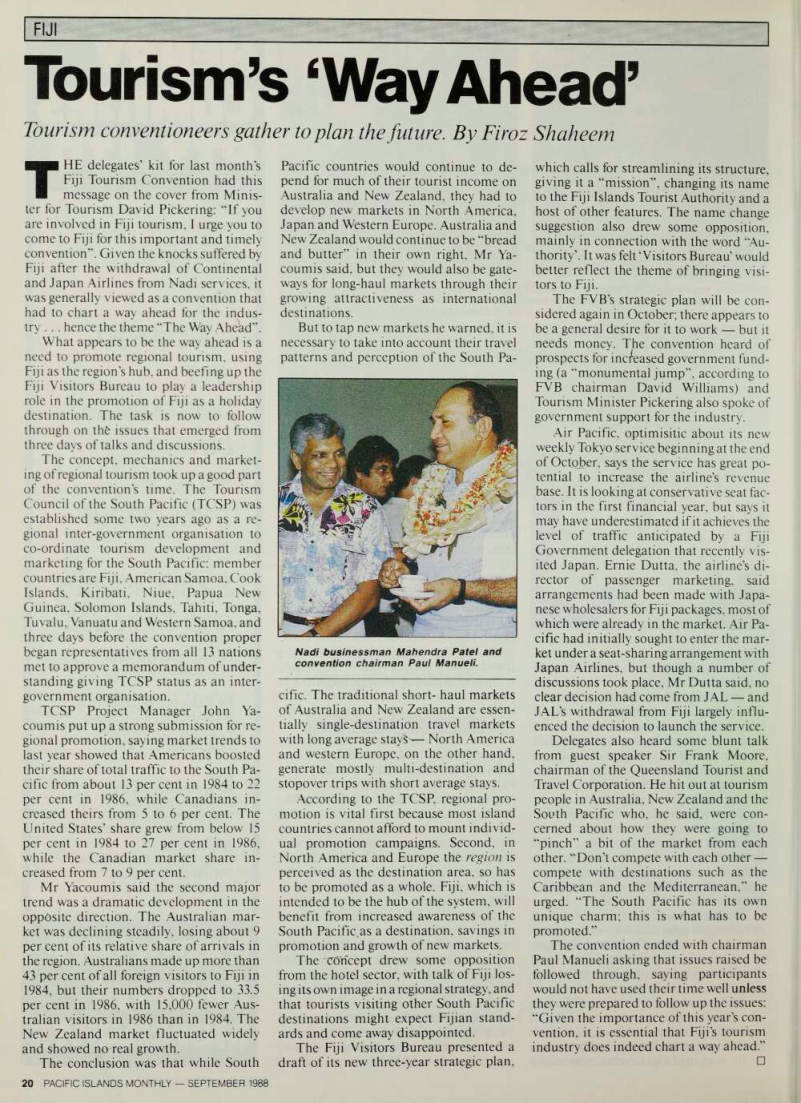
Nadi businessman Mahendra Patel and convention chairman Paul Manueli.