Fifty-one Days Adrift
pp. 18-19 · Read in the full issue
Tuvalu
How four young islanders survived an epic ordeal. By Diana McManus
FUNAFUTI, the capital of Tuvalu, was still rejoicing in late May this year because four of its young men had apparently returned from the dead.
The four men, who went adrift while fishing in February, were rescued on the island of Futuna in the French territory of Isles de Home, 400 nautical miles south southeast of Tuvalu after an epic 51 days at sea in a tiny dinghy. Afele Kitiona, a po lice constable, loane Maae and Tanei Tau mafua. a wireless operator, are all from the island community of Vaitupu; Tapaa Fiti, a Tuvalu Maritime School graduate, is from Niutao.
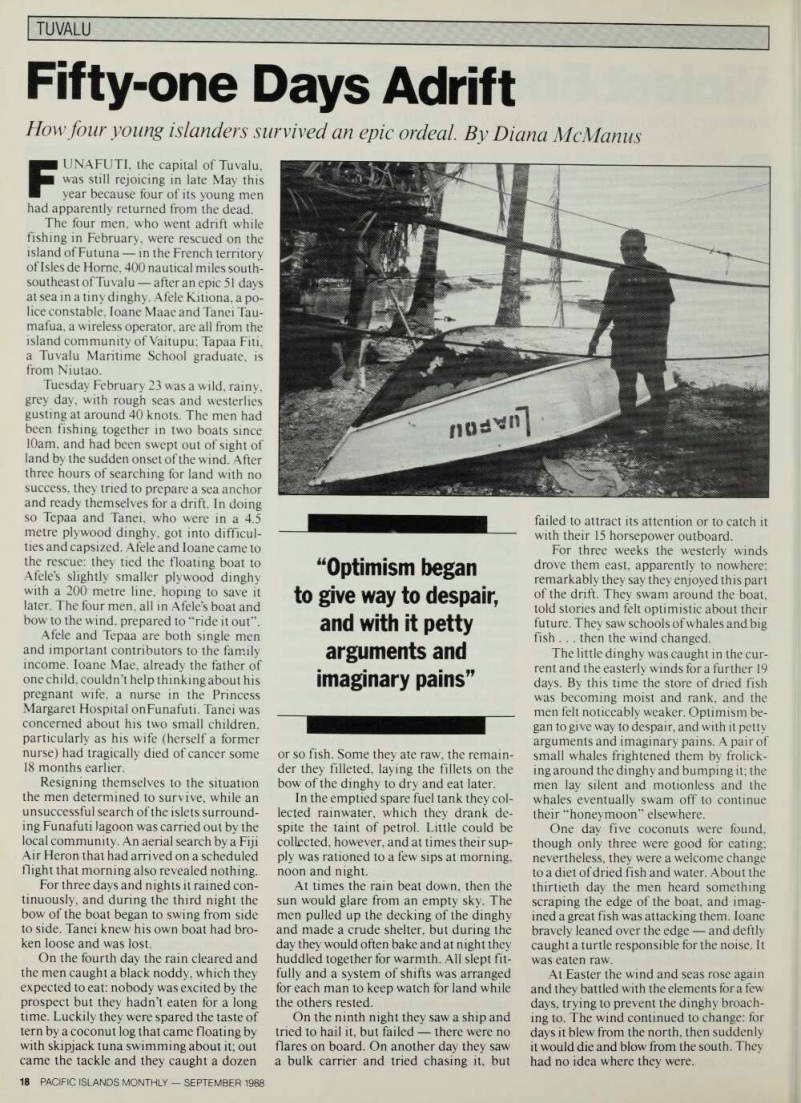
Tuesday February 23 was a wild, rainy, grey day, with rough seas and westerlies gusting at around 40 knots. The men had been fishing together in two boats since 10am, and had been swept out of sight of land by the sudden onset of the wind. After three hours of searching for land with no success, they tried to prepare a sea anchor and ready themselves for a drift. In doing so Tepaa and Tanei, who were in a 4.5 metre plywood dinghy, got into difficul ties and capsized. Afele and loane came to the rescue; they tied the floating boat to Afele’s slightly smaller plywood dinghy with a 200 metre line, hoping to save it later. The four men, all in Afele’s boat and bow to the wind, prepared to “ride it out”.
Afele and Tepaa are both single men and important contributors to the family income. loane Mae, already the father of one child, couldn’t help thinking about his pregnant wife, a nurse in the Princess Margaret Hospital onFunafuti. Tanei was concerned about his two small children, particularly as his wife (herself a former nurse) had tragically died of cancer some 18 months earlier.
Resigning themselves to the situation the men determined to survive, while an unsuccessful search of the islets surround ing Funafuti lagoon was carried out by the local community. An aerial search by a Fiji Air Heron that had arrived on a scheduled flight that morning also revealed nothing.
For three days and nights it rained con tinuously, and during the third night the bow of the boat began to swing from side to side. Tanei knew his own boat had bro ken loose and was lost.
On the fourth day the rain cleared and the men caught a black noddy, which they expected to eat: nobody was excited by the prospect but they hadn’t eaten for a long time. Luckily they were spared the taste of tern by a coconut log that came floating by with skipjack tuna swimming about it; out came the tackle and they caught a dozen
“Optimism began to give way to despair, and with it petty arguments and imaginary pains”
or so fish. Some they ate raw, the remain der they filleted, laying the fillets on the bow of the dinghy to dry and eat later.
In the emptied spare fuel tank they col lected rainwater, which they drank de spite the taint of petrol. Little could be collected, however, and at times their sup ply was rationed to a few sips at morning, noon and night.
At times the rain beat down, then the sun would glare from an empty sky. The men pulled up the decking of the dinghy and made a crude shelter, but during the day they would often bake and at night they huddled together for warmth. All slept fit fully and a system of shifts was arranged for each man to keep watch for land while the others rested.
On the ninth night they saw a ship and tried to hail it, but failed there were no flares on board. On another day they saw a bulk carrier and tried chasing it, but
failed to attract its attention or to catch it with their 15 horsepower outboard.
For three weeks the westerly winds drove them east, apparently to nowhere: remarkably they say they enjoyed this part of the drift. They swam around the boat, told stories and felt optimistic about their future. They saw schools of whales and big fish . . . then the wind changed.
The little dinghy was caught in the cur rent and the easterly winds for a further 19 days. By this time the store of dried fish was becoming moist and rank, and the men felt noticeably weaker. Optimism be gan to give way to despair, and with it petty arguments and imaginary pains. A pair of small whales frightened them by frolick ing around the dinghy and bumping it; the men lay silent and motionless and the whales eventually swam off to continue their “honeymoon” elsewhere.
One day five coconuts were found, though only three were good for eating; nevertheless, they were a welcome change to a diet of dried fish and water. About the thirtieth day the men heard something scraping the edge of the boat, and imag ined a great fish was attacking them. loane bravely leaned over the edge and deftly caught a turtle responsible for the noise. It was eaten raw.
At Easter the wind and seas rose again and they battled with the elements for a few days, trying to prevent the dinghy broach ing to. The wind continued to change: for days it blew from the north, then suddenly it would die and blow from the south. They had no idea where they were.
tion officials, there was feasting and dancing in their honour and the people presented them with garlands and a suit case ,of clothes.
The MV Nivanga, Tuvalu’s own inter island boat, made a detour from Fiji to collect the men and the little dinghy that had seen them to safety four days later.
The vessel’s captain, Houato lele, said the Futuna jetty was packed with islanders farewelling their guests. loane, Afele, Tanei and Tepaa arrived back in Funafuti on April 20 to happy rel atives, friends and onlookers who greeted them with more garlands and tears of joy. The community showed its enthusi asm at their return with a feast and fatele (dance) for the four men at the Vaitupu maneaba (meeting hall) on April 23, while the rest of the island was commemorating Bomb Day. A week later, the Police Force honoured the return of Afele and his friends with a special feast at the Vaiaku maneaba ; that night saw a magnificent private family feast held by Tepaa’s family at his home. Tepaa’s companions were honoured guests at the feast.
On Sunday May 1 a special Thanksgiv ing service was held at the Fetu ao Lima Church, where Afele Kitiona spoke on be half of the boys. He said while at sea they had prayed constantly and had never for gotten the Bible quote that says, ”Ask and ye shall receive”. He also gave thanks to God and his mercy. Another short service was held at the Tuvalu Maritime School on May 8, at which Tepa gave thanks for the survival skills he had learnt while a student there.
It’s not uncommon for Pacific island ers to go adrift and to be found days, weeks or even months later in far-off places. Yet their feats of endurance are rarely publi cised outside the local press. The story of these young men’s survival is a tribute to them and to the Polynesian affinity with the sea: it’s marvellous to see that age-old skills of survival and seamanship, partic ularly in such a small craft, are still very much alive in the 20th century □
Just as despair threatened to over whelm the weakened islanders, Afele and loane sighted land at about 10 o’clock on the morning of Wednesday April 13.
Twenty-four hours later they were close enough to start the outboard and use the little fuel remaining to make landfall.
Though weak, thin and troubled by sea so res, they were otherwise in good health, with plenty of dried fish and four gallons of “fresh” water on board.
Tanei was the first ashore and stag gered up the beach to a young man busy mending a punctured tyre. “Do you speak English?” Tanei asked, but the reply was negative. Afele joined Tanei moments later and asked him in Tuvaluan, “Did you find out the name of this island?”
To their astonishment the young man joined in the conversation apart from French, Tuvaluan is the second language of the inhabitants of Futuna! The young man listened to their story, then ran to alert the island and get help.
The astonished islanders of Futuna gave the young Tuvaluans a tumultuous reception: the island’s chief made the lads his special guests after they had been med ically examined and cleared by immigra-
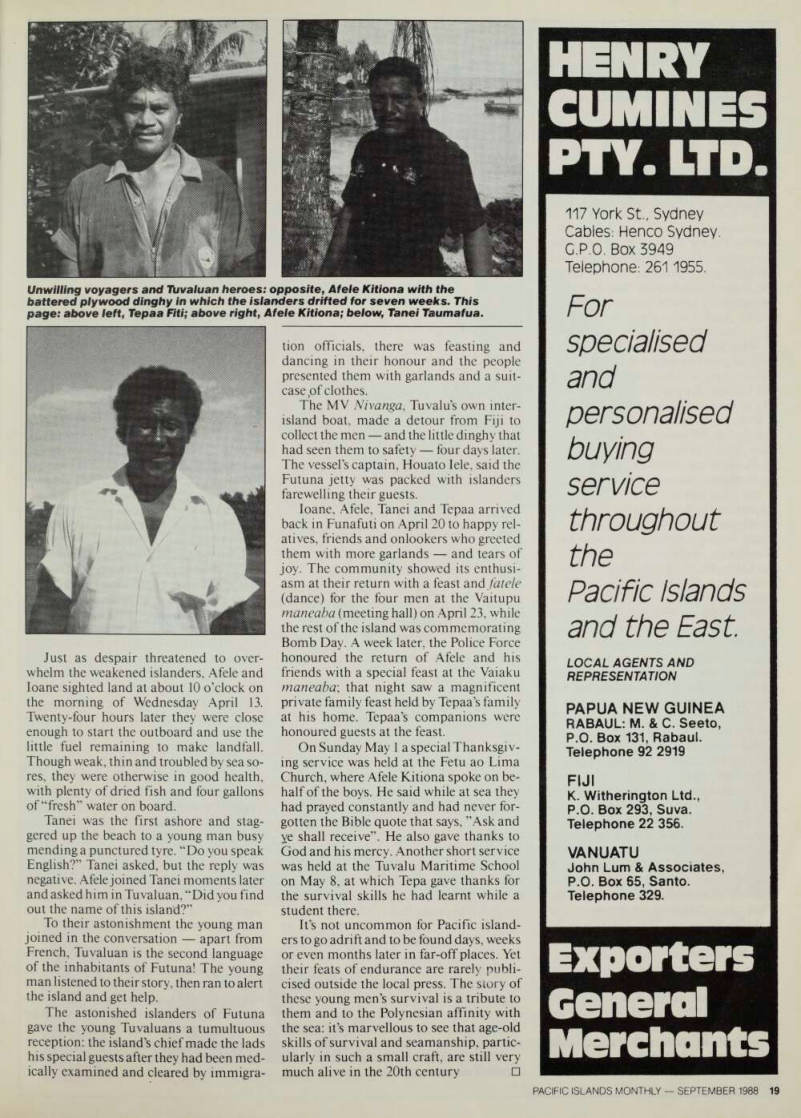
Unwilling voyagers and Tuvaluan heroes: opposite, Afele Kitiona with the battered plywood dinghy in which the islanders drifted for seven weeks. This page: above left, Tepaa Fiji; above right, Afele Kitiona; below, Tanei Taumafua.