Violent End For Salii
p. 17 · Read in the full issue
Palau
Rumours surround gunshot death of Palau’s President.
By Ed Rampell
DURING a 1986 campaign for a proposed Compact of Free Associ ation between the United States and Palau, Palauan President Lazarus Salii reportedly stated that “anyone opposing the Compact deserves to be beakV the Palauan word meaning “a target to be shot”. Salii has become Palau’s second president to become a beakl and to die of gunshot wounds within three years.
However, unlike President Haruo Re meliik, who was gunned down by un known assailants on June 30 1985, it is uncertain at time of going to press whether Salii’s death was the result of assassination or suicide.
According to Palau Government spokesman Bonifacio Basilius, the shoot ing occurred at about 1.30 pm on August 20. A security guard, a maid and the First Lady, Christina Salii, were reportedly eat ing lunch outside the presidential resi dence in Koror when they heard a gunshot.
The guard inspected the grounds of the President’s house but found nothing unu sual, and Mrs Salii did not enter the home for a further 20 minutes.
Inside she found her husband dead, slumped in a chair. Police discovered a .357 caliber magnum revolver and spent car tridge. The revolver had one chamber empty and five rounds remaining (fire arms are strictly forbidden in Palau). The 54-year-old President was pronounced dead an hour later at Roror’s McDonald Memorial Hospital.
Vice President and Minister for Justice Thomas Remengesau was sworn in as in terim President by Chief Justice Mamoru Nakamura some five hours after the shooting. Fifty-seven-year-old Remenge sau will serve out the remaining four months of Salii’s term (this November, Palauans are to vote in general and presi dential elections) and prior to Salii’s death Remengesau had reportedly announced his candidacy for the presidency.
Early news dispatches termed the Salii shooting an “assassination”, but Palauan and US officials swiftly asserted that the President may have taken his own life: headlines soon appeared indicating the death could be a “suicide”. Guam’s chief medical examiner flew to Koror to assist in the autopsy on August 22.
Assuming that the suicide hypothesis is true, what factors could have led to Sal ii’s taking his own life? The authoritarian chief executive had a mercurial person ality and had over recent months faced a series of political setbacks. Salii’s main source of frustration was his inability to attain Compact ratification, which he had
been seeking for 21 years. Palau’s courts repeatedly ruled that the treaty’s military stipulations clashed with the constitu tion’s nuclear-free statue, and required a 75 per cent vote to override the anti nuclear provision. Despite 10 related ref erendums and numerous court cases Salii, like his predecessor, remained unable to resolve the Compact dilemma.
US Congressional investigations have alleged links between the late President
and his Administration with widespread corruption, the drug trade, and more. Salii had admitted to receiving SUS2OO,OOO from the IPSECO power project, and his younger brother was recently impeached by the House of Delegates for taking up to SUSI.S million from IPSECO while Speaker of the House.
Last month a US District Court ruled that Palau had to pay SUS 43 million to IPSECO’s creditors more than double the tiny Republic’s annual budget.
Unconfirmed reports indicate that Pa lau’s Washington-based liaison officer, Haruo Wilter, met with Salii shortly be fore his death, and that he may have con veyed disturbing information to Salii on the morning of August 20; perhaps regard ing impending indictments, since the US Government has been cracking down on corruption in its overseas territories.
Contrary to the suicide hypothesis is the news that the High Court appeal on the latest Compact-related court case had not been delivered prior to Salii’s death.
Salii also had enemies the Presiden tial limousine reputedly had a machine gun, and armed guards accompanied him
everywhere who resented a regime deemed “vindictive” and “oppressive” by Palauan dissidents, international poll watchers and human rights groups.
On the other hand, unable to untie the Compact knot (like Remeliik before him) Salii may have been regarded as “expend able” by pro-Compacl zealots. The night after Salii’s death the Compact camp was already meeting to choose a successor.
A more complete picture will emerge in weeks to come, depending on who an nounces candidacy for President and if any particular faction is blamed for Salii’s de mise. It is nevertheless past time for the United Nations and the United States to launch an investigation into the continu ing history of political violence in their joint Trusteeship responsibility not least because, for Lazarus Salii, the biblical edict “He who lives by the sword dies by the sword” has come terribly true. □
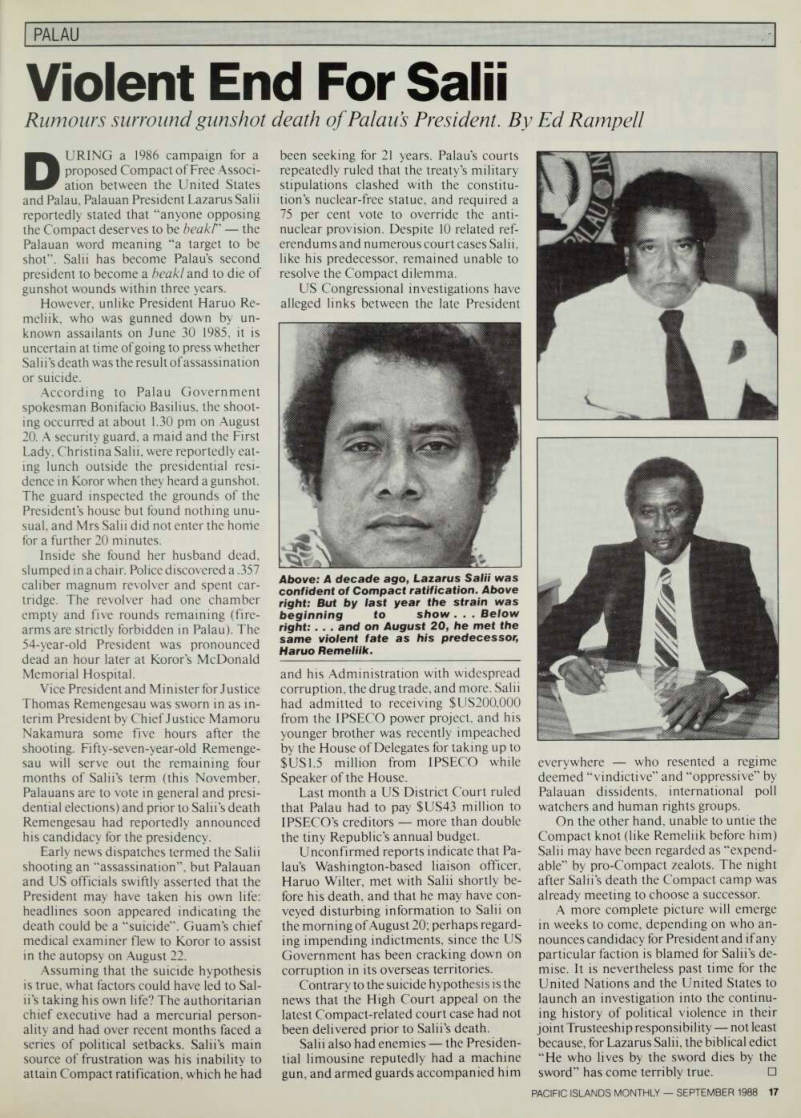
Above: A decade ago, Lazarus Salii was confident of Compact ratification. Above right: But by last year the strain was beginning to show . .. Below right: . . . and on August 20, he met the same violent fate as his predecessor, Haruo Remeliik.