What Price Oceanic Art?
pp. 48-49 · Read in the full issue
Private collectors and museums around the world are threatening the Pacific’s
artistic heritage.
by Peter Huck
IN 1966, a watershed auction took place at New York’s Parke-Bemet Galleries.
The occasion was the dispersal of the fabled Helena Rubinstein Collection, which included several important pieces of Oceanic art. The Rubinstein auction at tracted considerable international interest and precipitated a boom in the sale of Pacific artifacts that has continued una bated to the present day.
The trend was fuelled by other signi ficent collections going under the hammer and leading, says Sotheby’s Australian di rector and Oceanic art expert Robert Bleakley, to a “rapid escalation in value, with prices increasing 15 to 20 times over 10 years.” Whereas the top price (for a fig urine from New Guinea’s Lake Sentani re gion) at the Rubinstein auction was $U522,500, by 1986 a Karawari River cave figurine from the collection of South American artist Roberto Malta fetched
$ Usboo,Ooo.
But the bull market created little ex citement in the Pacific, where valuable ar tifacts had been plundered by outsiders since Cook and Bougainville first carted them off as curios and souvenirs. By the late 19th century the Pacific was being tapped by more methodical collectors, among them several German ethno graphic expeditions to New Guinea. Other major collectors included the shadowy Australian trader Captain Thomas Far rell, a swashbuckling figure who supplied a fortune in Melanesian artifacts (most from the New Ireland region) to institu tions such as the Australian Museum in the 1870 s, and British anthropologist Lieuten ant-General Augustus Pitt-Rivers, an en thusiast who, says Bleakley, “used a shotgun approach, buying absolutely any thing he could lay his hands on” for his private museum in Dorset.
By the early 19505, following a frenzy of buying in the 1920 s and 19305, supplies of quality Oceanic art such as rare figu rines and fetishes were running out, most pieces having disappeared into pri vate collections and public museums in Europe and the United States.
How many remains in private hands in Oceania today is debatable. Robert Bleak ley thinks most of the pre-contact art (pro duced by traditional methods and tools) has long since been discovered and re moved or destroyed by missionaries and bureaucrats, with perhaps “a couple of dozen major pieces lurking in the woodwork.”
Dr Jim Specht, head of the Pacific An thropology collection at the Australian Museum in Sydney, is less sure and sus pects that some pre-contact art is “defi-
nitely” still in private hands, especially in the Solomons, Vanuatu and New Zealand.
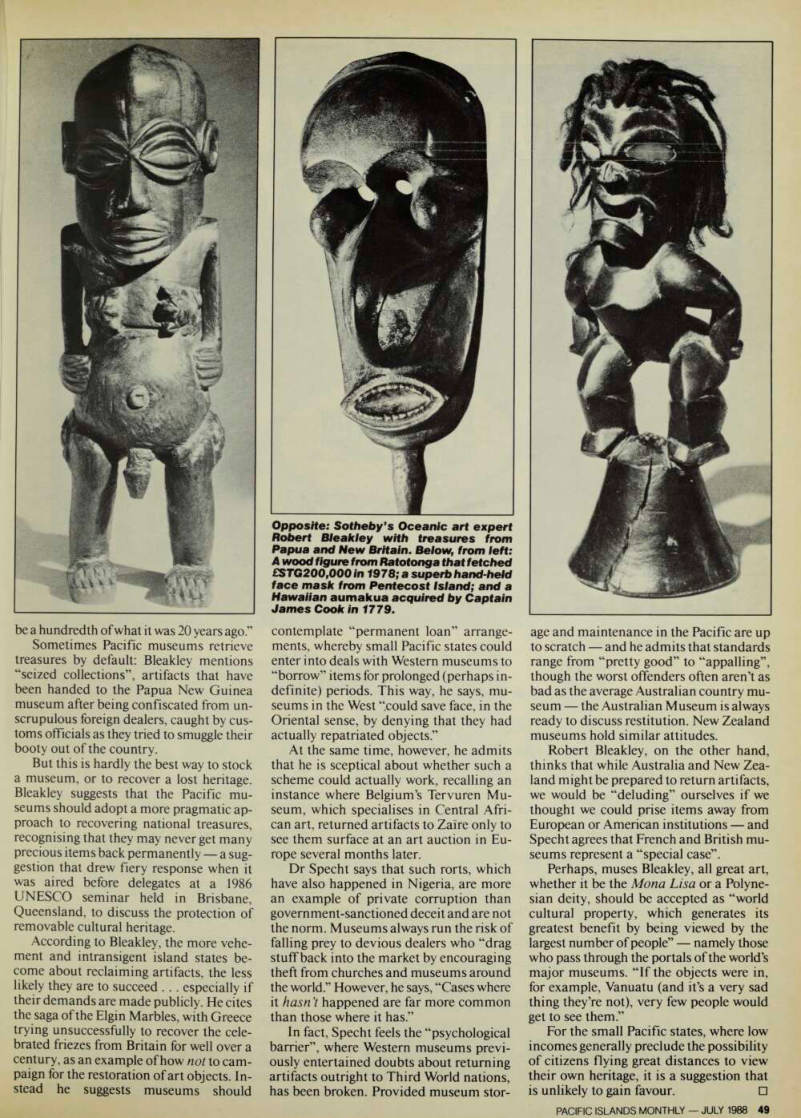
However, with the exceptions of New Zea land, Hawaii, Australia and to a lesser ex tent Papua New Guinea, precious little remains in many Pacific island museums compared with the booty held in the Northern Hemisphere. Bleakley remem bers visiting Vanuatu’s Vila Museum and discovering that it lacked a Pentecost Is land mask, one of the key icons of the na tion’s culture: instead, the museum had no more than “a photograph of a mask that had been sold by Sotheby’s in London for the colossal price of £lBO,OOO (about $US400,000) in 1978.”
The position for Pacific states that wish to forge a sense of national identity by publicly displaying their cultural heritage is grim. Buying heirlooms back is patently impossible in most cases: few if any of them can afford to compete on the inter
national art market. Dr Specht cites an ex ample following the breakup of the Ortex Collection in 1978, when Hawaii’s Bernice P Bishop Museum raised $U5250,000 to bid for a Hawaiian figurine originally col lected by Cook. The 26mm high sculpture went for £275,000, more than SUS6OO,OOO, and was lost probably forever to Ha waii and its people.
Fewer and fewer valuable items, in contrast to everyday artifacts such as weapons, which are still readily available, are appearing on the market; most have found permanent homes in the West. This is particularly true of what Robert Bleak ley describes as “small esoteric items of fine quality, such as masks or figurines”, sculptural objects most prized by wealthy collectors for their exquisite craftsman ship and rarity. “It’s a finite and dimin ishing market,” he says. “The amount of material circulating now would probably
be a hundredth of what it was 20 years ago.”
Sometimes Pacific museums retrieve treasures by default: Bleakley mentions “seized collections”, artifacts that have been handed to the Papua New Guinea museum after being confiscated from un scrupulous foreign dealers, caught by cus toms officials as they tried to smuggle their booty out of the country.
But this is hardly the best way to stock a museum, or to recover a lost heritage.
Bleakley suggests that the Pacific mu seums should adopt a more pragmatic ap proach to recovering national treasures, recognising that they may never get many precious items back permanently a sug gestion that drew fiery response when it was aired before delegates at a 1986 UNESCO seminar held in Brisbane, Queensland, to discuss the protection of removable cultural heritage.
According to Bleakley, the more vehe ment and intransigent island states be come about reclaiming artifacts, the less likely they are to succeed ... especially if their demands are made publicly. He cites the saga of the Elgin Marbles, with Greece trying unsuccessfully to recover the cele brated friezes from Britain for well over a century, as an example of how not to cam paign for the restoration of art objects. In stead he suggests museums should
contemplate “permanent loan” arrange ments, whereby small Pacific states could enter into deals with Western museums to “borrow” items for prolonged (perhaps in definite) periods. This way, he says, mu seums in the West “.could save face, in the Oriental sense, by denying that they had actually repatriated objects.”
At the same time, however, he admits that he is sceptical about whether such a scheme could actually work, recalling an instance where Belgium’s Tervuren Mu seum, which specialises in Central Afri can art, returned artifacts to Zaire only to see them surface at an art auction in Eu rope several months later.
Dr Specht says that such rorts, which have also happened in Nigeria, are more an example of private corruption than government-sanctioned deceit and are not the norm. Museums always run the risk of falling prey to devious dealers who “drag stuff back into the market by encouraging theft from churches and museums around the world.” However, he says, “Cases where it hasn’t happened are far more common than those where it has.”
In fact, Specht feels the “psychological barrier”, where Western museums previ ously entertained doubts about returning artifacts outright to Third World nations, has been broken. Provided museum stor-
age and maintenance in the Pacific are up to scratch and he admits that standards range from “pretty good” to “appalling”, though the worst offenders often aren’t as bad as the average Australian country mu seum the Australian Museum is always ready to discuss restitution. New Zealand museums hold similar attitudes.
Robert Bleakley, on the other hand, thinks that while Australia and New Zea land might be prepared to return artifacts, we would be “deluding” ourselves if we thought we could prise items away from European or American institutions and Specht agrees that French and British mu seums represent a “special case”.
Perhaps, muses Bleakley, all great art, whether it be the Mona Lisa or a Polyne sian deity, should be accepted as “world cultural property, which generates its greatest benefit by being viewed by the largest number of people” namely those who pass through the portals of the world’s major museums. “If the objects were in, for example, Vanuatu (and it’s a very sad thing they’re not), very few people would get to see them.”
For the small Pacific states, where low incomes generally preclude the possibility of citizens flying great distances to view their own heritage, it is a suggestion that is unlikely to gain favour. □
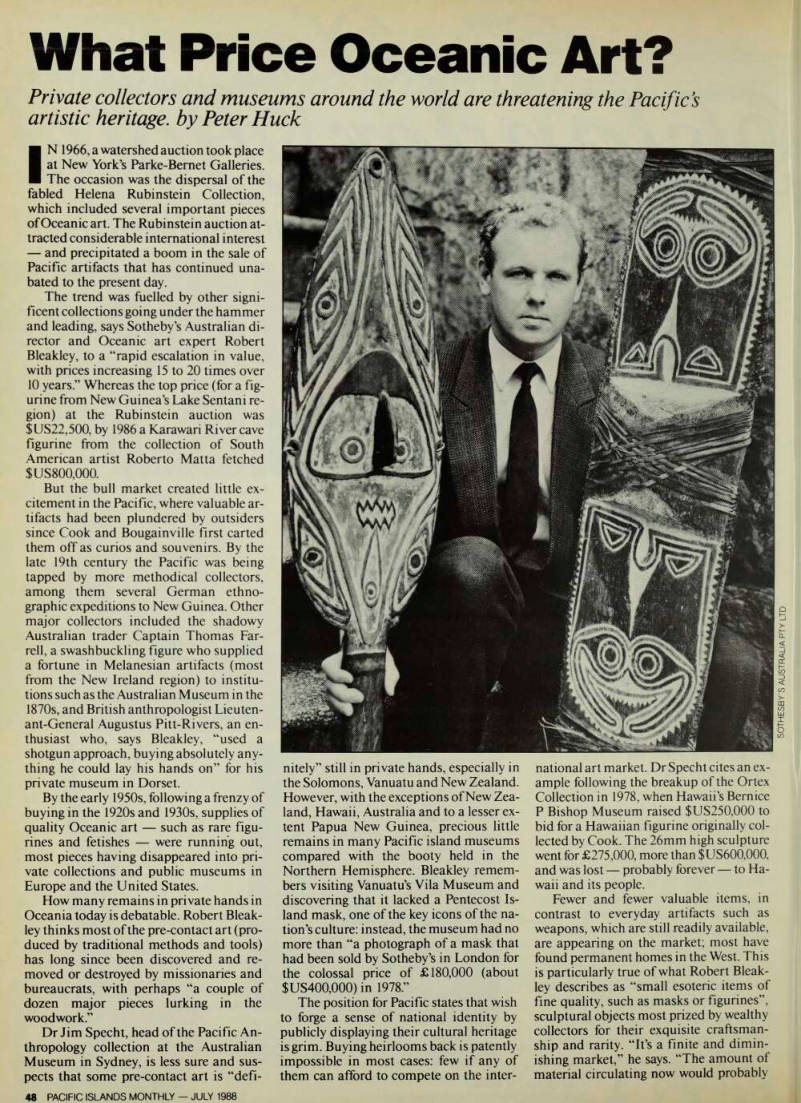
Opposite: Sotheby’s Oceanic art expert Robert Bleakley with treasures from Papua and New Britain. Below, from left: A wood figure from Ratotonga that fetched £STG200,000 in 1978; a superb hand-held face mask from Pentecost Island; and a Hawaiian aumakua acquired by Captain James Cook in 1779.