He Maungarongo Kia Tau Ai Te Rangimarie
p. 46 · Read in the full issue
New Zealand
An international outcry saves one piece of Pacific art.
By Jack Kelleher
A CONTINUING European and American trade in human heads, grisly trophies from the days of co lonisation, has recently had a long over due setback.
New sensitivity to what is appropriate in museums, private or public, and what deserves burial or other rites played a part in the cancellation in May of a scheduled auction in London of the tattooed head of a Maori warrior.
An outcry from the race concerned played a greater part: the New Zealand Government joined with the country’s prestigious Maori Council in a legal as sault, on the other side of the world, after taking legal action in their own country that could be an example for all native races around the world.
In the New Zealand High Court a Maori of unquestionable status to repre sent his people, Sir Graham Latimer, chairman of the Maori Council, won power to act as executor of the estate of the long dead Maori warrior whose preserved head was to be auctioned.
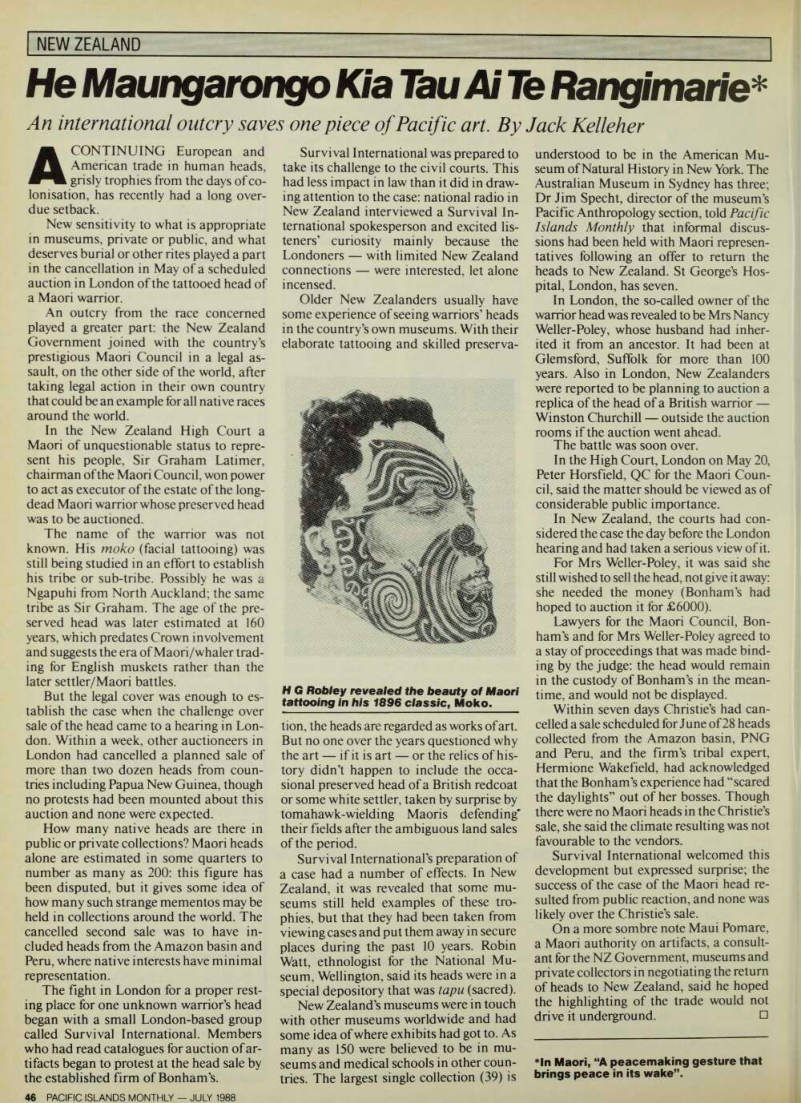
The name of the warrior was not known. His moko (facial tattooing) was still being studied in an effort to establish his tribe or sub-tribe. Possibly he was a Ngapuhi from North Auckland; the same tribe as Sir Graham. The age of the pre served head was later estimated at 160 years, which predates Crown involvement and suggests the era of Maori/whaler trad ing for English muskets rather than the later settler/Maori battles.
But the legal cover was enough to es tablish the case when the challenge over sale of the head came to a hearing in Lon don. Within a week, other auctioneers in London had cancelled a planned sale of more than two dozen heads from coun tries including Papua New Guinea, though no protests had been mounted about this auction and none were expected.
How many native heads are there in public or private collections? Maori heads alone are estimated in some quarters to number as many as 200: this figure has been disputed, but it gives some idea of how many such strange mementos may be held in collections around the world. The cancelled second sale was to have in cluded heads from the Amazon basin and Peru, where native interests have minimal representation.
The fight in London for a proper rest ing place for one unknown warrior’s head began with a small London-based group called Survival International. Members who had read catalogues for auction of ar tifacts began to protest at the head sale by the established firm of Bonham’s.
Survival International was prepared to take its challenge to the civil courts. This had less impact in law than it did in draw ing attention to the case: national radio in New Zealand interviewed a Survival In ternational spokesperson and excited lis teners’ curiosity mainly because the Londoners with limited New Zealand connections were interested, let alone incensed.
Older New Zealanders usually have some experience of seeing warriors’ heads in the country’s own museums. With their elaborate tattooing and skilled preserva-
tion, the heads are regarded as works of art.
But no one over the years questioned why the art if it is art or the relics of his tory didn’t happen to include the occa sional preserved head of a British redcoat or some white settler, taken by surprise by tomahawk-wielding Maoris defending' their fields after the ambiguous land sales of the period.
Survival International’s preparation of a case had a number of effects. In New Zealand, it was revealed that some mu seums still held examples of these tro phies, but that they had been taken from viewing cases and put them away in secure places during the past 10 years. Robin Watt, ethnologist for the National Mu seum, Wellington, said its heads were in a special depository that was tapu (sacred).
New Zealand’s museums were in touch with other museums worldwide and had some idea of where exhibits had got to. As many as 150 were believed to be in mu seums and medical schools in other coun tries. The largest single collection (39) is
understood to be in the American Mu seum of Natural History in New York. The Australian Museum in Sydney has three; Dr Jim Specht, director of the museum’s Pacific Anthropology section, told Pacific Islands Monthly that informal discus sions had been held with Maori represen tatives following an offer to return the heads to New Zealand. St George’s Hos pital, London, has seven.
In London, the so-called owner of the warrior head was revealed to be Mrs Nancy Weller-Poley, whose husband had inher ited it from an ancestor. It had been at Glemsford, Suffolk for more than 100 years. Also in London, New Zealanders were reported to be planning to auction a replica of the head of a British warrior Winston Churchill outside the auction rooms if the auction went ahead.
The battle was soon over.
In the High Court, London on May 20, Peter Horsfield, QC for the Maori Coun cil, said the matter should be viewed as of considerable public importance.
In New Zealand, the courts had con sidered the case the day before the London hearing and had taken a serious view of it.
For Mrs Weller-Poley, it was said she still wished to sell the head, not give it away: she needed the money (Bonham’s had hoped to auction it for £6000).
Lawyers for the Maori Council, Bon ham’s and for Mrs Weller-Poley agreed to a stay of proceedings that was made bind ing by the judge; the head would remain in the custody of Bonham’s in the mean time, and would not be displayed.
Within seven days Christie’s had can celled a sale scheduled for June of 28 heads collected from the Amazon basin, PNG and Peru, and the firm’s tribal expert, Hermione Wakefield, had acknowledged that the Bonham’s experience had “scared the daylights” out of her bosses. Though there were no Maori heads in the Christie’s sale, she said the climate resulting was not favourable to the vendors.
Survival International welcomed this development but expressed surprise; the success of the case of the Maori head re sulted from public reaction, and none was likely over the Christie’s sale.
On a more sombre note Maui Pomare, a Maori authority on artifacts, a consult ant for the NZ Government, museums and private collectors in negotiating the return of heads to New Zealand, said he hoped the highlighting of the trade would not drive it underground. □
*ln Maori, “A peacemaking gesture that brings peace in its wake”.
H G Robley revealed the beauty of Maori tattooing in his 1896 classic, Moko.