Tropicalities
p. 44 · Read in the full issue
War and Peace, 1988
M M E chose Honolulu for this ** year’s convention to dra- W W matise the growing impor tance of the Pacific to America’s economic, military and foreign policy interests,” said George Wilson, outgoing chairman of the American Newspaper Publishers Associ ation, during his keynote address before thousands of media delegates at the ANPA’s 1988 convention. The 102nd gath ering of publishers, held from April 25 to 27 at the Waikiki-Sheraton, included top journalists and newsmakers and high lighted the growing contact between East and West in the Pacific.
The media convention lived up to its motto of dedication to freedom of the press by presenting forums where Soviet, Amer ican, Chinese, Taiwanese and other spokesmen addressed issues of super power realpolitik in Oceania. The morn ing of the final day of the conference was devoted to the subject of “Asia and the Pa cific in the Year 2000”. For that discus sion, Soviet spokesman Gennadiy Gerasimov, Chief of the Information De partment of the USSR’s Ministry of For eign Affairs, squared off against Admiral Ronald Hays, Commander in Chief of
Cincpac.
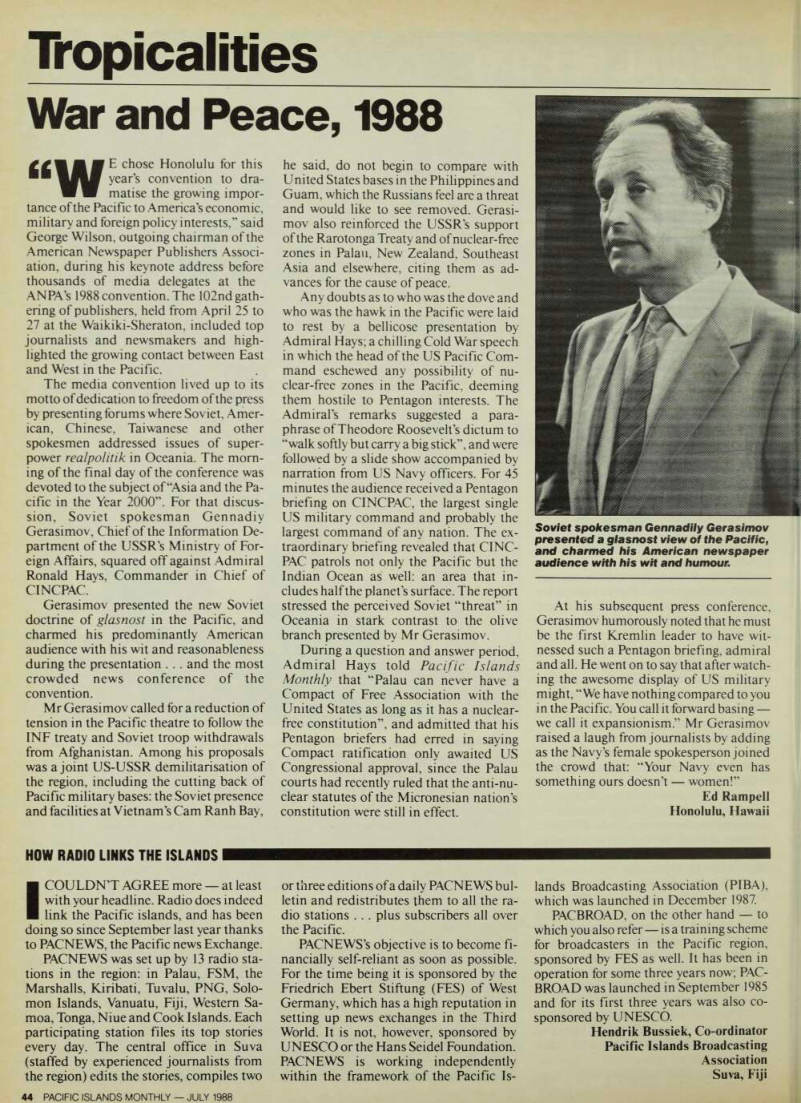
Gerasimov presented the new Soviet doctrine of glasnost in the Pacific, and charmed his predominantly American audience with his wit and reasonableness during the presentation . . . and the most crowded news conference of the convention.
Mr Gerasimov called for a reduction of tension in the Pacific theatre to follow the INF treaty and Soviet troop withdrawals from Afghanistan. Among his proposals was a joint US-USSR demilitarisation of the region, including the cutting back of Pacific military bases: the Soviet presence and facilities at Vietnam’s Cam Ranh Bay,
he said, do not begin to compare with United States bases in the Philippines and Guam, which the Russians feel are a threat and would like to see removed. Gerasi mov also reinforced the USSR’s support of the Rarotonga Treaty and of nuclear-free zones in Palau, New Zealand, Southeast Asia and elsewhere, citing them as ad vances for the cause of peace.
Any doubts as to who was the dove and who was the hawk in the Pacific were laid to rest by a bellicose presentation by Admiral Hays; a chilling Cold War speech in which the head of the US Pacific Com mand eschewed any possibility of nu clear-free zones in the Pacific, deeming them hostile to Pentagon interests. The Admiral’s remarks suggested a para phrase of Theodore Roosevelt’s dictum to “walk softly but carry a big stick”, and were followed by a slide show accompanied by narration from US Navy officers. For 45 minutes the audience received a Pentagon briefing on CINCPAC, the largest single US military command and probably the largest command of any nation. The ex traordinary briefing revealed that CINC PAC patrols not only the Pacific but the Indian Ocean as well: an area that in cludes half the planet’s surface. The report stressed the perceived Soviet “threat” in Oceania in stark contrast to the olive branch presented by Mr Gerasimov.
During a question and answer period, Admiral Hays told Pacific Islands Monthly that “Palau can never have a Compact of Free Association with the United States as long as it has a nuclear free constitution”, and admitted that his Pentagon briefers had erred in saying Compact ratification only awaited US Congressional approval, since the Palau courts had recently ruled that the anti-nu clear statutes of the Micronesian nation’s constitution were still in effect.
At his subsequent press conference, Gerasimov humorously noted that he must be the first Kremlin leader to have wit nessed such a Pentagon briefing, admiral and all. He went on to say that after watch ing the awesome display of US military might, “We have nothing compared to you in the Pacific. You call it forward basing we call it expansionism.” Mr Gerasimov raised a laugh from journalists by adding as the Navy’s female spokesperson joined the crowd that: “Your Navy even has something ours doesn’t women!”
Ed Rampell Honolulu, Hawaii
How Radio Links The Islands
I COULDN’T AGREE more at least with your headline. Radio does indeed link the Pacific islands, and has been doing so since September last year thanks to PACNEWS, the Pacific news Exchange.
PACNEWS was set up by 13 radio sta tions in the region: in Palau, FSM, the Marshalls, Kiribati, Tuvalu, PNG, Solo mon Islands, Vanuatu, Fiji, Western Sa moa, Tonga, Niue and Cook Islands. Each participating station files its top stories every day. The central office in Suva (staffed by experienced journalists from the region) edits the stories, compiles two
or three editions of a daily PACNEWS bul letin and redistributes them to all the ra dio stations . . . plus subscribers all over the Pacific.
PACNEWS’s objective is to become fi nancially self-reliant as soon as possible.
For the time being it is sponsored by the Friedrich Ebert Stiftung (FES) of West Germany, which has a high reputation in setting up news exchanges in the Third World. It is not, however, sponsored by UNESCO or the Hans Seidel Foundation.
PACNEWS is working independently within the framework of the Pacific Is
lands Broadcasting Association (PIBA), which was launched in December 1987.
PACBROAD, on the other hand to which you also refer is a training scheme for broadcasters in the Pacific region, sponsored by FES as well. It has been in operation for some three years now; PAC BROAD was launched in September 1985 and for its first three years was also co sponsored by UNESCO.
Hendrik Bussiek, Co-ordinator Pacific Islands Broadcasting Association Suva, Fiji
Soviet spokesman Gennadily Gerasimov presented a glasnost view of the Pacific, and charmed his American newspaper audience with his wit and humour.