Japan’s Stake In Fiji’s Future
pp. 40-43 · Read in the full issue

Tokyo’s EIF Corporation invests SF3O million in tourism.
By lan Connellan
mgm HE future of the Republic has been pnc around the Fijian ■ ‘SlaSds'ror months, so it was reasonable that a group dining at the Regent of Fiji hotel recently should be tackling it.
But midway through that particular evening, the discussion took a peculiar tumandguests Fiji’s Minister for Tourism and Aviation, Mr David Pickering, among them found themselves listening to a lively debate about lucky numbers: 1988 is a pivotal year for Fiji, so it is little wonder that the debate, having gone through the range of gamblers’ favourites, turned to the numerals one, nine and eight, “Eight is a very, very good number for Muslims,” said Mr Dhiraj Hemraj, an accountant from Lautoka. The sum of eight, seven and six, Mr Hemraj said, produced a number divisible by three, which is also a lucky number for Muslims.
“Eight is also a lucky number in the Orient ” replied Dr Bungo Ishizaki, principal investment advisor for the Tokyobased EIE Development Company. The Chinese character for eight, Dr Ishizaki explained, has the promise of limitlessness. It suggests direction without final-
ity. Gamblers’ instincts notwithstanding, it is exactly the image that Dr Ishizaki would like to see at the altar for the mar riage of EIE and the Republic of Fiji.
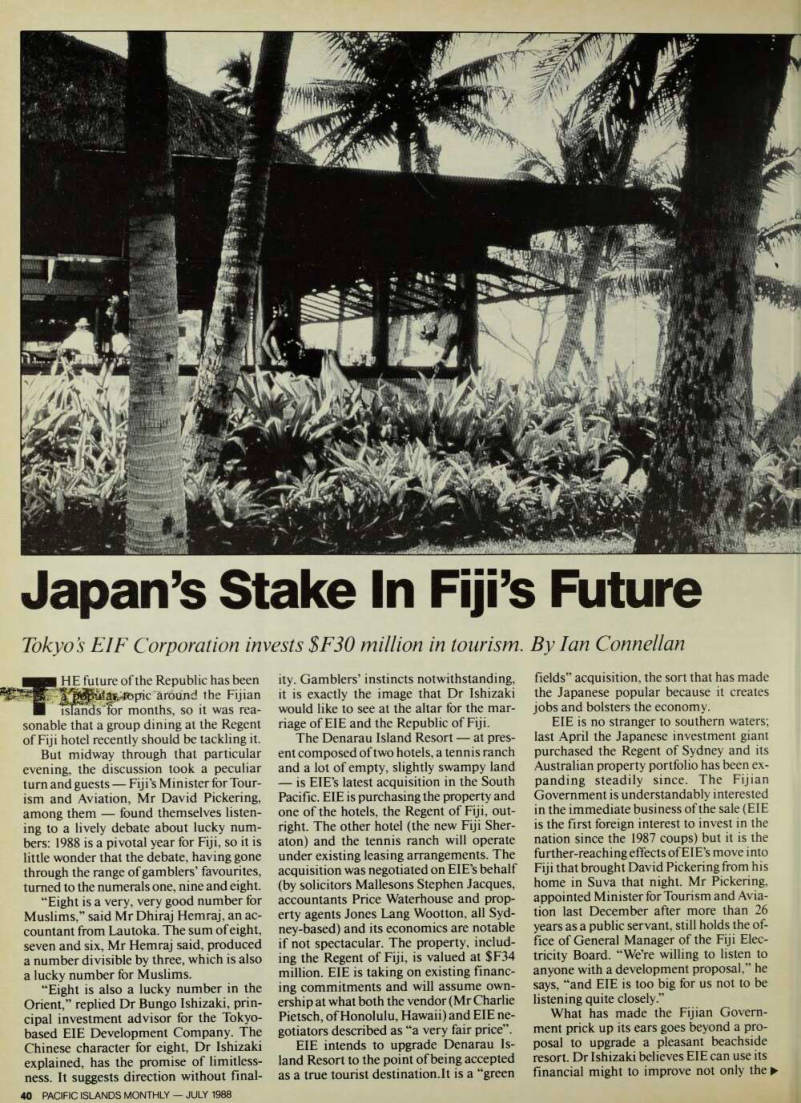
The Denarau Island Resort at pres ent composed of two hotels, a tennis ranch and a lot of empty, slightly swampy land —is ElE’s latest acquisition in the South Pacific. EIE is purchasing the property and one of the hotels, the Regent of Fiji, out right. The other hotel (the new Fiji Sher aton) and the tennis ranch will operate under existing leasing arrangements. The acquisition was negotiated on ElE’s behalf (by solicitors Mallesons Stephen Jacques, accountants Price Waterhouse and prop erty agents Jones Lang Wootton, all Syd ney-based) and its economics are notable if not spectacular. The property, includ ing the Regent of Fiji, is valued at SF34 million. EIE is taking on existing financ ing commitments and will assume own ership at what both the vendor (Mr Charlie Pietsch, of Honolulu, Hawaii) and EIE ne gotiators described as “a very fair price”.
EIE intends to upgrade Denarau Is land Resort to the point of being accepted as a true tourist destination.lt is a “green
fields” acquisition, the sort that has made the Japanese popular because it creates jobs and bolsters the economy, EIE is no stranger to southern waters; last April the Japanese investment giant purchased the Regent of Sydney and its Australian property portfolio has been ex panding steadily since. The Fijian Government is understandably interested in the immediate business of the sale (EIE is the first foreign interest to invest m the nation since the 1987 coups) but it is the further-reaching effects of ElE’s move into Fiji that brought David Pickering from his home in Suva that night. Mr Pickering, appointed Minister for Tourism and Avia tion last December after more than 26 years as a public servant, still holds the ot fice of General Manager of the Fiji Elec tricity Board. Were willing to hsten to anyone with a development proposal, he says, “and EIE is too big for us not to be listening quite closely.”
What has made the Fijian Govern ment pnck up its ears goes beyond a pro posal to upgrade a pleasant beachside resort. Dr Ishizaki believes EIE can use its financial might to improve not only the ►
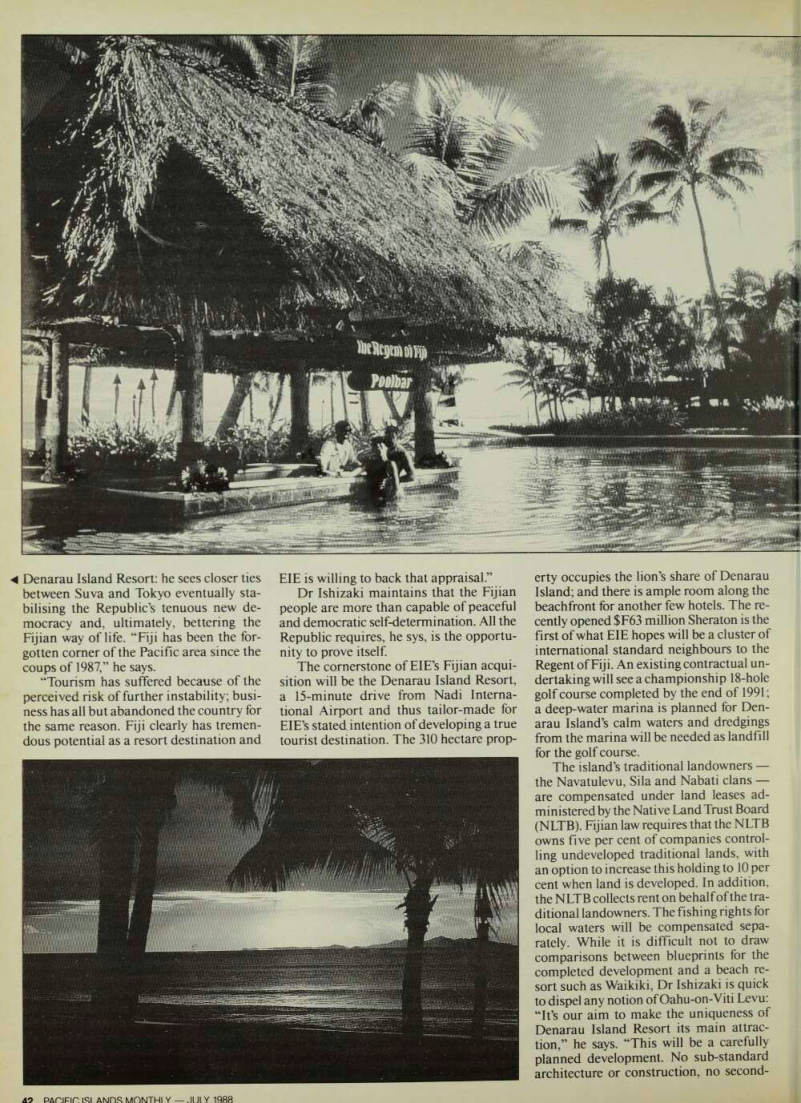
◄ Denarau Island Resort: he sees closer ties between Suva and Tokyo eventually sta bilising the Republic’s tenuous new de mocracy and, ultimately, bettering the Fijian way of life. “Fiji has been the for gotten comer of the Pacific area since the coups of 1987,” he says.
“Tourism has suffered because of the perceived risk of further instability; busi ness has all but abandoned the country for the same reason. Fiji clearly has tremen dous potential as a resort destination and
EIE is willing to back that appraisal.”
Dr Ishizaki maintains that the Fijian people are more than capable of peaceful and democratic self-determination. All the Republic requires, he sys, is the opportu nity to prove itself.
The cornerstone of ElE’s Fijian acqui sition will be the Denarau Island Resort, a 15-minute drive from Nadi Interna tional Airport and thus tailor-made for ElE’s stated intention of developing a true tourist destination. The 310 hectare prop-
erty occupies the lion’s share of Denarau Island; and there is ample room along the beachfront for another few hotels. The re cently opened SF63 million Sheraton is the first of what EIE hopes will be a cluster of international standard neighbours to the Regent of Fiji. An existing contractual un dertaking will see a championship 18-hole golf course completed by the end of 1991; a deep-water marina is planned for Den arau Island’s calm waters and dredgings from the marina will be needed as landfill for the golf course.
The island’s traditional landowners the Navatulevu, Sila and Nabati clans are compensated under land leases ad ministered by the Native Land Trust Board (NLTB). Fijian law requires that the NLTB owns five per cent of companies control ling undeveloped traditional lands, with an option to increase this holding to 10 per cent when land is developed. In addition, the NLTB collects rent on behalf of the tra ditional landowners. The fishing rights for local waters will be compensated sepa rately. While it is difficult not to draw comparisons between blueprints for the completed development and a beach re sort such as Waikiki, Dr Ishizaki is quick to dispel any notion ofOahu-on-Viti Levu: “It’s our aim to make the uniqueness of Denarau Island Resort its main attrac tion,” he says. “This will be a carefully planned development. No sub-standard architecture or construction, no second
rate shops or services. Everything consid ered, planned and perfect.”
Dr Ishizaki is also enthusiastic about an initiative to bring Fiji and Japan closer together via EIE stewardship. EIE is sug gesting what is effectively a privately or ganised international aid package: already there is a committee composed of civic and business leaders and the Fijian Minister for Education selecting young Fijians to study in Japan. Those students chosen (the first is already in Japan) will return to Fiji far more readily than did students who travelled to Australia or New Zealand in the past for tertiary education. Dr Ishizaki contends. “The Japanese business and so cial environment tends to swallow out siders,” he says. “Very few non-Japanese stay there long-term. Australia and New Zealand just don’t seem to have the same ‘l’ll never be able to succeed here’ effect.”
There are also moves to establish a school of information sciences in Fiji. The latest computer hardware and software would be accessible to the Fijian people, and the school would also serve as a centre for Jap anese language studies.
The development and retention of an intellectual elite is essential to the survival of any nation, and there has been a no ticeable exodus of trained professionals from Fiji since the coups; so these propos als are tempting indeed. But will young Fi jians versed in the latest technology remain in the country after training if there is no work for them?
It would seem Dr Ishizaki has contem plated that possibility: he foresees the Jap anese playing a major role in the upgrading of telecommunications in Fiji, brought up to date with the assistance of EIE financ ing and Japanese technology. Such a sys tem would require skilled operators and technicians, and may represent at least one employment possibility for Fijians trained in information sciences.
Dr Ishizaki admits that EIE must be prepared for a decent interval before its Fi jian investment pays dividends. Room oc cupancy at the Regent of Fiji was running at 85 per cent a year ago; of late that has been as low as 40 per cent.
Mrs Cherrill Watson, the Regent of Fi ji’s marketing director, says that post-coup business has been quiet and the rebuilding of the tourism industry frustratingly slug gish. “The scarcity of Bights to the island has been the big problem,” she says, blam ing the airlines’ reaction to the coups and hence the withdrawal of flights on “inaccurate and sensational” reporting.
“We need a very sophisticated cam paign to get facts out accurately; I feel that now we’re gradually starting to get better press,” she says.
EIE must make it an immediate objec-
tive to dissociate western Viti Levu from the 1987 coups. Fijians living on the op posite side of the island to Suva are at pains to explain that there was little, if any, civil unrest in their part of Fiji during the mil itary takeovers.
“I heard that a group of locals set up a roadblock just outside of Nadi during the May coup,” Dhiraj Hemraj says, “and the people in the first car they stopped told them, ‘you go east if you want to do this’.
Apparently they just packed away their roadblock and went home.”
Ratu Ilaitia Vuiyasawa, the Regent’s Rooms Division Manager, says that the possibility of further political instability cannot be discounted but believes that the issue will be settled in time. “It will be set tled in the South Pacific way,” he says: “slowly, but surely and fairly.”
International acceptance of the Repub lic may improve with better press; but it is apparent that it may not hasten the revival of the Fijian tourism industry. Jackson Marr, Assistant Manager of the Regent of Fiji, says that the days of the quick-and dirty profit from investment in Fijian tourism are past. “We were a profitable hotel until last May; now we’re looking at gradual, consolidated growth back to the position we were in and that may take a year to 18 months. FIE appears willing to wait to reap the benefits. They have the fi nancial security to put their bucks in now, some time before a return.”
But there must still be an element of chance in ElE’s decision to involve itself in Fiji’s stability. At the moment Japanese investors may only speculate on the course Fiji sets for the future. □
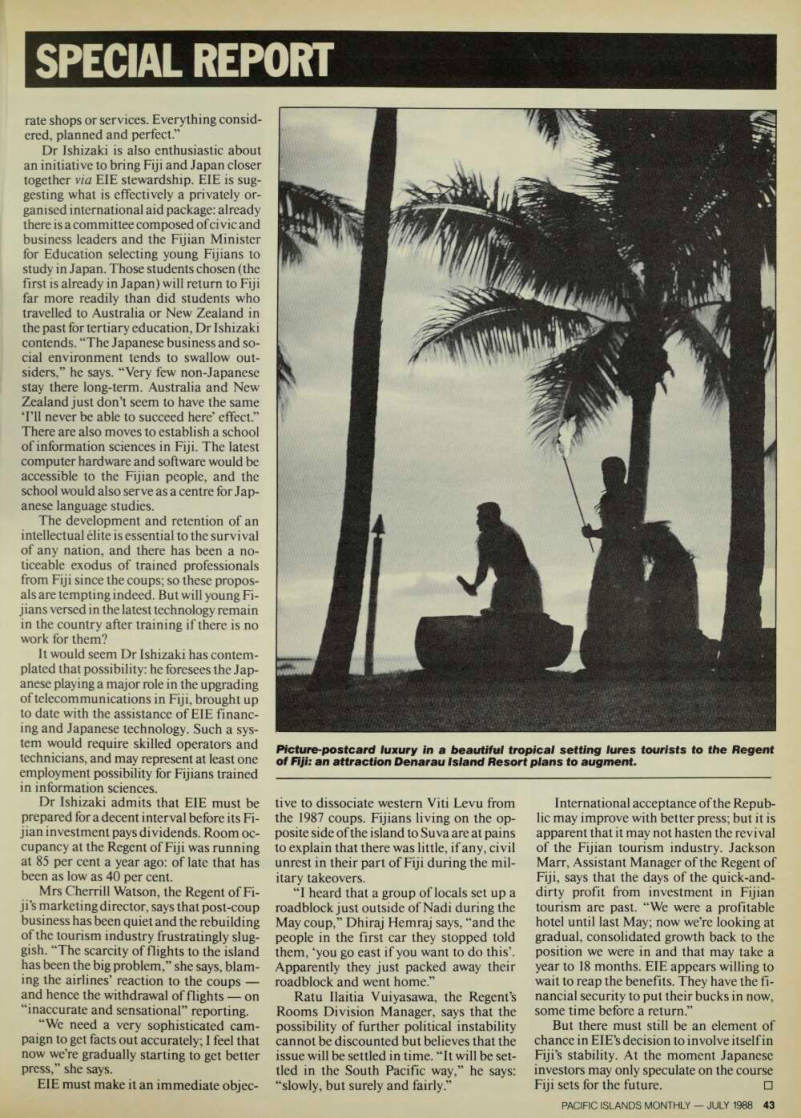
Picture-postcard luxury in a beautiful tropical setting lures tourists to the Regent of Fiji: an attraction Denarau Island Resort plans to augment.