Hunting The Relics of War
pp. 25-26 · Read in the full issue
Solomon Islands
David J Haden searches for memories of World War II in the Shortland Islands.
ATRIP to the Solomon Islands is a must for those interested in World War II relics, but outside Honiara, the capital, organised tours to battlefields and relics are virtually non-existent. My friend Tony Lee and I chose to go to the northernmost part of the Solomons, the Shortland Islands, and were therefore forced to rough it. Information on the Shortland Islands is hard to find and a trip to the Island simply means going and doing your own thing.
The Shortland Islands airstrip, Bal lalae, looks quite small from above and Tony and I wondered if it was long enough for our Piper Aztec to make a safe landing, but the Japanese used this trip in wartime for hundreds of Betty bombers and freight planes so I knew we should have no trouble setting down on the bumpy grass strip that stretches the full length of Ballalae Island.
We alighted to find a large group of lo cals scattered around the tiny terminal building. Some were waiting for mail or supplies; others were just out for a stickybeak.
We had been told that there was a small unofficial guest house at Korovou, the main settlement of the Shortlands, where we could stay. To reach Korovou from Bal lalae airstrip meant an open canoe ride with a young gung-ho skipper who pushed the outboard motor to the limit, thus en suring that Tony and I were drenched.
At Korovou we were told there was no longer any accommodation for visitors but there was a gentleman on nearby Porpor ang Island who could accommodate us for a few days. So off we went for another canoe trip. This was a vast improvement on the previous trip, with the shelter of Shortland and Porporang Islands making the sea calm and the waters clear and inviting.
We stopped twice briefly to be shown two submerged Japanese planes, ideal for snorkelling on. But after about 10 minutes we found ourselves at Nila, the main set tlement on Porporang Island. We pulled into a roughly made coral jetty with a small house our home for the next few days at its landward end. We were met by an elderly local, Dennis Moses, owner of the Nila Guest House.
Dennis was a friendly man, pleased to have some strangers stay at his house and was quick to ask why we were here and where we were from. There were no motor vehicles at Nila and the only way around the island was via small bush tracks. Den nis had done well to get the guest house established as building materials are ex pensive and hard to obtain.
When Tony enquired about toilet and washing facilities, Dennis pointed to a leaf hut on stilts mounted over the lagoon about 30 metres away. This was the toilet. Wash ing facilities consisted of a concrete slab about five metres to the rear of the house.
A pipe was mounted on a pole over the slab and this was the shower. No covering sur rounded this facility, so care was required when taking a shower not to offend any body watching from the surrounding bush and coconut groves.
The guest house was comfortable, and being the only guests we had the run of the place. However, we had to contend with the hordes of green ants whose sticky feet adhered to our skin long enough to deliver a small nip. A gas stove was provided for cooking and a kerosene hurricane lamp was our only form of light after dark. We had no food, so we took another canoe ride to buy some stores for our stay.
Food was expensive more than dou ble Honiara prices and consisted mainly of tinned food and small packets of noo dles. Tony and I chose carefully and parted with a large amount of cash for what seemed a small amount of food before heading back to the guest house.
There, we had the whole afternoon ahead of us so we set out on foot to look for some land-based World War II relics.
We did not have to go far. An old Jap anese plane wing lay just to the side of the track not far from the Catholic mission, just 10 minutes from the guest house; old
ammunition buildings were in the mis sion grounds and remains of flying boats lay strewn around the village. Floats, wings and sections of fuselage lay about, a legacy of the Japanese occupation of these is lands. I understood there were some Jap anese coastal defence guns mounted in the hills around Porporang Island, so we set out to find a guide to show them to us.
On the main track we met four young boys, of whom one volunteered to show us the guns on the hillside. The track started off well and we passed a Japanese-built fresh water pipeline still in good working order, and parts of an old Japanese truck used to ferry supplies to the regiment sta tioned near the guns on the hilltop.
After about 10 minutes of walking things grew more difficult; vegetation had taken over the track in places and the climb was near vertical at times. We went on and on in sticky heat, slipping and sliding along the muddy track damp from recent rain.
It soon became apparent that our young guide hadn’t a clue where he was taking us. I confronted him, asking where we were and how much longer it would be before we reached our destination.
He looked dumbfounded. I said “We’re bloody lost, aren’t we?” He sheepishly re plied, “Yes, boss.” We decided to return to the village.
Going down was quicker than going up.
We skidded down on our rears, hanging on to vegetation to keep us from hurtling out of control. After a 20-minute descent we ►
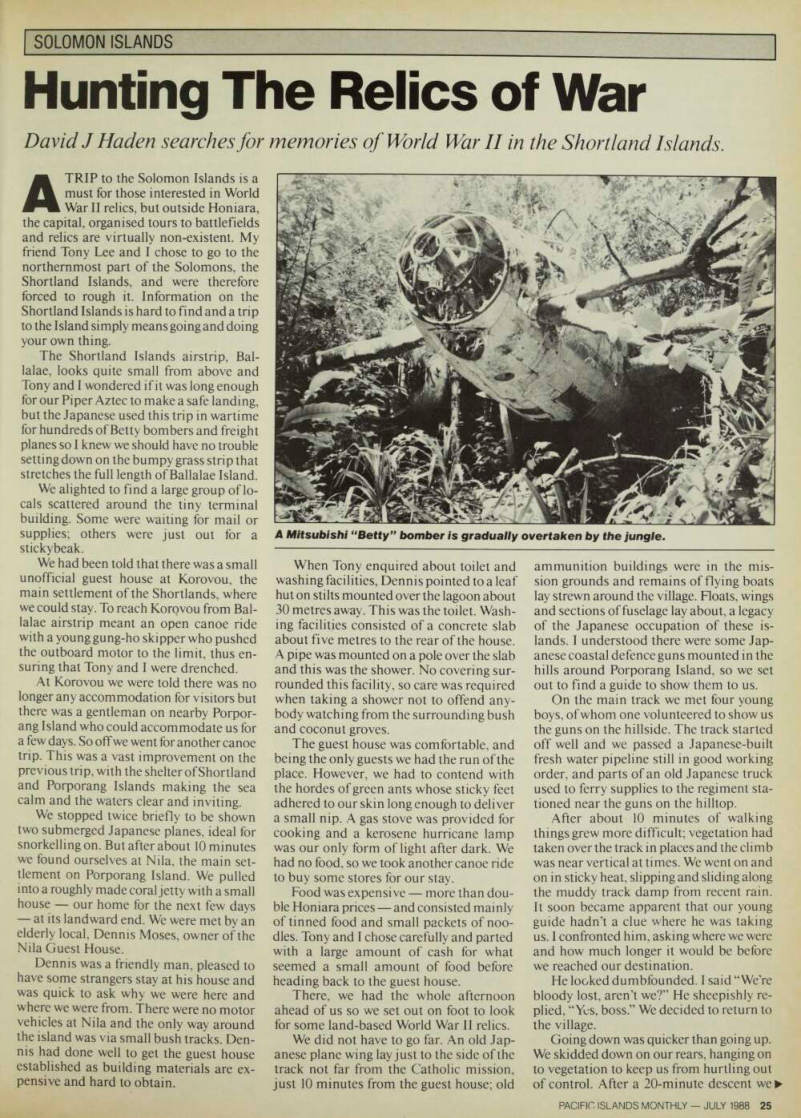
A Mitsubishi “Betty” bomber is gradually overtaken by the jungle.
◄reached the village . . . covered in mud, dirt, sweat and scratches. We headed back to the guest house to gather our thoughts and plan for tomorrow.
On the way back to the guest house we passed through a small village where the dwellings were made of traditional mate rials and the people were friendly. We stopped at the medical clinic at the Cath olic mission and were treated to fresh pineapple and a chat with local villagers.
The clinic was the meeting place in Nila. Tony was surprised at the “service fees”: one egg for band-aids, three eggs for ointment, one pineapple for pills and so on.
There, too, we met Porporang Island’s only expatriate, Father Cyril O’Grady of the Catholic Mission.
Father Cyril told us how to secure a canoe and guide to take us back to Ballalae
strip: a few Japanese trucks lay mangled and rusted in the thick growth and cans and drums littered the jungle floor. After crossing the runway we ventured into the interior and came across two Mitsubishi heavy bombers. They were in the jungle not far from the runway and had had quite a bit of equipment scavenged from them, but were still identifiable as G4M Mitsub ishi heavy bombers, known to the Allies as Bettys or to the Japanese as Hamaki.
We found the remains of about five Betty bombers on Ballalae in various states of decay. Only one was in fairly good con dition with most of the cockpit instru ments and fuselage intact; most had been stripped or vandalised and parts lay all around the aircraft, and nearly all were covered in growth and vines.
The heat as we climbed through the
airstrip to look for the Japanese planes left from the war. We would be picked up from the wharf at 6.30 the next morning.
Darkness settles around 6.30 pm in the Shortlands and we sat in front of the guest house to watch the sun set behind stormy clouds and flashes of lightning from the west. Once the sun went the mosquitos at tacked, but fortunately we had repellent. It was peaceful and quiet, with only the sound of the night creatures to be heard.
We were up at daylight: I was the first to try the leaf toilet, and had to compete with the mangrove crabs for the seat.
Breakfast was a cup of coffee and some tinned cake, then we sat down to wait for our hosts to arrive for the trip by canoe to Ballalae. At 9.30 a canoe pulled up at the wharf and an elderly local clambered out.
After we introduced ourselves, we haggled on a fair price and then set off for Ballalae.
There, we trekked into the bush toward the runway, our bodies coated with insect repellent as ticks and fleas were rife. We encountered the debris of war near the air
jungle soon sapped our energy, and large black stinging ants gave us hell. Remnants of war lay everywhere on the jungle floor: cans, drums, sake bottles, live ammuni tion and remains of trucks and road con struction equipment in various stages of rust and decay. Photography was ham pered by the thick overhead growth that filtered out light.
Father Cyril had mentioned that the airstrip that stretches from one end of the island to the other was built by about 200 prisoners of war in cruel and harsh con ditions. Many of the POWs died from dis ease or at the hands of their Japanese captors: some say they were Australians, others that they were British brought over from Singapore. It would have been a de bilitating task to build an airstrip in that heat and jungle.
After the best part of a day on Ballalae we headed back to Nila for a cold shower, a rest and a chance to compare our notes and views on the day’s expedition. Den nis, waiting for us at the guest house, men
tioned there were remains of Japanese flying boats near the village just short of the Catholic mission.
We wandered over to take a look and were amazed to find the remains of four planes stashed together in the growth next to the mangroves. Each had been stripped of working parts and the remaining fuse lages were strewn about the bush. Identi fying the planes was difficult, but it was clear that at least a couple were Aichi EI3A “Jake” three-seater reconnaissance float planes, among the most popular recon naissance seaplanes used during the war.
Local elders informed us that the Jap anese seaplane base there was quite large during the war and many seaplanes had been stationed in the lagoon between Por porang and Shortland Island. The elders also said that the Japanese had built a ra dar station and searchlight facility atop a hill overlooking Nila, not far from the coastal defence guns we had sought previously.
Later that day Father Cyril introduced us to a local elder who would guide us to the coastal defence guns, radar and searchlight installations all in one morn ing. That suited us fine.
We were up early next morning, ready for our walk to the guns. Armed with our cameras and plenty of film we headed off toward the hill via a different track from that we had taken earlier in the week.
After 15 minutes’ casual walking along a relatively well worn track we came to the remains of an old command centre. Empty sake bottles lay amid rusty ration tins, fur ther along the rail there were the remains of a Japanese army truck, and nearby a motorbike and sidecar still with rotting rubber on its wheels but with engine intact.
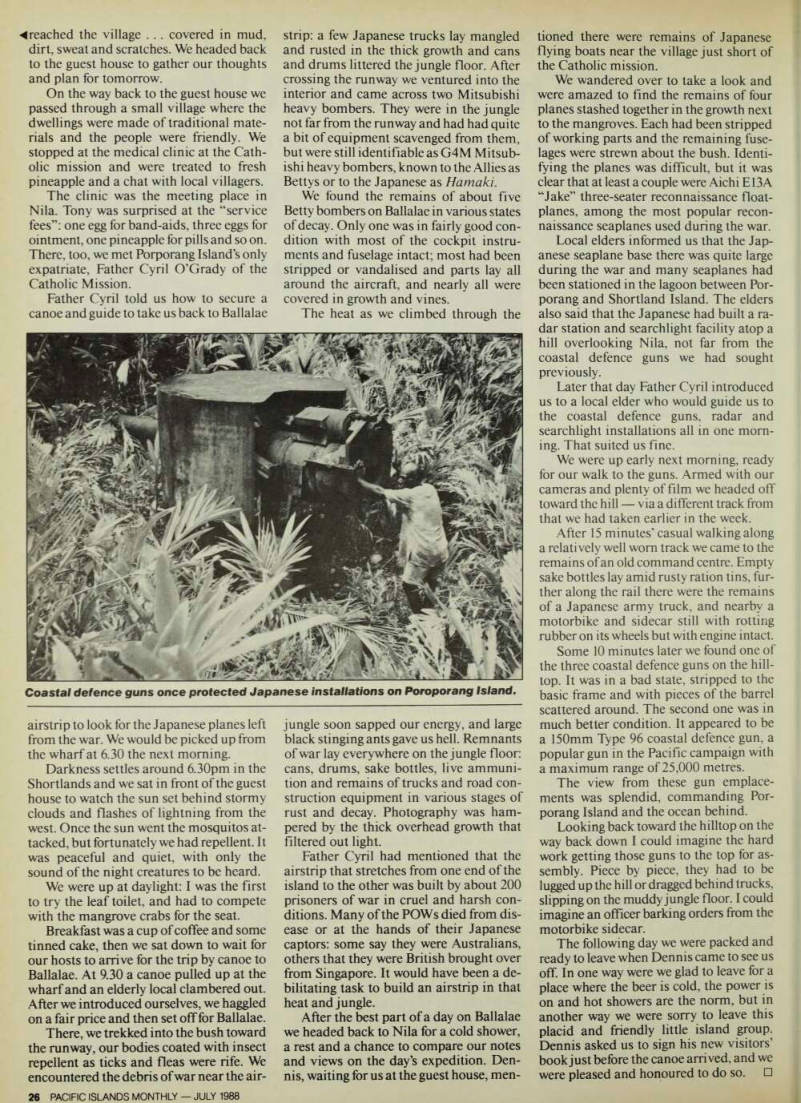
Some 10 minutes later we found one of the three coastal defence guns on the hill top. It was in a bad state, stripped to the basic frame and with pieces of the barrel scattered around. The second one was in much better condition. It appeared to be a 150 mm Type 96 coastal defence gun, a popular gun in the Pacific campaign with a maximum range of 25,000 metres.
The view from these gun emplace ments was splendid, commanding Por porang Island and the ocean behind.
Looking back toward the hilltop on the way back down I could imagine the hard work getting those guns to the top for as sembly. Piece by piece, they had to be lugged up the hill or dragged behind trucks, slipping on the muddy jungle floor. I could imagine an officer barking orders from the motorbike sidecar.
The following day we were packed and ready to leave when Dennis came to see us off. In one way were we glad to leave for a place where the beer is cold, the power is on and hot showers are the norm, but in another way we were sorry to leave this placid and friendly little island group.
Dennis asked us to sign his new visitors’ book just before the canoe arrived, and we were pleased and honoured to do so. □
Coastal defence guns once protected Japanese installations on Poroporang Island.