Courtesy East-West Center, Hawaii
pp. 23-24 · Read in the full issue
The Region
Islanders Remember WWII
The region’s people present their view ofglobal conflict.
By Ed Rampell
HISTORY IS usually written by the victors, but a recent symposium on World War II in the Pacific pre sented the conflict from the perspective of the victims. Hawaii’s East-West Centre’s “Cultural Encounters in the Pacific War” conference voiced the views of islanders caught up in the war.
Islanders’ analyses of the war and its legacy are very different from the histories promulgated by Allied and Axis chroni clers, correspondents, apologists and pro pagandists. This new picture of World War 11, based largely on oral history, emerged from the papers and talks of the 24 island ers, academics, anthropologists and his torians who participated.
The keynote address was presented by John Waiko, University of Papua New Guinea history professor, who delivered a dialectical interpretation of World War 11.
He said the war was a catastrophe of apoc alyptic proportions for Pacific islanders; one that thrust them into the 20th century and brought culture shock in the wake of superpower militarism.
According to Waiko, there was one for eign soldier per Papua New Guinean in PNG during the war years, and the sol diers’ presence left many, impressions.
These included white looting, which de stroyed the soldiers’ veneer of superiority, and Australian soldiers being more egali tarian than colonists. Also, the war changed society forever. For example, skilled elders were killed during the fight ing and their canoe building talents were lost with them; and more than 55,000 natives were recruited as labourers, which further shattered village life.
Other speakers from Melanesia, Mi cronesia and Polynesia evidenced similar patterns of disruption to island life.
But not all changes were negative: as in the rest of the Third World, the war helped to break down colonialism in Oceania.
Jonathan Fifi’i, a Solomon Islander and veteran independence leader, told the conference: “The war was good, because the ousted British colonisers were evil. ..
The British were worse than the Japa nese.” The elder spoke of the harsh colon ial conditions in his homeland before the war: Fifi’i still bears a scar beneath his eye caused when an Englishwoman smashed an egg into her servant’s face over a minor breach of etiquette.
“The American presence after the bat tle for Guadalcanal greatly upset the racist caste system of Solomons colonialism,” said Fifi’i. The Americans, who came as liberators, not as conquerors or colonis-
ers, were egalitarian toward the natives, which unnerved the British colonial es tablishment. Black Americans in partic ular challenged the Solomons status quo.
Although they served in segregated units, these soldiers wore uniforms, were armed and had control over the all-important cargo. They urged their fellow blacks to stand up and speak out against their co lonisers. According to Dr Lament Lind strom of the University of Tulsa’s Anthropology Department, this dynamic was also true in Vanuatu.
A number of Japanese papers at the conference stressed that the Japanese presence, too, fostered anti-colonial feel ings among Melanesians. In theory, Ja pan’s “Greater East-Asia Co-Prosperity Sphere” aimed to remove European co lonialism from the Pacific Rim, but in reality, according to many observers, it proved to be a form of Asian fascism and imperialism.
Australia’s Brisbane College lecturer Basil Shaw suggested that the 1942-1945 Japanese occupation of the Wewak-Lower Sepik River areas in what is now PNG greatly influenced the character and world view of the nation’s first Prime Minister, Michael Somare. One Japanese occupa
tion forces soldier in particular, judicial affairs officer Yukio Shibata, inspired young Somare in the lad’s home village in the Murik Lakes. As key administrator for the Karau Lagoon district, Shibata estab lished a school system to educate the Papua New Guineans.
This was the eight-year-old Somare’s first formal education, which “was pro vided by .. . the Japanese, who were fa vourably different from the white men he had seen in Rabaul”. Shibata claimed that the goal of his Shinto-style village school ing was to inculcate the abilities and atti tudes necessary for “self-determination.
Somare was motivated by a desire for self determination ... Shibata may have planted this seed”.
This aspect should be put into the con text of the growth of “disaffected” Papua New Guineans who had rebelled against European authority in early 1942. The Japanese also displayed greater “equality” in their dealings with the Melanesians than did whites, working, eating, and so on alongside them and respecting black womanhood, unlike many Allied soldiers who “seduced native women”.
The Micronesian experience during the war was markedly different from that of ►
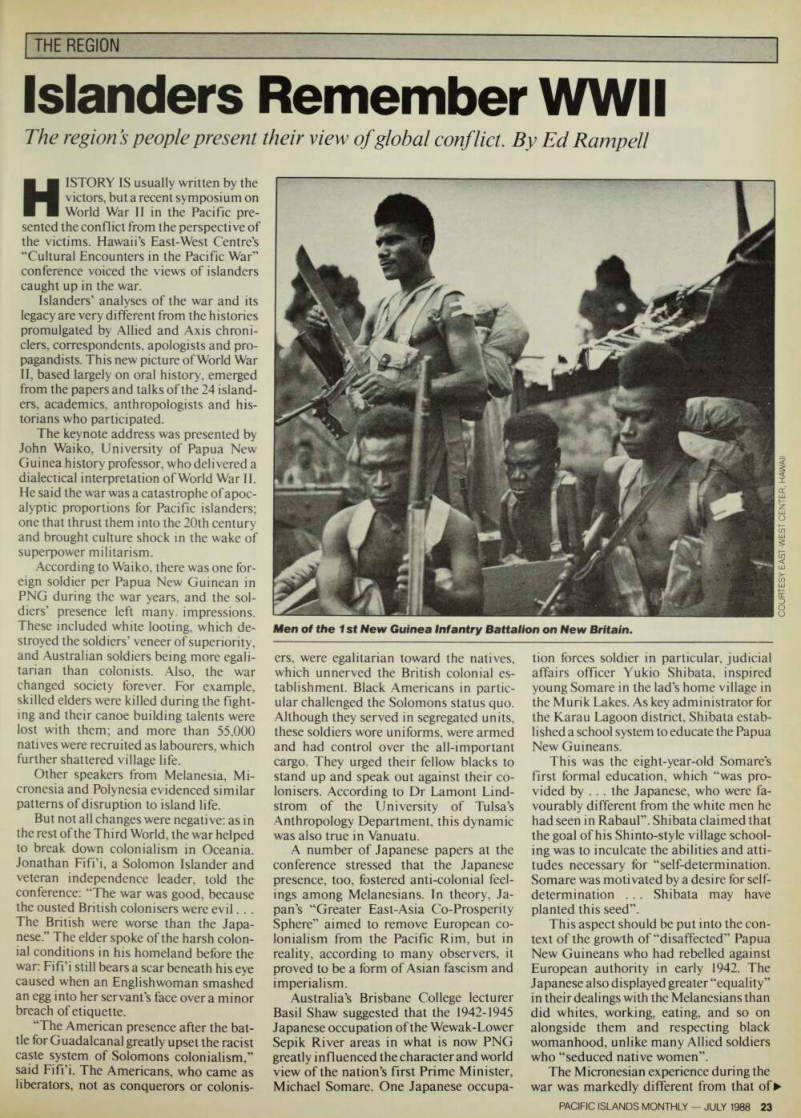
Men of the 1st New Guinea Infantry Battalion on New Britain.
Courtesy East-West Center, Hawaii
* Melanesia. By the 19405, most of Micro nesia had already been administered by Tokyo for three decades as part of the Lea gue of Nations mandate spoils of an ear lier world war. Japan’s South Seas empire was marked by extensive economic de velopment and settlement by large num bers of Japanese, eventually outnumbering the islanders, who lived in apartheid-like conditions. In the late 19305, Japan forti fied and annexed Micronesia in violation of League rules and went on to betray the altruistic intent of the League mandate to improve conditions for the native inhabitants.
Once World War II began, Japanese co lonialism became cruel. Japan’s invasions of the parts of Micronesia not already un der its rule were devastating and included atrocities and slavery. This was made clear in the documentary Liberation 40 about wartorn Guam, and in the presentation by Sam Highland of Kiribati, who com plained that fighting at Tarawa totally de stroyed the abundant subsistence way of life. Betio Village has never recovered from this destruction, and must today depend on imported foods.
Polynesia was spared the worst of the war, though its effects were felt even on those isles most remote from the conflict.
A massive presence of US troops at Bora Bora and Pago Pago did not pass unnot iced. According to Robert Franco of Hon olulu’s Kapiolani Community College and Samoan Tuala Sevaaetasi, the opportu nity for wage labour undermined both the traditional subsistence economy and the matai system at Tutuila. To this day, American Samoans and Guamanians see the military as a stepping stone “off the rock”, and during the Vietnam War these two nationalities had the highest casual ties of any ethnic group in the US.
The aftereffects of World War II still resonate in many ways in Oceania. Ac cording to Dr Geoffrey White, the East- West Centre Research Associate and an thropologist who co-ordinated the confer ence, “casualty figures for natives during the war are uncertain. Out of a population of about two million indigenous people in what is now PNG, 50,000 died.”
Indo-Fijian History Professor Dr Brij Lai of the University of Hawaii stressed that the war “totally transformed the Fiji Defence Forces into the Fiji Military Forces. Instead of an internal unit, Fijian soldiers could now be deployed anywhere.
In World War II they served in the Solo mons, and in the 50s in Malaya, fighting against Chinese communists ... the war made Fiji’s military the potent force it has become. During the war the military be came dominated by Taukei. The British colonial Government and the Fijian chiefs saw the military as a tremendous power and refused to open up recruitment to oth ers. The British portrayed the Fijian In dians as lacking enthusiasm for the war effort... In fact, they didn’t want Indians
to join the military so they could continue to work the cane plantations.”
The nuclear-free and independent Pa cific movement is a direct outgrowth of World War 11. Palauan legislator Tosiwo Nakamura has said he introduced the anti nuclear clause to Palau’s constitution be cause the Peleliu native had been horri fied by the annihilation wrought by the war in his islands. In the postwar period Nak amura, who is part-Japanese, also trav elled to Hiroshima and Nagasaki and witnessed there the awesome effects of atomic warfare.
World War II began and ended for the US in Micronesia. The Pearl Harbour at tack by Japan was deployed out of the Marshall Islands, and the atomic bomb ing of Japan was launched from Tinian, in the Northern Marianas. Critics of US pol icy in the Trust Territory of the Pacific Is lands among them Mikhail Gorbarchev have charged that Washington has “an nexed” Micronesia, betraying the benev olent intention of the United Nations trusteeship in order to further US military and strategic interests.
After two global conflagrations Pacific peoples today have retreated into a sort of island isolationism in an attempt to min imise yet another conflict not of their making nor in their interest, but one that nevertheless engulfs them. The nuclear free movement is, to many islanders, the most pragmatic politics possible. Islands dotting the map may merely be potential bases and targets to the great powers, but for Pacific islanders these specks are the only homes they have on earth; homes they are seeking to preserve from the super power folly of World War 111. □
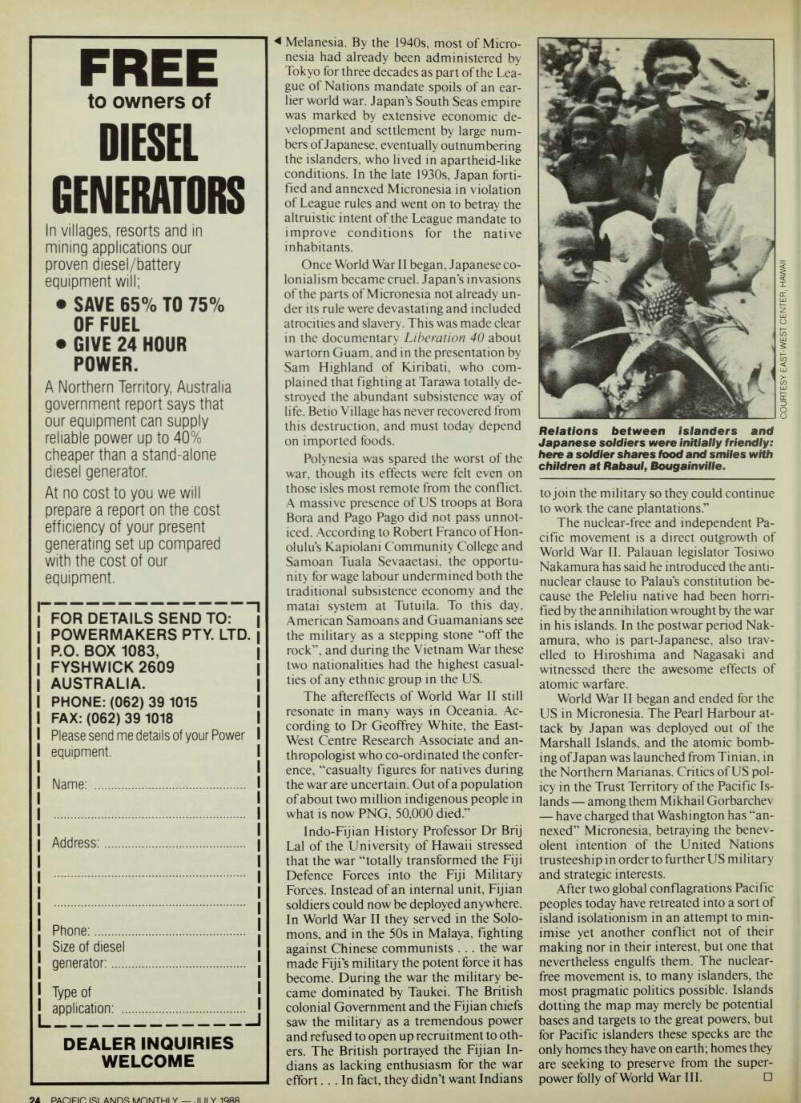
Relations between islanders and Japanese soldiers were initially friendly: here a soldier shares food and smiles with children at Rabaul, Bougainville.