Tuna Bill Passed
p. 22 · Read in the full issue
United States
The controversial US fishing treaty gets .the go-ahead.
By David S North
THE TUNA treaty between the United States and the island governments is at last to move into action. Millions of US dollars will go to the islands, buying American tuna boats the right to fish in 200-nautical-mile Eco nomic Exclusion Zones with impunity. But the treaty has been ratified only after a bi zarre and time-consuming passage in the US Congress.
The drama had little to do with the tuna treaty being controversial; rather, of all things, the implementation of the treaty was snagged in a no-holds-barred political fight over New York City’s nasty habit of dumping sewage sludge in the Atlantic Ocean, off the coast of New Jersey.
It happened like this: The tuna treaty (which allows the US Government and the tuna industry to pay the island nations SUSI 4 million a year for the next several years’ tuna harvests) had been agreed to in Tonga in October 1986; it had been signed in Port Moresby in April 1987 and had been approved 89-0 earlier this year by the US Senate. President Reagan had signed it and most of the island govern ments had ratified it but that was not enough. In America’s government of checks-and-balances, no funds can be spent until so-called enabling legislation has moved through both Houses of Con gress ... and therein lay the rub.
The tuna bill was duly introduced in both the US Senate and in the House of Representatives; the bill itself had no ene mies and its passing was regarded as es sential to meet the nation’s international
commitments, but it attracted a variety of amendments dealing with other issues that probably could not be passed if they were separated from the host bill.
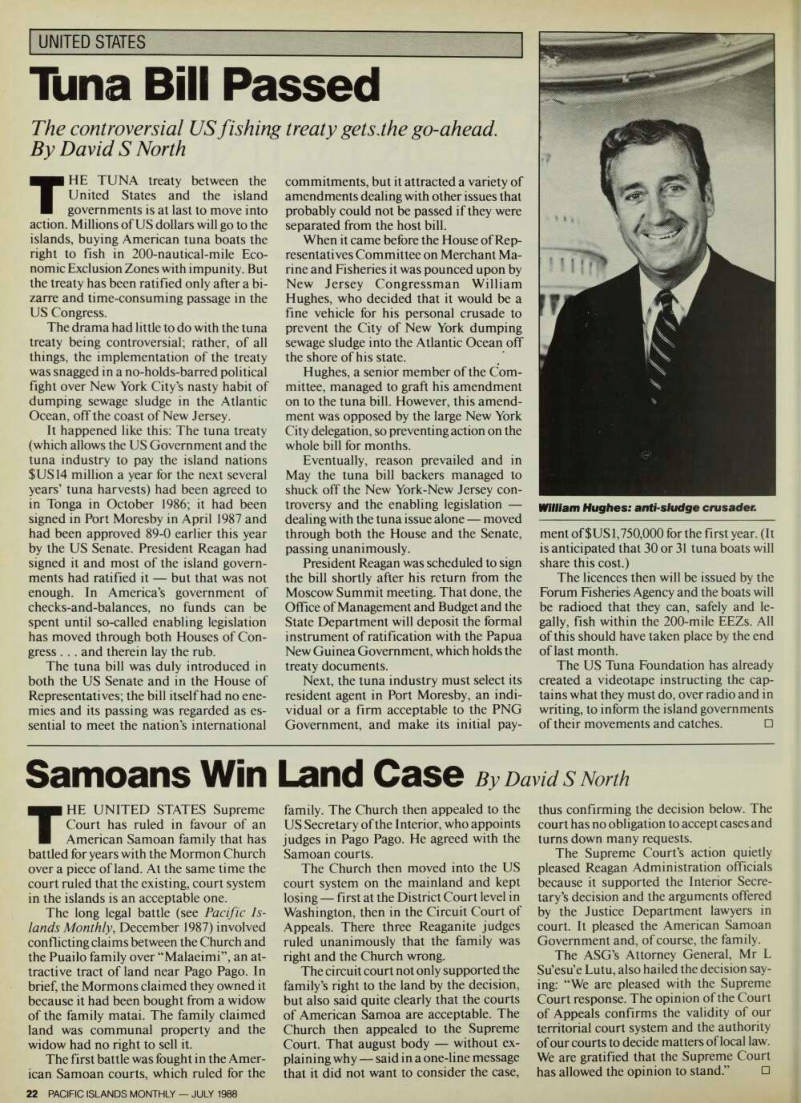
When it came before the House of Rep resentatives Committee on Merchant Ma rine and Fisheries it was pounced upon by New Jersey Congressman William Hughes, who decided that it would be a fine vehicle for his personal crusade to prevent the City of New York dumping sewage sludge into the Atlantic Ocean off the shore of his state.
Hughes, a senior member of the Com mittee, managed to graft his amendment on to the tuna bill. However, this amend ment was opposed by the large New York City delegation, so preventing action on the whole bill for months.
Eventually, reason prevailed and in May the tuna bill backers managed to shuck off the New York-New Jersey con troversy and the enabling legislation dealing with the tuna issue alone moved through both the House and the Senate, passing unanimously.
President Reagan was scheduled to sign the bill shortly after his return from the Moscow Summit meeting. That done, the Office of Management and Budget and the State Department will deposit the formal instrument of ratification with the Papua New Guinea Government, which holds the treaty documents.
Next, the tuna industry must select its resident agent in Port Moresby, an indi vidual or a firm acceptable to the PNG Government, and make its initial pay-
merit of SUS 1,750,000 for the first year. (It is anticipated that 30 or 31 tuna boats will share this cost.) The licences then will be issued by the Forum Fisheries Agency and the boats will be radioed that they can, safely and le gally, fish within the 200-mile EEZs. All of this should have taken place by the end of last month.
The US Tuna Foundation has already created a videotape instructing the cap tains what they must do, over radio and in writing, to inform the island governments of their movements and catches. □
William Hughes: anti-sludge crusader.