Arms Finds Spark Furore
p. 20 · Read in the full issue
Fiji
Gun-running reports long on rumour, short on facts.
By Jai Kumar
THE ALREADY tense atmosphere of the South Pacific was high lighted late in May the discovery by Australian Customs in Sydney of a 16tonne container of arms and ammunition.
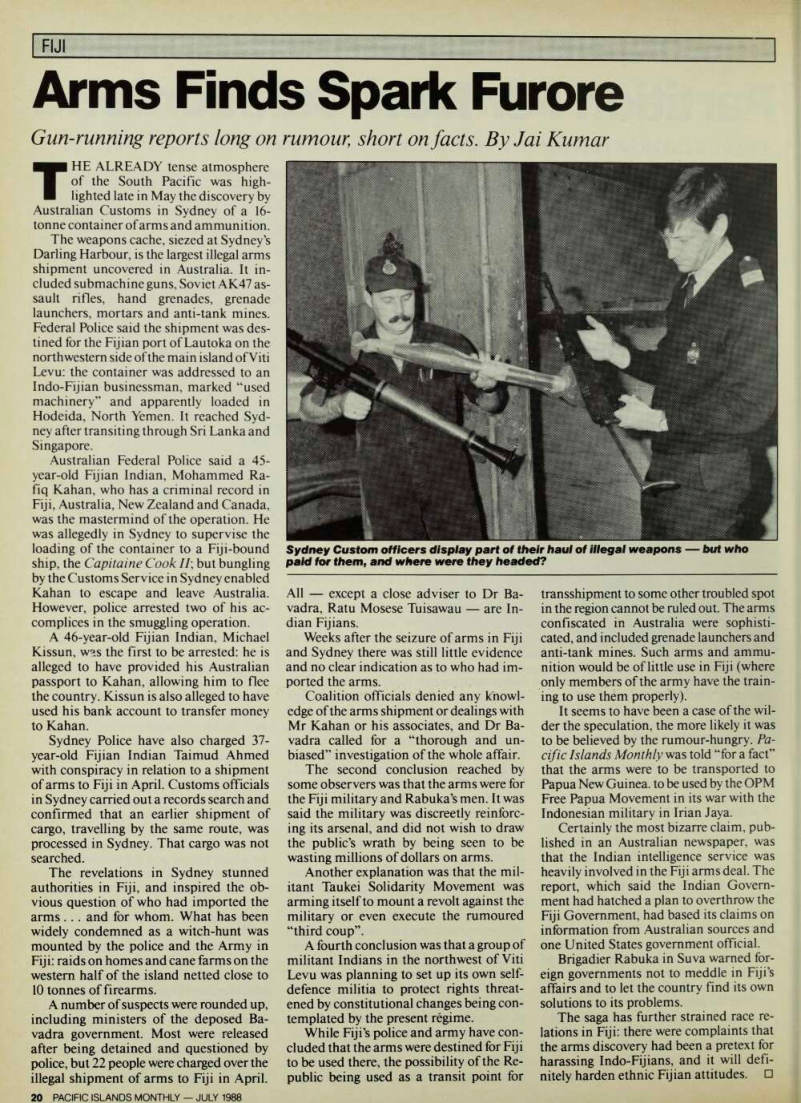
The weapons cache, siezed at Sydney’s Darling Harbour, is the largest illegal arms shipment uncovered in Australia. It in cluded submachine guns, Soviet AK47 as sault rifles, hand grenades, grenade launchers, mortars and anti-tank mines.
Federal Police said the shipment was des tined for the Fijian port of Lautoka on the northwestern side of the main island of Viti Levu: the container was addressed to an Indo-Fijian businessman, marked “used machinery” and apparently loaded in Hodeida, North Yemen. It reached Syd ney after transiting through Sri Lanka and Singapore.
Australian Federal Police said a 45year-old Fijian Indian, Mohammed Ra fiq Kahan, who has a criminal record in Fiji, Australia, New Zealand and Canada, was the mastermind of the operation. He was allegedly in Sydney to supervise the loading of the container to a Fiji-bound ship, the Capitaine Cook //; but bungling by the Customs Service in Sydney enabled Kahan to escape and leave Australia.
However, police arrested two of his ac complices in the smuggling operation.
A 46-year-old Fijian Indian, Michael Kissun, was the first to be arrested: he is alleged to have provided his Australian passport to Kahan, allowing him to flee the country. Kissun is also alleged to have used his bank account to transfer money to Kahan.
Sydney Police have also charged 37year-old Fijian Indian Taimud Ahmed with conspiracy in relation to a shipment of arms to Fiji in April. Customs officials in Sydney carried out a records search and confirmed that an earlier shipment of cargo, travelling by the same route, was processed in Sydney. That cargo was not searched.
The revelations in Sydney stunned authorities in Fiji, and inspired the ob vious question of who had imported the arms... and for whom. What has been widely condemned as a witch-hunt was mounted by the police and the Army in Fiji: raids on homes and cane farms on the western half of the island netted close to 10 tonnes of firearms.
A number of suspects were rounded up, including ministers of the deposed Ba vadra government. Most were released after being detained and questioned by police, but 22 people were charged over the illegal shipment of arms to Fiji in April.
All except a close adviser to Dr Ba vadra, Ratu Mosese Tuisawau are In dian Fijians.
Weeks after the seizure of arms in Fiji and Sydney there was still little evidence and no clear indication as to who had im ported the arms.
Coalition officials denied any knowl edge of the arms shipment or dealings with Mr Kahan or his associates, and Dr Ba vadra called for a “thorough and un biased” investigation of the whole affair.
The second conclusion reached by some observers was that the arms were for the Fiji military and Rabuka’s men. It was said the military was discreetly reinforc ing its arsenal, and did not wish to draw the public’s wrath by being seen to be wasting millions of dollars on arms.
Another explanation was that the mil itant Taukei Solidarity Movement was arming itself to mount a revolt against the military or even execute the rumoured “third coup”.
A fourth conclusion was that a group of militant Indians in the northwest of Viti Levu was planning to set up its own self defence militia to protect rights threat ened by constitutional changes being con templated by the present regime.
While Fiji’s police and army have con cluded that the arms were destined for Fiji to be used there, the possibility of the Re public being used as a transit point for
transshipment to some other troubled spot in the region cannot be ruled out. The arms confiscated in Australia were sophisti cated, and included grenade launchers and anti-tank mines. Such arms and ammu nition would be of little use in Fiji (where only members of the army have the train ing to use them properly).
It seems to have been a case of the wil der the speculation, the more likely it was to be believed by the rumour-hungry. Pa cific Islands Monthly was told “for a fact” that the arms were to be transported to Papua New Guinea, to be used by the OPM Free Papua Movement in its war with the Indonesian military in Irian Jaya.
Certainly the most bizarre claim, pub lished in an Australian newspaper, was that the Indian intelligence service was heavily involved in the Fiji arms deal. The report, which said the Indian Govern ment had hatched a plan to overthrow the Fiji Government, had based its claims on information from Australian sources and one United States government official.
Brigadier Rabuka in Suva warned for eign governments not to meddle in Fiji’s affairs and to let the country find its own solutions to its problems.
The saga has further strained race re lations in Fiji: there were complaints that the arms discovery had been a pretext for harassing Indo-Fijians, and it will defi nitely harden ethnic Fijian attitudes. □
Sydney Custom officers display part of their haul of illegal weapons -but who paid for them, and where were they headed?