Why The Coalition Failed
pp. 13-14 · Read in the full issue
Papua New Guinea
Frank Senge examines the saga of attempts to bring political stability to PNG
IT WAS to be Papua New Guinea’s political marriage of the decade. But the Grand Coalition of the country’s two largest parties effectively the Government and the Opposition turned out to be a second-rate farce.
On Wednesday, May 25, Prime Min ister Paias Wingti and Opposition Pangu Pati leader Rabbie Namaliu signed into existence the merger of Mr Wingti’s People’s Democratic Movement (PDM) and former PM Michael Somare’s Pangu Pati, now led by Mr Namaliu. (See Pacific Islands Monthly , June).
Plagued by constant no confidence motions; a weak electoral system; a less than adequate provincial government sys tem; scores of senior government minis ters and members facing serious charges; and continous jockeying for power and material benefits by politicians, the two leaders decided to combine to weed out the bad and make the necessary constitu tional amendments.
Their combined numbers gave them 60 members, five more than the number needed to gain government. To make con stitutional amendments they needed only 12 more votes: these could be supplied by the five existing government coalition partners, who could muster 34 votes.
It looked as if for the first time in 12 years of independence, PNG would get a stable government.
But the two leaders either overplayed their hand or underestimated the various regional factions in their camps. The Grand Coalition lasted exactly seven days.
The following Wednesday, June 1, Mr Wingti dumped Pangu for its smaller Op position partner, the National Party headed by Michael Mel.
Even for a country used to constant changes of governments and leadership, the collapse of the Coalition was a record, beaten only by the failure of the Grand Coalition formed by the same two parties in April.
In that earlier marriage, sealed with a handshake by Mr Wingti and Mr Somare, the two parties had split up in two and a half days.
The double divorce, effected within 39 days, has sent the two parties reeling, al most certainly not to come together in such a marriage bid again at least not in this term of Parliament. And the question re maining in most people’s minds is why such an ideal coalition aimed at bring ing stability to the nation’s political sys tem failed not once, but twice.
The parties concerned are not giving
any straight answers. Mr Wingti, with his normal reluctance to assign blame, said the talks are history now and that he still re spects the spirit of the negotiations.
On the day he dumped Pangu he claimed that the entire understanding had been that Michael Somare would partici pate in the new Government. Even before the new cabinet was formed,’ the Foreign Affairs portfolio was reserved for him; but in the final days of negotiations Mr So mare, who had earlier accepted the port folio, declined.
Pangu, as is its wont, has piled all the blame on Mr Wingti. It claims Mr Wingti never had any intention of forming a Government and instead wanted to de stroy Pangu, his only real threat. It claims Mr Somare’s participation was never cen tral to the discussions, and that Mr Wingti was aware Mr Somare wanted out days be fore his decision.
The Grand Coalition (at least in the minds of its authors) was aimed at bring ing political stability to the country. But in its drawn-out and secret negotiations
and its dual failure, it cre ated the exact opposite: widespread confusion and uncertainty.
Several factors were apparently at work, most of them centred around new Pangu Pati leader Rabbie Namaliu.
It seems Mr Namaliu’s heart was in the first mar riage, but not the second.
He withdrew as principal negotiator after the first coalition failed, and re fused to have any part in the talks toward the sec ond. At the last minute re sponsibility was thrust on him when Mr Somare stepped down as party leader; the party caucus unanimously voted Mr Namaliu leader at a time when negotiations had already matured.
He tried to back the party out of the deal. Too late. He resigned from the party twice, two days after he was voted leader, but the caucus would not accept his resignation.
Reluctantly, he signed the memoran dum of understanding committing Pangu to a marriage with Mr Wingti’s People’s Democratic Movement, a union he was certain would fail again.
At the same time, as negotiations were going on with the PDM, Mr Namaliu was also involved in separate talks to form a New Guinea Islands Leaders Forum com prising politicians from the region. The forum voted as its leader former Minerals and Energy Minister John Kaputin.
When, during the talks with PDM, Mr Namaliu realised Mr Kaputin was going to be dropped as a Minister, he pressed for him to be included. As well, he wanted to include in the Coalition the Melanesian Alliance party headed by Father John Momis another New Guinea Islands man. The Prime Minister turned down both requests. ►
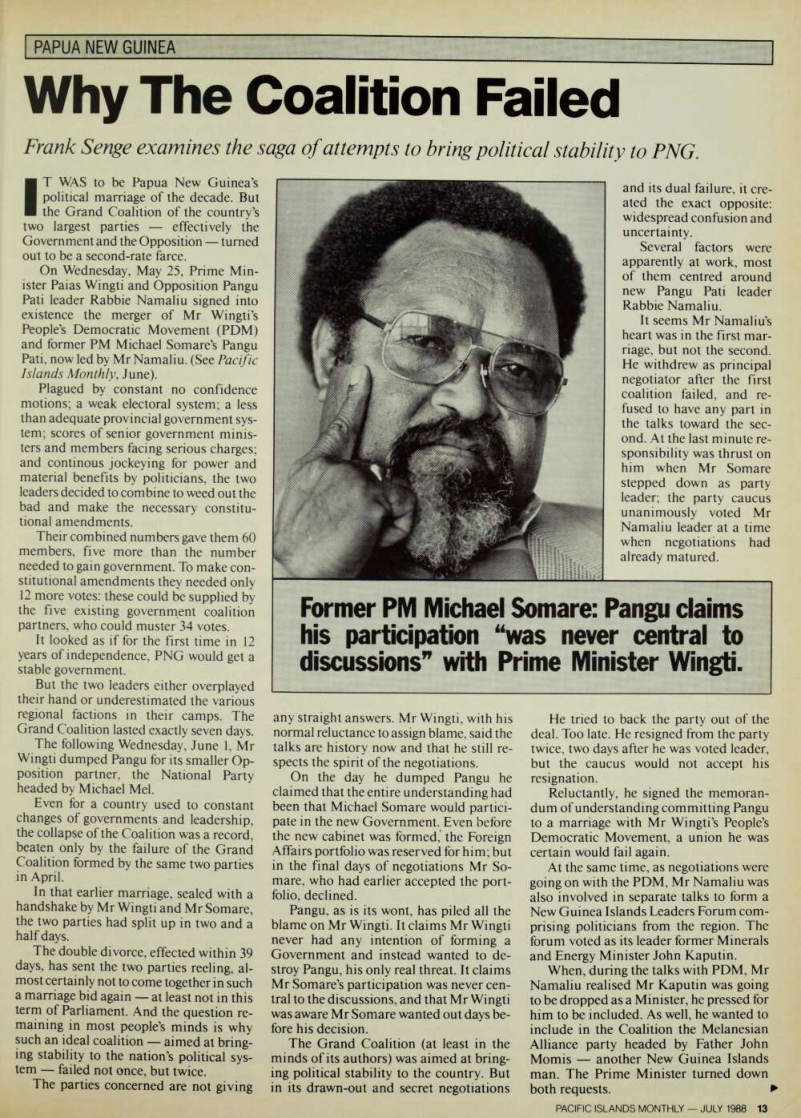
Former PM Michael Somare: Pangu claims his participation “was never central to discussions” with Prime Minister Wingti.
◄ A second reason was the regional in fighting within both the camps. When ministries were finalised, Highlanders in the Pangu camp realised only one was to be given to them. Embittered, they re quested fellow Highlander Paias Wingti to drop Pangu.
Within Mr Wingti’s own party there was equally fierce fighting, this time among Highlanders themselves. The party pressed Mr Wingti to step out of his four members to one ministry ratio and allo cate two extra ministries: Mr Wingti re fused to do this, too, and when Pangu was finally dropped four Southern Highlan ders withdrew from PDM, claiming that they had been promised a ministry.
Third, Mr Wingti was very reluctant to leave former Coalition partners, particu larly Sir Julius Chan’s People’s Progress Party, out of the Coalition. He tried to break his ministry ratio to allocate the PPP three ministries, when it would have re ceived only two with eight members in Parliament.
After the memorandum of under standing was signed, Mr Wingti asked Pangu for a weekend to talk to all his Co alition partners. Pangu reluctantly granted that time . .. since it was also demanding an additional, eighth ministry.
Mr Wingti’s announced reason that the Coalition had failed because of Mr So mare’s non-involvement was no more than a cover: Mr Somare had told Mr Wingti five days earlier that he would not be in volved, and his participation in govern ment was not central to the talks.
The Grand Coalition discussions be gan again in Brisbane, and again with Sir Julius Chan as mediator. While attending the opening of Expo 88 on April 30, Sir Ju lius and Mr Somare talked once more about forming a Grand Coalition.
Mr Somare called Pangu negotiators in Port Moresby and told them to begin ne gotiations at once. He went on to witness the opening of Federal Parliament in Can
berra, where he held further talks with Mr Wingti. When the leaders returned to PNG, dialogue had already been established.
For the next three weeks Transport Minister Roy Yaki and Labour and Em ployment Minister Masket langalio from the PDM camp and John Giheno, Pita Lus and Peter Garong from the Pangu camp
met almost each night to thrash out the details of the Coalition. Much of the talk centred on amendments to the constitu tion, namely the provisions regarding the votes of no confidence, electoral laws and the Organic Law on provincial governments.
Talks also touched briefly on one of the principal aims of a Grand Coalition: the need to “clean up” those politicians who were facing charges.
The negotiators were hampered in this —because one of them was facing charges himself. Mr Yaki is facing allegations of having misappropriated K 400,000 when he was Secretary General for the High lands Secretariat.
Others who were implicated in various deals or facing charges were Deputy Prime Minister Sir Julius Chan, over the Placer share controversy; Minister Assisting the Prime Minister Ted Diro, over his in volvement in the PNG forestry industry; and Agriculture and Livestock Minister Gai Duwabane, over a charge of conspir ing to defraud the PNG Harbours Board, While the Coalition has failed, certain of these matters are currently being con
sidered or have already been effected.
Messrs Diro and Duwabane have been dropped from their respective ministries, but while Mr Duwabane fades into the background to await the outcome of his charges, the last has certainly not been heard from Mr Diro.
His People’s Action Party, while still in government, has not been allocated any
ministry: two were al located to two former members of the party, Allan Ebu and Albert Karo, but as soon as they were settled in their ministries they announced they were joining the PDM. It is
understood the move was planned ahead of time in order for the two men to keep their ministries. Mr Diro is keeping quiet at the moment, but he features promi nently in various Opposition lists for al ternative governments.
Sir Julius Chan has stepped down as Deputy Prime Minister and Minister for Trade and Industry, pending a leadership tribunal decision over the Placer affair.
The Public Prosecutor referred Sir Ju lius to the tribunal on June 3. A week be forehand Mr Bona effectively dropped charges against 42 other leaders who had been charged with breaches of the lead ership code for their involvement in the Placer shares purchase, including the Chief Ombudsman and the Chief Justice. They were charged with negligence for not get ting permission from the Ombudsman while Sir Julius was additionally charged with conflict of interest and duty: he was Minister for Finance at the time of the Pla cer affair.
Sir Julius said: “This is the final test I must overcome. After so long, and after so much media coverage over the past two years, I deserve a proper hearing.
“Indeed, I have a right to one. I am an elected representative of the people, and I must obey the laws I helped legislate. If the laws are to be respected I must comply.”
In stepping down, Sir Julius has cre ated a problem for Mr Wingti: who is to become acting Deputy Prime Minister?
The man most logically placed to take that job is National Party leader Michael Mel. But Mr Mel is from the Highlands and, most importantly, he is from the Western Highlands, Mr Wingti’s home.
Can PNG tolerate a Prime Minister and Deputy PM from the same area?
Meanwhile, Mr Somare has written to the Speaker to withdraw his name as al ternate Prime Minister from the no con fidence motion. This makes the motion, sponsored in April’s short sitting, void.
Mr Namaliu refused to say if he was in tending to push ahead with another no confidence motion in the June 27 sitting, but it is certain that the bitter legacy of the shortlived marriage will continue to affect the immediate future of politics in Papua New Guinea. D
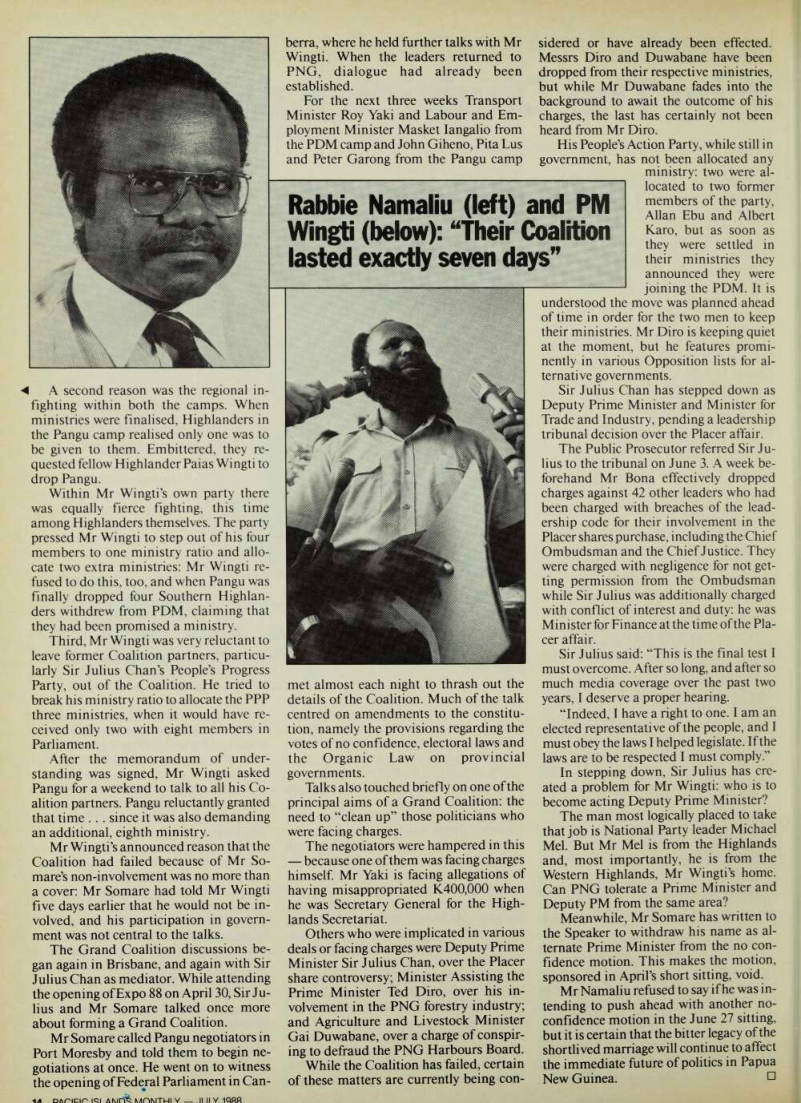
Rabble Namaliu (left) and PM Wingti (below): “Their Coalition lasted exactly seven days”