Port Vila Erupts
pp. 10-12 · Read in the full issue
Vanuatu
Barak Sope’s ill-fated bid to oust PM Walter Lini brought unprecedented riots and police violence to normally peaceful Vanuatu. David Robie reports.
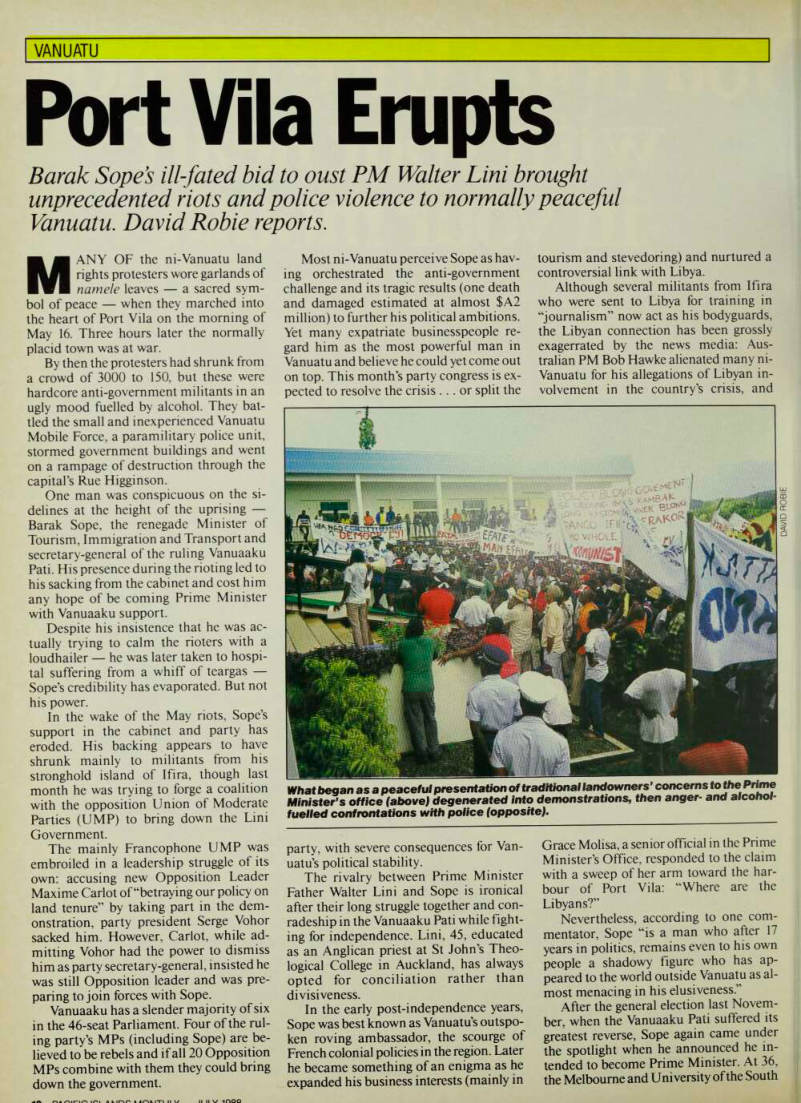
MANY OF the ni-Vanuatu land rights protesters wore garlands of namele leaves a sacred sym bol of peace when they marched into the heart of Port Vila on the morning of May 16. Three hours later the normally placid town was at war.
By then the protesters had shrunk from a crowd of 3000 to 150, but these were hardcore anti-govemment militants in an ugly mood fuelled by alcohol. They bat tled the small and inexperienced Vanuatu Mobile Force, a paramilitary police unit, stormed government buildings and went on a rampage of destruction through the capital’s Rue Higginson.
One man was conspicuous on the si delines at the height of the uprising Barak Sope, the renegade Minister of Tourism, Immigration and Transport and secretary-general of the ruling Vanuaaku Pati. His presence during the rioting led to his sacking from the cabinet and cost him any hope of be coming Prime Minister with Vanuaaku support.
Despite his insistence that he was ac tually trying to calm the rioters with a loudhailer he was later taken to hospi tal suffering from a whiff of teargas Sope’s credibility has evaporated. But not his power.
In the wake of the May riots, Sope’s support in the cabinet and party has eroded. His backing appears to have shrunk mainly to militants from his stronghold island of Ifira, though last month he was trying to forge a coalition with the opposition Union of Moderate Parties (UMP) to bring down the Lini Government.
The mainly Francophone UMP was embroiled in a leadership struggle of its own: accusing new Opposition Leader Maxime Carlot of “betraying our policy on land tenure” by taking part in the dem onstration, party president Serge Vohor sacked him. However, Carlot, while ad mitting Vohor had the power to dismiss him as party secretary-general, insisted he was still Opposition leader and was pre paring to join forces with Sope.
Vanuaaku has a slender majority of six in the 46-seat Parliament. Four of the rul ing party’s MPs (including Sope) are be lieved to be rebels and if all 20 Opposition MPs combine with them they could bring down the government.
Most ni-Vanuatu perceive Sope as hav ing orchestrated the anti-government challenge and its tragic results (one death and damaged estimated at almost SA2 million) to further his political ambitions.
Yet many expatriate businesspeople re gard him as the most powerful man in Vanuatu and believe he could yet come out on top. This month’s party congress is ex pected to resolve the crisis ... or split the
tourism and stevedoring) and nurtured a controversial link with Libya.
Although several militants from Ifira who were sent to Libya for training in “journalism” now act as his bodyguards, the Libyan connection has been grossly exagerrated by the news media: Aus tralian PM Bob Hawke alienated many ni- Vanuatu for his allegations of Libyan in volvement in the country’s crisis, and
party, with severe consequences for Van uatu’s political stability.
The rivalry between Prime Minister Father Walter Lini and Sope is ironical after their long struggle together and con radeship in the Vanuaaku Pati while fight ing for independence. Lini, 45, educated as an Anglican priest at St John’s Theo logical College in Auckland, has always opted for conciliation rather than divisiveness.
In the early post-independence years, Sope was best known as Vanuatu’s outspo ken roving ambassador, the scourge of French colonial policies in the region. Later he became something of an enigma as he expanded his business interests (mainly in
Grace Molisa, a senior official in the Prime Minister’s Office, responded to the claim with a sweep of her arm toward the har bour of Port Vila: “Where are the Libyans?”
Nevertheless, according to one com mentator, Sope “is a man who after 17 years in politics, remains even to his own people a shadowy figure who has ap peared to the world outside Vanuatu as al most menacing in his elusiveness.”
After the general election last Novem ber, when the Vanuaaku Pati suffered its greatest reverse, Sope again came under the spotlight when he announced he in tended to become Prime Minister. At 36, the Melbourne and University of the South
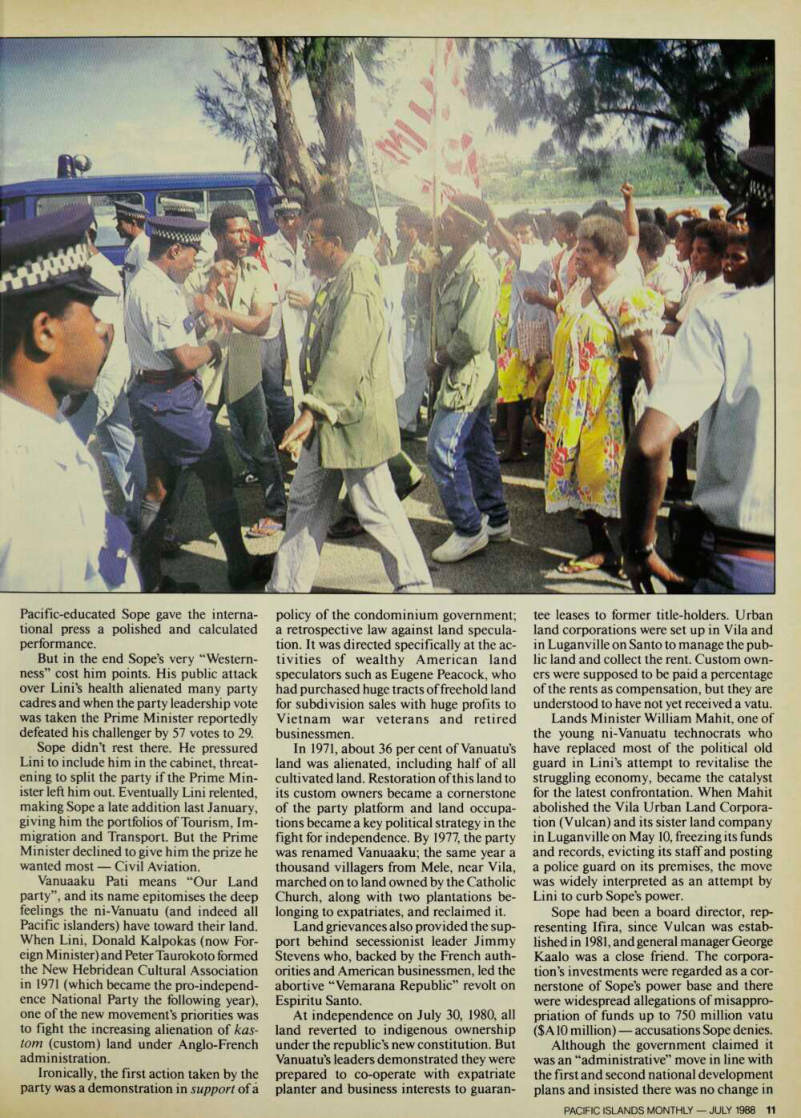
What began as a peaceful presentation of traditional landowners’ concerns to the Prime Minister’s office (above) degenerated into demonstrations, then anger- and alcohol fuelled confrontations with police (opposite).
Pacific-educated Sope gave the international press a polished and calculated performance.
But in the end Sope’s very “Westernness” cost him points. His public attack over Lini’s health alienated many party cadres and when the party leadership vote was taken the Prime Minister reportedly defeated his challenger by 57 votes to 29.
Sope didn’t rest there. He pressured Lini to include him in the cabinet, threatening to split the party if the Prime Minister left him out. Eventually Lini relented, making Sope a late addition last January, giving him the portfolios of Tourism, Immigration and Transport. But the Prime Minister declined to give him the prize he wanted most Civil Aviation.
Vanuaaku Pati means “Our Land party”, and its name epitomises the deep feelings the ni-Vanuatu (and indeed all Pacific islanders) have toward their land.
When Lini, Donald Kalpokas (now Foreign Minister) and Peter Taurokoto formed the New Hebridean Cultural Association in 1971 (which became the pro-independence National Party the following year), one of the new movement’s priorities was to fight the increasing alienation of kastom (custom) land under Anglo-French administration.
Ironically, the first action taken by the party was a demonstration in support of a
policy of the condominium government; a retrospective law against land specula tion. It was directed specifically at the ac tivities of wealthy American land speculators such as Eugene Peacock, who had purchased huge tracts of freehold land for subdivision sales with huge profits to Vietnam war veterans and retired businessmen.
In 1971, about 36 per cent of Vanuatu’s land was alienated, including half of all cultivated land. Restoration of this land to its custom owners became a cornerstone of the party platform and land occupa tions became a key political strategy in the fight for independence. By 1977, the party was renamed Vanuaaku; the same year a thousand villagers from Mele, near Vila, marched on to land owned by the Catholic Church, along with two plantations be longing to expatriates, and reclaimed it.
Land grievances also provided the sup port behind secessionist leader Jimmy Stevens who, backed by the French auth orities and American businessmen, led the abortive “Vemarana Republic” revolt on Espiritu Santo.
At independence on July 30, 1980, all land reverted to indigenous ownership under the republic’s new constitution. But Vanuatu’s leaders demonstrated they were prepared to co-operate with expatriate planter and business interests to guaran
tee leases to former title-holders. Urban land corporations were set up in Vila and in Luganville on Santo to manage the pub lie land and collect the rent. Custom own ers were supposed to be paid a percentage of the rents as compensation, but they are understood to have not yet received a vatu, Lands Minister William Mahit, one of the young ni-Vanuatu technocrats who have replaced most of the political old guard in Lini’s attempt to revitalise the struggling economy, became the catalyst for the latest confrontation. When Mahit abolished the Vila Urban Land Corpora tion (Vulcan) and its sister land company in Luganville on May 10, freezing its funds and records, evicting its staff and posting a police guard on its premises, the move was widely interpreted as an attempt by Lini to curb Sope’s power, Sope had been a board director, rep resenting Ifira, since Vulcan was estab lished in 1981, and general manager George Kaalo was a close friend. The corpora tion’s investments were regarded as a cor nerstone of Sope’s power base and there were widespread allegations of misappro priation of funds up to 750 million vatu ($A 10 million) accusations Sope denies.
Although the government claimed it was an “administrative” move in line with the first and second national development plans and insisted there was no change in
◄ land policy, Sope branded the sudden sei zure of the corporation a “surprise com mando attack”. He claimed the shutdown was an assault on party policy and the na tion’s constitution, which guarantees that all land belongs to customary owners.
“Vanuaaku means our land,” he said.
“Before independence the land issue was the foundation for the Vanuaaku Pati: take away that you’re destroying the party.”
Sope launched his counterattack by or ganising meetings of Ifira, Erakor and Pango, the three villages that hold cus tomary land in the capital, and his mili tants set up a protest march on the Prime Minister’s Office on Monday, May 16.
Supposed to be non-political and peace ful, the 3000 marchers soon unfurled ban ners claiming Lini Hemi Wan Komunist “Lini Wants Communism” de nouncing the Prime Minister one moment as a communist and the next as a fascist.
Ifira militants armed with iron bars and clubs attacked Vietnamese-owned busi nesses and wrecked a police truck. Many marchers chanted: “We want a revolution like in Fiji”. Outer islanders, who com prise most of the town’s 20,000 popula tion, felt threatened by the demonstration.
After a petition was presented to Lands Minister Mahit seeking the repeal of the closure of Vulcan, most of the demonstra tors disbanded peacefully. But about 150 militants, fuelled by a drunken barbecue on the port foreshore, stoned the Hotel de Poste. Telephone operators fled, cutting outward international phone links until the next day. Parliament and adjoining government offices were attacked; most of the shop and office windows in Rue Hig ginson were smashed and many of the shops looted.
Vanuatu Mobile Force soldiers were called in to quell the rioters with teargas.
They battled the militants in scenes of violence never seen before in Vanuatu, even during the struggle for independ ence. “The people who caused the dis turbance failed to respect their chiefs and custom,” Lini lamented. “The namele leaves were abused by the rioters.”
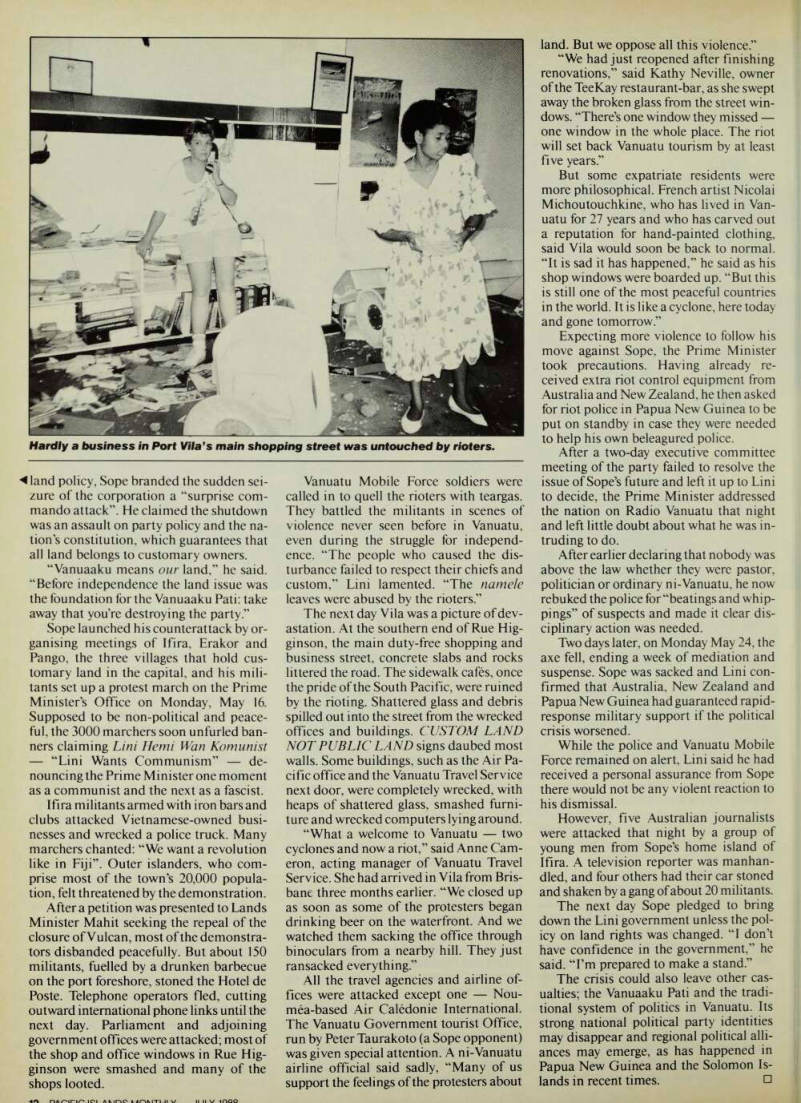
The next day Vila was a picture of dev astation. At the southern end of Rue Hig ginson, the main duty-free shopping and business street, concrete slabs and rocks littered the road. The sidewalk cafes, once the pride of the South Pacific, were ruined by the rioting. Shattered glass and debris spilled out into the street from the wrecked offices and buildings. CUSTOM LAND NOT PUBLIC LAND signs daubed most walls. Some buildings, such as the Air Pa cific office and the Vanuatu Travel Service next door, were completely wrecked, with heaps of shattered glass, smashed furni ture and wrecked computers lying around.
“What a welcome to Vanuatu two cyclones and now a riot,” said Anne Cam eron, acting manager of Vanuatu Travel Service. She had arrived in Vila from Bris bane three months earlier. “We closed up as soon as some of the protesters began drinking beer on the waterfront. And we watched them sacking the office through binoculars from a nearby hill. They just ransacked everything.”
All the travel agencies and airline of fices were attacked except one Nou mea-based Air Caledonie International.
The Vanuatu Government tourist Office, run by Peter Taurakoto (a Sope opponent) was given special attention. A ni-Vanuatu airline official said sadly, “Many of us support the feelings of the protesters about
land. But we oppose all this violence.”
“We had just reopened after finishing renovations,” said Kathy Neville, owner of the Tee Kay restaurant-bar, as she swept away the broken glass from the street win dows. “There’s one window they missed one window in the whole place. The riot will set back Vanuatu tourism by at least five years.”
But some expatriate residents were more philosophical. French artist Nicolai Michoutouchkine, who has lived in Van uatu for 27 years and who has carved out a reputation for hand-painted clothing, said Vila would soon be back to normal.
“It is sad it has happened,” he said as his shop windows were boarded up. “But this is still one of the most peaceful countries in the world. It is like a cyclone, here today and gone tomorrow.”
Expecting more violence to follow his move against Sope, the Prime Minister took precautions. Having already re ceived extra riot control equipment from Australia and New Zealand, he then asked for riot police in Papua New Guinea to be put on standby in case they were needed to help his own beleagured police.
After a two-day executive committee meeting of the party failed to resolve the issue of Sope’s future and left it up to Lini to decide, the Prime Minister addressed the nation on Radio Vanuatu that night and left little doubt about what he was in truding to do.
After earlier declaring that nobody was above the law whether they were pastor, politician or ordinary ni-Vanuatu, he now rebuked the police for “beatings and whip pings” of suspects and made it clear dis ciplinary action was needed.
Two days later, on Monday May 24, the axe fell, ending a week of mediation and suspense. Sope was sacked and Lini con firmed that Australia, New Zealand and Papua New Guinea had guaranteed rapid response military support if the political crisis worsened.
While the police and Vanuatu Mobile Force remained on alert, Lini said he had received a personal assurance from Sope there would not be any violent reaction to his dismissal.
However, five Australian journalists were attacked that night by a group of young men from Sope’s home island of Ifira. A television reporter was manhan dled, and four others had their car stoned and shaken by a gang of about 20 militants.
The next day Sope pledged to bring down the Lini government unless the pol icy on land rights was changed. “I don’t have confidence in the government,” he said. “I’m prepared to make a stand.”
The crisis could also leave other cas ualties; the Vanuaaku Pati and the tradi tional system of politics in Vanuatu. Its strong national political party identities may disappear and regional political alli ances may emerge, as has happened in Papua New Guinea and the Solomon Is lands in recent times. □
Hardly a business in Port Vila’s main shopping street was untouched by rioters.