One Man’s Battle
p. 50 · Read in the full issue
Tony Keen s debacle in the Solomons.
By Robin Bromby
TONY KEEN has found there is more to fishing in the South Pacific than just catching and selling. After 18 months of working in the Solomon Is lands, he complains he continually found bureaucratic stumbling blocks that made running a business a constant nightmare.
“It’s nearly impossible to run a Euro pean-style business there,” he says. “If you make a profit, they think you’ve been cheating them.” Clashes with Govern ment authorities in early 1988 brought a suspension of Keen’s work permit and re sidency, separating him from the fisheries business he had founded.
Tony Keen is managing director of Pre mium Island Marine Exports, which is completely owned by Australian interests but operates from the Solomon Islands.
The company specialises in catching reef fish (such as red emperor and perch), cray fish and mud crabs. The catch is proc essed in Honiara, then airfreighted to Sydney, Brisbane or the United States.
The shipment amounts to about a tonne a week which is a significant economic load of crayfish. “I’d been poking around the Solomons for about 10 years and I saw the potential,” says Keen. He did not have the capital to get into the highly lucrative tuna business, but settled for exploiting coastal fisheries.
Keen claims his enterprise offered the island fishermen their first opportunity to earn significant cash income from their work. Premium Island owned no fishing boats itself: it set up co-operatives out in the provinces. Once a month, after alert ing the co-ops by radio, it would send a ship. The fishermen would meet the ship, sell their catch and be paid on the spot
there are no middlemen. In all. Premium Island had agreements with 40 villages for mud crabs alone; each village had built holding tanks to accommodate the catch until Premium Islands’ monthly visit.
But it was the company’s experiences with government in the Solomon Islands that proved more difficult than making a living from fishing.
Tony Keen received a work permit and preliminary approval from the Government in Honiara. But things became complicated from there. The company then had to negotiate separately with provincial governments, area councils and traditional owners, a ritual that can sorely try the patience of European businessmen not used to Melanesian methods.
While the poachers further out to sea avoid all this time-consuming and expensive negotiation and poaching is still
rampant, especially by Taiwanese clam boats those who take the legal path, such as Keen, face all the problems ashore. “I’d have given up long ago if there hadn’t been such enormous potential,” he says.
Then there were the missed opportun ities. For example, he says, the tuna boats dump all the gamefish in their nets; they
and all the offal go over board, while the Solomon Islands imports all its chicken feed. Keen argues that the dumped fish could be dried for stock feed.
“And you can’t go to a restaurant in Honiara and have a meal of fresh local fish,” he says. The local fishermen have not devel oped the handling needed to make fish appealing to restaurant customers or the Europeans who live in Honiara. Like others who have tried to do business in the Solomon Islands, Keen found agreements do not always have the bind ing effect that contracts
imply in Australia or New Zealand.
“Also, there’s little concept of over head. They visit Sydney where they’ll see crayfish on sale for $l6 a kilo, and they re member that they were paid $5 a kilo in Honiara. Then they think that we’ve taken the difference there’s no conception of our having to pay wages, overheads, leases on the boat, and so on.”
But Tony Keen does not want to sever his link with the Solomon Islands. He be lieves that, properly managed, the coun try’s fishing industry could transform the economy.
Even if he did want to pull out, Keen considers there would be little chance of his recovering the company’s investment: it would, he says, be nearly impossible to persuade any foreign company to go through all the processes needed to oper ate in the Solomon Islands. □
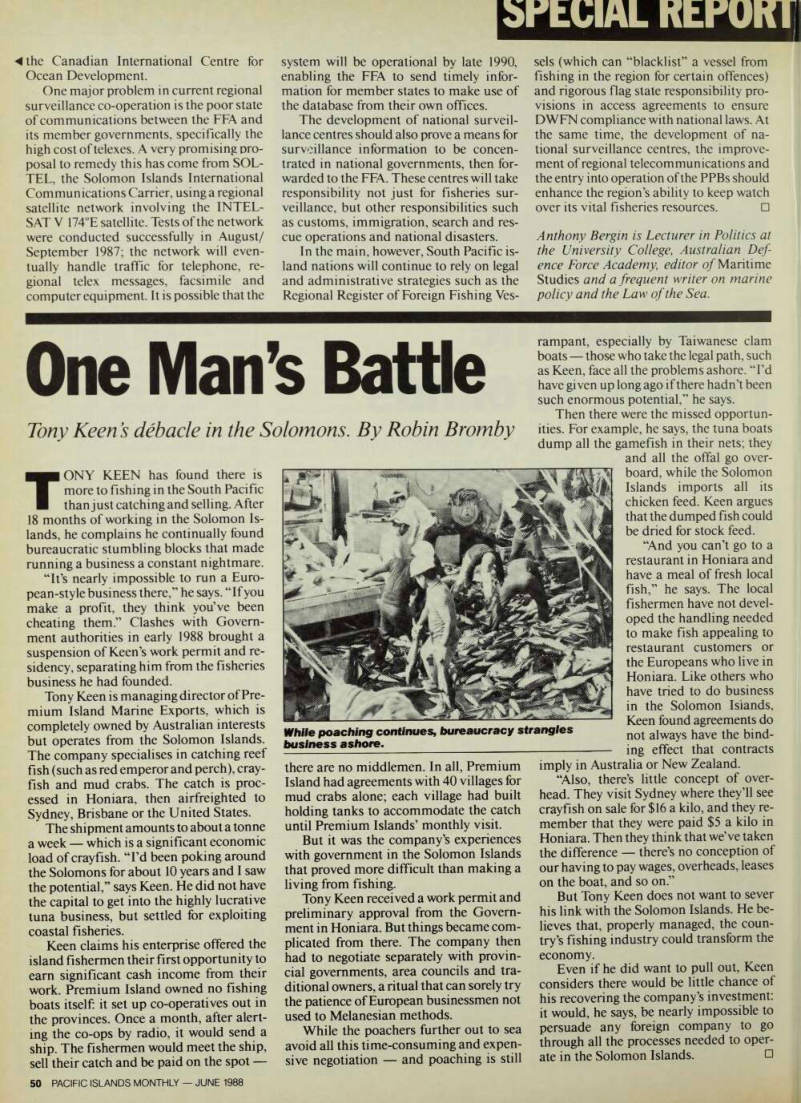
While poaching continues, bureaucracy strangles business ashore.