Fishing Grounds
pp. 49-50 · Read in the full issue
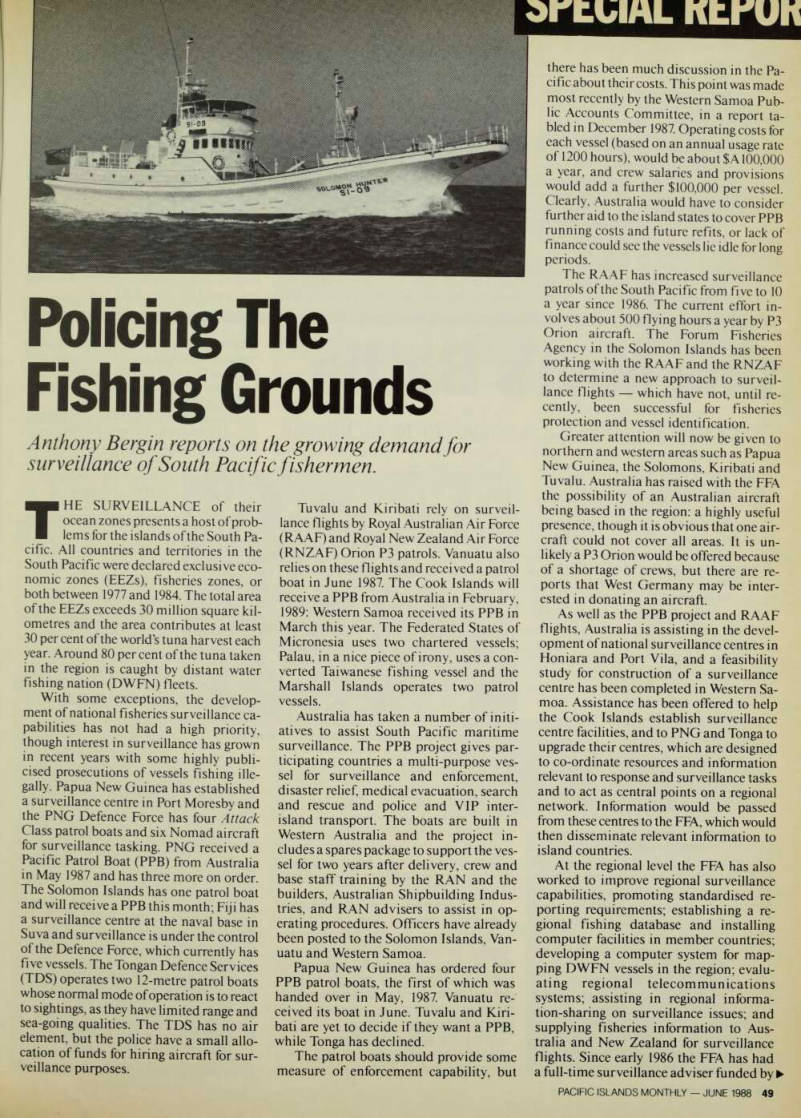

Policing The Fishing Grounds
Anthony Bergin reports on the growing demand for surveillance of South Pacific fishermen.
THE SURVEILLANCE of their ocean zones presents a host of prob lems for the islands of the South Pa cific. All countries and territories in the South Pacific were declared exclusive eco nomic zones (EEZs), fisheries zones, or both between 1977 and 1984. The total area of the EEZs exceeds 30 million square kil ometres and the area contributes at least 30 per cent of the world’s tuna harvest each year. Around 80 per cent of the tuna taken in the region is caught by distant water fishing nation (DWFN) fleets.
With some exceptions, the develop ment of national fisheries surveillance ca pabilities has not had a high priority, though interest in surveillance has grown in recent years with some highly publi cised prosecutions of vessels fishing ille gally. Papua New Guinea has established a surveillance centre in Port Moresby and the PNG Defence Force has four Attack Class patrol boats and six Nomad aircraft for surveillance tasking. PNG received a Pacific Patrol Boat (PPB) from Australia in May 1987 and has three more on order.
The Solomon Islands has one patrol boat and will receive a PPB this month; Fiji has a surveillance centre at the naval base in Suva and surveillance is under the control of the Defence Force, which currently has five vessels. The Tongan Defence Services (TDS) operates two 12-metre patrol boats whose normal mode of operation is to react to sightings, as they have limited range and sea-going qualities. The TDS has no air element, but the police have a small allo cation of funds for hiring aircraft for sur veillance purposes.
Tuvalu and Kiribati rely on surveil lance flights by Royal Australian Air Force (RAAF) and Royal New Zealand Air Force (RNZAF) Orion P 3 patrols. Vanuatu also relies on these flights and received a patrol boat in June 1987. The Cook Islands will receive a PPB from Australia in February, 1989: Western Samoa received its PPB in March this year. The Federated States of Micronesia uses two chartered vessels; Palau, in a nice piece of irony, uses a con verted Taiwanese fishing vessel and the Marshall Islands operates two patrol vessels, Australia has taken a number of initi atives to assist South Pacific maritime surveillance. The PPB project gives par ticipating countries a multi-purpose ves sel for surveillance and enforcement, disaster relief, medical evacuation, search and rescue and police and VIP inter island transport. The boats are built in Western Australia and the project in eludes a spares package to support the ves sel for two years after delivery, crew and base staff training by the RAN and the builders, Australian Shipbuilding Indus tries, and RAN advisers to assist in op crating procedures. Officers have already been posted to the Solomon Islands, Van uatu and Western Samoa, Papua New Guinea has ordered four PPB patrol boats, the first of which was handed over in May, 1987. Vanuatu re ceived its boat in June. Tuvalu and Kiri bati are yet to decide if they want a PPB, while Tonga has declined, The patrol boats should provide some measure of enforcement capability, but
there has been much discussion in the Pa cific about their costs. This point was made most recently by the Western Samoa Pub lic Accounts Committee, in a report ta bled in December 1987. Operating costs for each vessel (based on an annual usage rate of 1200 hours), would be about $A 100,000 a year, and crew salaries and provisions would add a further $lOO,OOO per vessel.
Clearly, Australia would have to consider further aid to the island states to cover PPB running costs and future refits, or lack of finance could see the vessels lie idle for long periods.
The RAAF has increased surveillance patrols of the South Pacific from five to 10 a year since 1986. The current effort in volves about 500 flying hours a year by P 3 Orion aircraft. The Forum Fisheries Agency in the Solomon Islands has been working with the RAAF and the RNZAF to determine a new approach to surveil lance flights which have not, until re cently, been successful for fisheries protection and vessel identification.
Greater attention will now be given to northern and western areas such as Papua New Guinea, the Solomons, Kiribati and Tuvalu. Australia has raised with the FFA the possibility of an Australian aircraft being based in the region: a highly useful presence, though it is obvious that one air craft could not cover all areas. It is un likely a P 3 Orion would be offered because of a shortage of crews, but there are re ports that West Germany may be inter ested in donating an aircraft.
As well as the PPB project and RAAF flights, Australia is assisting in the devel opment of national surveillance centres in Honiara and Port Vila, and a feasibility study for construction of a surveillance centre has been completed in Western Sa moa. Assistance has been offered to help the Cook Islands establish surveillance centre facilities, and to PNG and Tonga to upgrade their centres, which are designed to co-ordinate resources and information relevant to response and surveillance tasks and to act as central points on a regional network. Information would be passed from these centres to the FFA, which would then disseminate relevant information to island countries.
At the regional level the FFA has also worked to improve regional surveillance capabilities, promoting standardised re porting requirements; establishing a re gional fishing database and installing computer facilities in member countries; developing a computer system for map ping DWFN vessels in the region; evalu ating regional telecommunications systems; assisting in regional informa tion-sharing on surveillance issues; and supplying fisheries information to Aus tralia and New Zealand for surveillance flights. Since early 1986 the FFA has had a full-time surveillance adviser funded by ►
◄ the Canadian International Centre for Ocean Development.
One major problem in current regional surveillance co-operation is the poor state of communications between the FFA and its member governments, specifically the high cost of telexes. A very promising pro posal to remedy this has come from SOL TEL, the Solomon Islands International Communications Carrier, using a regional satellite network involving the INTEL SAT V 174°E satellite. Tests of the network were conducted successfully in August/ September 1987; the network will even tually handle traffic for telephone, re gional telex messages, facsimile and computer equipment. It is possible that the
system will be operational by late 1990, enabling the FFA to send timely infor mation for member states to make use of the database from their own offices.
The development of national surveil lance centres should also prove a means for surveillance information to be concen trated in national governments, then for warded to the FFA. These centres will take responsibility not just for fisheries sur veillance, but other responsibilities such as customs, immigration, search and res cue operations and national disasters.
In the main, however. South Pacific is land nations will continue to rely on legal and administrative strategies such as the Regional Register of Foreign Fishing Ves
sels (which can “blacklist” a vessel from fishing in the region for certain offences) and rigorous flag state responsibility pro visions in access agreements to ensure DWFN compliance with national laws. At the same time, the development of na tional surveillance centres, the improve ment of regional telecommunications and the entry into operation of the PPBs should enhance the region’s ability to keep watch over its vital fisheries resources. □ Anthony Bergin is Lecturer in Politics at the University College, Australian Def ence Force Academy, editor of Maritime Studies and a frequent writer on marine policy and the Law of the Sea.