Tuna Wars
pp. 45-47 · Read in the full issue
The struggle continues.
By Dr Geoffrey Waugh
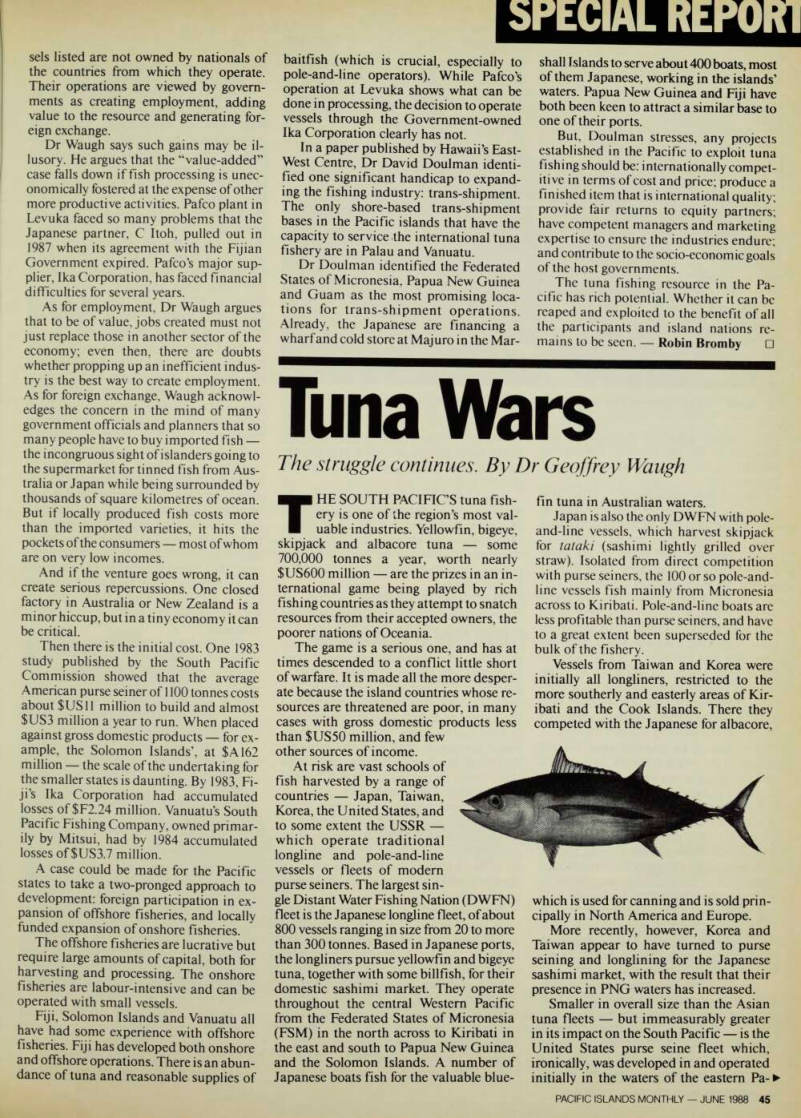
THE SOUTH PACIFIC’S tuna fishery is one of the region’s most valuable industries. Yellowfm, bigeye, skipjack and albacore tuna some 700,000 tonnes a year, worth nearly SUS6OO million are the prizes in an international game being played by rich fishing countries as they attempt to snatch resources from their accepted owners, the poorer nations of Oceania.
The game is a serious one, and has at times descended to a conflict little short of warfare. It is made all the more desperate because the island countries whose resources are threatened are poor, in many cases with gross domestic products less than SUSSO million, and few
other sources of income.
At risk are vast schools of fish harvested by a range of countries Japan, Taiwan, Korea, the United States, and to some extent the USSR which operate traditional longline and pole-and-line vessels or fleets of modern purse seiners. The largest sin
gle Distant Water Fishing Nation (DWFN) fleet is the Japanese longline fleet, of about 800 vessels ranging in size from 20 to more than 300 tonnes. Based in Japanese ports, the longliners pursue yellowfm and bigeye tuna, together with some billfish, for their domestic sashimi market. They operate throughout the central Western Pacific from the Federated States of Micronesia (FSM) in the north across to Kiribati in the east and south to Papua New Guinea and the Solomon Islands. A number of Japanese boats fish for the valuable blue-
fm tuna in Australian waters, Japan is also the only DWFN with pole and-line vessels, which harvest skipjack for tataki (sashimi lightly grilled over straw). Isolated from direct competition with purse seiners, the 100 or so pole-and line vessels fish mainly from Micronesia across to Kiribati. Pole-and-line boats are less profitable than purse seiners, and have to a great extent been superseded for the bulk of the fishery, Vessels from Taiwan and Korea were initially all longliners, restricted to the more southerly and easterly areas of Kir ibati and the Cook Islands. There they competed with the Japanese for albacore,
which is used for canning and is sold prin cipally in North America and Europe.
More recently, however, Korea and Taiwan appear to have turned to purse seining and longlining for the Japanese sashimi market, with the result that their presence in PNG waters has increased, Smaller in overall size than the Asian tuna fleets but immeasurably greater in its impact on the South Pacific is the United States purse seine fleet which, ironically, was developed in and operated initially in the waters of the eastern Pa- ►
cific. The fleet’s markets were more or less confined to the canneries of California, and the canned product was for domestic consumption.
During the “tuna boom” of the late 19705, the US industry over-invested in large purse seiners and over-committed itself with debt repayments. The tuna market promptly collapsed in the early 1980 s; prices fell, exchange rates moved against the industry, fuel prices rose and imports from Asia (especially Thailand) became cheaper. Shipowners were faced with high trans-shipment costs to foreign ports, higher than expected debt servicing payments and fuel hills and a 30 per cent fall in tuna prices. To cap it all, El Nino weather conditions resulted in poor fishing in the eastern tropical Pacific from 1982 to 1984 and correspondingly improved fishing in the tropical western Pacific.
The search for cheaper tuna led US vessels to the western Pacific, but significant encouragement was given to their efforts by US foreign fisheries policies. The United States’ position on the 1982 Convention on the Law of the Sea (CLOS) with regard to highly migratory species differs from that of every other fishing nation: Article 62 of CLOS gives the coastal state (the owner of the resource) the right to require payment for access by foreign fishing vessels to its surplus harvestable fish stock within its 200 nautical mile EEZ.
Article 64 deals with highly migratory species; and Annex 1 of the Article names tuna among those migratory species.
Article 64 further requires the coastai state to co-operate with other states fishing in the region to ensure the conservation and optimum utilisation of species both within the EEZ and beyond: in the view of many international lawyers, that proviso means highly migratory species
are subject to coastal authority in the EEZ in the same way as are other species, ex cept for the additional requirement of co-operation.
In contrast, the US view is that tuna do not come within the exclusive jurisdiction of coastal states beyond the 12-nautical mile limit an opinion that has clearly developed to protect the interests of the powerful commercial fishing lobby in the United States.
That lobby has a long history of transgressions against the fishing rights of other nations, and has been influential in the formulation of US fisheries policy since the 19305, when disputes between US tuna boats and Mexico led to arrests and disa greements over fees and time permits. The 1945 Truman Proclamation established the nature of today’s conflict by creating “conservation zones” outside the tradi tional three-mile limit and providing for the exclusion of foreign fishing vessels from these zones giving the US fleet a “closed shop” within American waters.
The Proclamation was soon aban doned, but a number of Latin American states had responded to its provisions by creating their own exclusive fishing zones; by 1976, 17 Latin American states had is sued proclamations regarding continental shelf and territorial waters, Peru arrested its first United States tuna vessel in 1947; by 1954, no less than 20 US tuna boats had been apprehended by Peru, Ecuador, Colombia, El Salvador and Panama. The arrests involved impris onment and fines running into thousands of dollars and are still occurring: be tween 1961 and 1968 Peru arrested 74 fish ing vessels; between 1979 and 1983, 79 United States vessels were seized by a range of countries including Canada, Costa Rica, Mexico, Venezuela, Colom
bia and Ecuador, resulting in fines totall ing more than SUSI 3 million.
The US Government, pressed by pow erful fishing lobbies including the Amer ican Tunaboat Association, had begun responding to boat seizures through leg islation: the 1954 Fishermens Protective Act gave the Secretary of State the right to take action to aid crews and vessels when boats were impounded under claims not recognised by the US. Further, the Act en sured that the Secretary of the Treasury would automatically compensate boat owners for fines and for payments made for the release of crews and vessels. The Act has since been amended a number of times: in 1968, for example, the tactic of subtracting these payments from the US foreign aid bill was incorporated.
The US continued to oppose unilateral extension of fishing rights until 1976, when the Fishery Conservation and Manage ment Act, popularly known as the Mag nuson Act, provided for a 200-nautical mile coastal zone around the United States, with the US having exclusive rights over its management: no foreign fishing activity was allowed within this zone without a negotiated agreement. The pol icy change did not, however, extend to tuna or other “highly migratory” species (with the exception of some billfish, in response to lobbying from US recreational fishing interests). Indeed, the Magnuson Act slates that “the United States shall not recognise the exclusive zones of foreign nations that do not themselves accept that highly mi gratory species are to be internationally managed”.
The Magnuson Act goes further: it pro vides for an embargo on the fisheries products of any nation that arrests a US vessel for fishing for migratory species outside a 12 mile limit: the embargo is automatic once the State Department has certified the vessel has been seized.
The combined effect of the Fishermens Protective Act and the Magnuson Act is simply to encourage tuna fishermen to vi olate the EEZs of other countries. And with such a history, it is no surprise that the United States tuna fleet’s entry into the Western Pacific has not been without its share of controversy and conflict.
The first seizure of a US tuna boat oc curred in 1982, when the Danica, a 1500tonne purse seiner, was arrested by Papua New Guinea. The vessel was forfeited and the captain fined a nominal amount of around SUS26O. The United States im mediately invoked the Magnuson Act and banned imports of fish products from PNG; the embargo lasted for but a brief period, the vessel was released to her own ers for K 200,000 ($U5270,000) and the American Tunaboat Association entered into an agreement with the Government of PNG to pay fees for the right to fish.
On June 20, 1984, the Jeanette Diana,
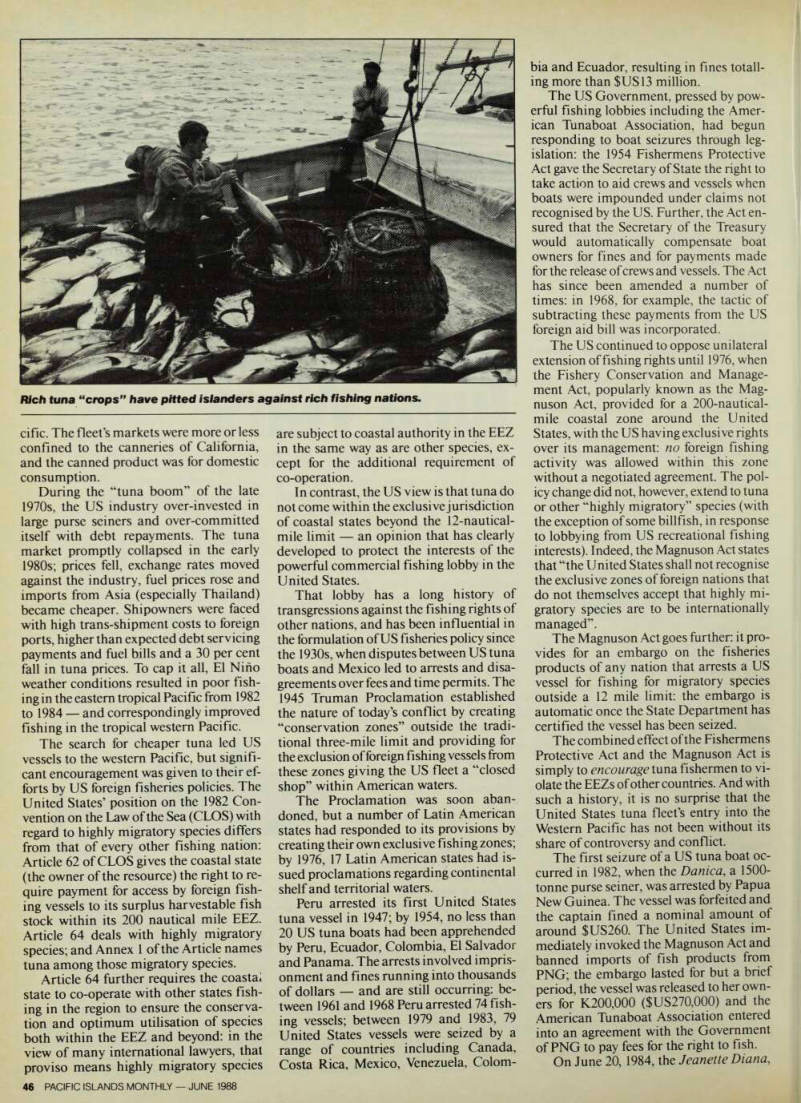
Rich tuna “crops” have pitted islanders against rich fishing nations.
a purse seiner of 1073 tonnes under the command of Captain Jose Finete, was seized by a Solomon Islands patrol boat after a two-hour chase that ended only when the patrol boat fired three shots across the seiner’s bow. Despite the cap tain’s (and the owners’) vigorous denials of the charge of illegal fishing, they were found guilty by the High Court, fined a to tal of $172,000 and the vessel, its gear and illegal catch were forfeited by the court.
The Solomons Government sought to sell the vessel for 5513.9 million; for its part, the US Government responded predicta bly with a total ban on imports of fish products from the Solomons under the Magnuson Act.. . and agreed to recom pense the owners and captain of the ar rested vessel, adding the threat that this compensation would be deducted from aid payments to the Solomons. The dispute continued for seven months and it was not until April 1985 that agreement was reached: the Solomon Islands sold the Je anette Diana back to her owners for $51770,000, and the embargo was lifted.
The Jeanette Diana case, a host of sim ilar acts of piracy, and a protracted dis pute with the Republic of Kiribati led to negotiations between the United States and the Forum nations. Ten meetings over two and a half years culminated in the
signing of a treaty in Port Moresby early in 1987, giving the Forum countries around SUS6O million over a five-year period in return for access to their tuna resources.
The tuna industry itself contributes only 10 per cent of the fee.
The treaty is unique in a number of ways. First, it is the first treaty between a single nation the United States and a region, represented by the South Pacific Forum. Second, it is the first time the US has accepted the concept of the 200-mile limit for highly migratory species. And third, the US has agreed to pay not only for fishing within the 200-mile EEZ, but also for fishing in the “high seas pockets” enclosed by each nation’s EEZ.
The situation should have improved from that point. But American purse sei ners have continued to fish illegally. There have been many reports of US tuna boats operating without permission in Forum members’ EEZs, but nothing to compare to the mass invasion that occurred in April 1987, when a RNZAF Orion reconnais sance aircraft photographed 10 purse sei ners in Kiribati waters; some of them engaged in fishing. Despite vigorous pro tests (and evidence of wrongdoing), the US Government did nothing, preferring to view any interference by Kiribati as an “act of hostility”.
Kiribati eventually did reply to the United States’ taunts, and with a combi nation of tact and cunning arrested the Tradition. Caught in action and with fresh fish in her hold, there was no alternative for the vessel’s owners but to plead guilty.
Fines were in excess of SUS3OO,OOO, and the vessel was sold back to her owners for SUSI million.
There are hopeful signs today that the war, if not over, may be drawing to a close.
The US has signed an agreement with the South Pacific Forum to regulate the actions of US tuna vessels in its waters, and poaching should eventually disappear. Yet the whole sad story is an object lesson in the politics of might (often rationalised as the workings of the free market): to quote the Government of Kiribati, ‘it is with great regret that we find that our trust in the word of the United States has been shaken ... It is a matter of great sadness that the government of the richest nation on Earth cannot (will not!) stop its citizens stealing one of the few natural resources of some of the poorest people on Earth”. □
Dr Geoffrey Waugh, Senior Lecturer in Economics at the University of New South Wales, has a special interest in the eco nomics of the South Pacific tuna fishery.