Fisheries In Crisis
pp. 43-45 · Read in the full issue
Special Report
Special writers Robin Bromby, Dr Geoffrey Waugh, David S North and Anthony Bergin look at the development of the region’s most important industry and the problems faced by Pacific countries in protecting this vital resource.
WHEN A coun try the size of New Zealand finds its fishing industry in deep trouble, the scope of the challenge for South Pacific states in estab lishing such an industry falls into perspective. A year ago, the New Zea land fishing industry was one of the golden pros pects for the country’s economic revival; now it is in the doldrums. Boats are laid up and now two large fish processing fac tories in the Bay of Plenty have closed.
High fuel taxes, the burden of the Govern ment’s resource rental and drops in exports to the US of about 40 per cent have been the main reasons. But New Zea land has a well-estab lished fishing industry, a highly skilled workforce,
engineering and transport infrastructure all of which are usually missing in the smaller island states.
In 1985, 138 fishing vessels were based in the Pacific states, ranging from 30 working out of Pago Pago in American Sa moa serving the two tuna canneries there, to one each at Tonga and Tuvalu whose catches went to the Pafco cannery at Le vuka, Fiji. Even a major Pacific state such as Papua New Guinea had only 10 vessels based there; and their catches were sold on the open market or sent to Levuka, rather than being processed within the country.
The Pacific-based fleet consisted of 26 purseseiners, 51 longliners and 61 pole and-line vessels. The combined value of the boats was estimated at SUSI9O mil lion, but as Dr David Doulman, deputy director of the Honiara-based Forum Fisheries Agency has pointed out, be tween 80 and 85 per cent of the fleet’s cap ital investment was owned by individuals and corporations outside the region.
Tuna catching plants are located in American Samoa, Fiji and the Solomon Islands, with the two at Pago Pago ac counting for 89 per cent of the fish proc essed. The Fijian and Solomon Island plants are joint ventures with the national governments in each case, but the exper tise and money come from Japan.
Certainly, most of the island nations see fishing (along with tourism) as one of the real potential growth areas for their econ omies. The potential varies: Papua New Guinea, Solomon Islands and Vanuatu are located beside the richest tuna resource in the world; but all the countries do have a viable resource on which to base an in dustry. Papua New Guinea, for example, exported just over 2000 tonnes of fish in 1986, though the Government estimates that 180,000 tonnes of skipjack tuna could be harvested each year without depleting the stock.
Dr Geoff Waugh, formerly a senior economist with the Forum Fisheries
Agency and now lectur ing at the University of New South Wales, sees problems in establishing a fish processing indus try. He believes that in an ideal world the most efficient way would be for the various governments to license foreign vessels and col lect a fair and economic rental, but recent expe rience shows some for eign ship owners are unlikely to honour any deals. (There have also been suggestions, from time to time, that several countries band together to fund a jointly owned processing plant, but this has foundered on the question of which of the partners would provide the site and reap the con comitant benefits of for eign exchange and jobs.) Dr Waugh estimates
the annual catch of tuna in the central western Pacific at between 600,000 and 700,000 tonnes a year, worth about SUS6OO million. This prize is plucked from waters belonging to some of the poorer countries in the world, in many cases with gross domestic products below $5O million a year. In a paper delivered late last year, Dr Waugh summed up the play ers in the game: “Japan to a large extent ceased operations in 1987, being unwilling to pay a reasonable price to the poorer South Pacific countries. Taiwan and South Korea continue to pay less than might be considered reasonable. Russia has sensed that there are political gains to be made and is just testing the water.
“The United States has signed a unique and historic treaty with the Forum coun tries of the South Pacific, but has broken the conditions of the treaty even before ratification; the American tuna vessels are blatantly continuing to fish illegally with out paying royalties, they continue to re- ►
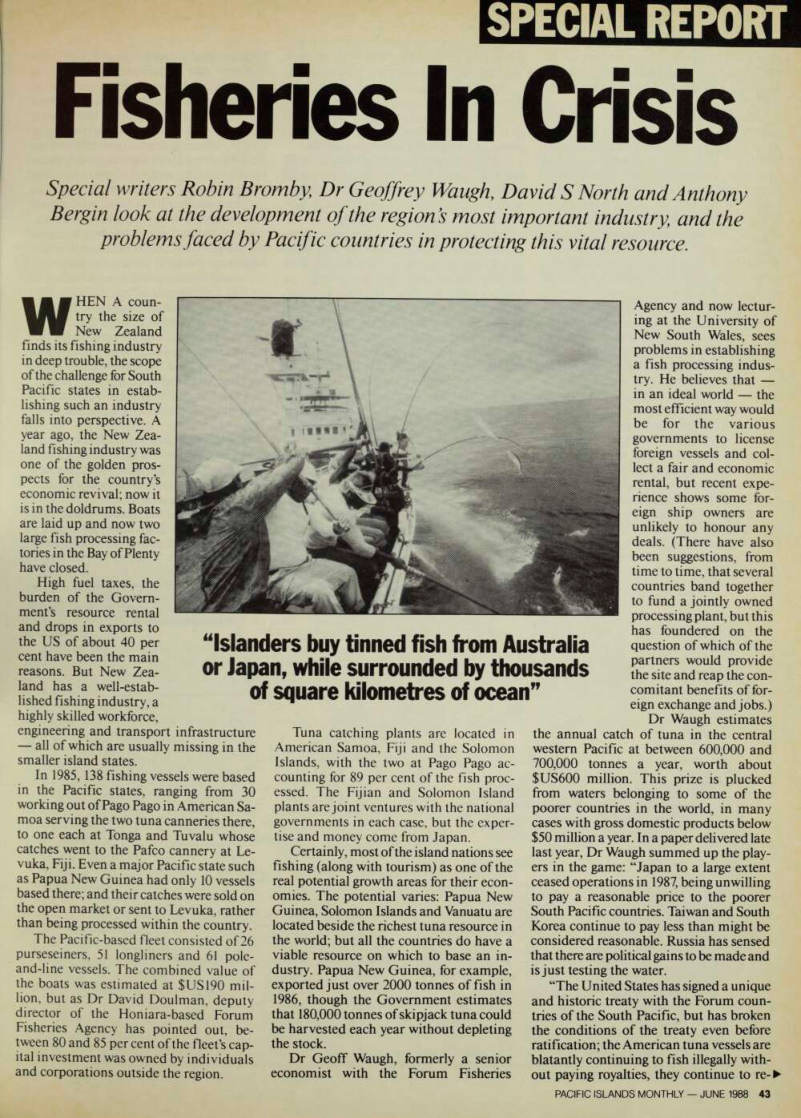
“Islanders buy tinned fish from Australia or Japan, while surrounded by thousands of square kilometres of ocean”
◄ gard the negotiated fees promised in the treaty (and as yet unpaid) as potential aid payment, and the treaty now hangs in the balance.”
American sensibility toward the politi cal integrity of the small island states has been negligible as regards the fishing in dustry. A blind eye was turned toward large-scale poaching within national eco nomic zones and when ships were caught in the act, the US Government fiercely supported its nationals. When Papua New Guinea arrested the purse sei ner Danica in 1982, the United States in voked the Magnuson Act, which provides for an embargo on the fisheries product of any nation that arrests an American boat, and banned fish products from PNG.
In 1984 the Solomon Islands Govern ment seized the purse seiner Jeanette Diana. The captain and owners were found guilty by the country’s High Court, fined $S 172,000 and ordered to forfeit the ves sel, gear and catch. Not only did the US Government again impose the Magnuson Act (which cost the Solomon Islands SSI 10 million in lost sales to the US) but agreed to recompense the owners and captain of the arrested vessel, adding the threat that this sum would be deducted from its for eign aid to the Solomon Islands.
Similarly, US boats have continued to fish illegally in the waters of Kiribati. As Dr Waugh concludes, it is sad that one of
the richest nations on earth will not stop its citizens stealing from one of the poorest.
But the Americans are not the only poachers: for example, it is widely ac cepted that Taiwanese boats fish illegally in the economic zones of several Pacific states, including the Solomon Islands.
As the nations of the South Pacific look to develop their fisheries, this question of whether to opt for domestic development against the collection of fees from foreign owned boats must soon be faced.
New Zealand is now, in fact, facing that decision and at the time of writing there was growing evidence the Government would license more foreign vessels. A country with New Zealand’s resources and experience finding that the most eco nomic path is to sell off, or rent, the re source must raise doubts whether the smaller Pacific states can realistically as pire to their own land-based processing industry or to operate a fleet. The prob lems of viability experienced by the Pa cific Fishing Company in Levuka and the South Pacific Fishing Company in Vanu atu add weight to the question mark.
The New Zealand Government has di rected an interdepartmental committee to review the whole foreign licensed nations (FLN) policy. They are examining such radical measures as allowing foreign com panies to bid for a share of the quota pre viously reserved for domestic operators.
New Zealand currently earns SNZ2O mil lion each year from licensing foreign ves sels in its 320 kilometre EEZ, and foreign companies can own up to a quarter of New Zealand fishing operators. (The issue is clouded by the claim by Maori tribes to the country’s fishing resource, but there is no doubting the Labour Government’s deter mination to rip away protection in every part of the nation’s economy.) The past trend has been very clearly that, when given the opportunity, the Pa cific nations will opt to develop their own industry. In the Solomon Islands, every advantage has been offered the joint-ven ture company, Solomon Taiyo Limited. In its 1981 Development Plan, Fiji identified tuna fishing as a major opportunity to in crease foreign exchange earnings.
Fiji’s Ika Corporation operates six pole and-line vessels and charters boats from Taiwan and New Zealand. Ika is a major supplier to the Pafco cannery at Levuka.
In the Solomon Islands, 38 boats op erate out of Tulagi to supply the Solomon- Taiyo plant.
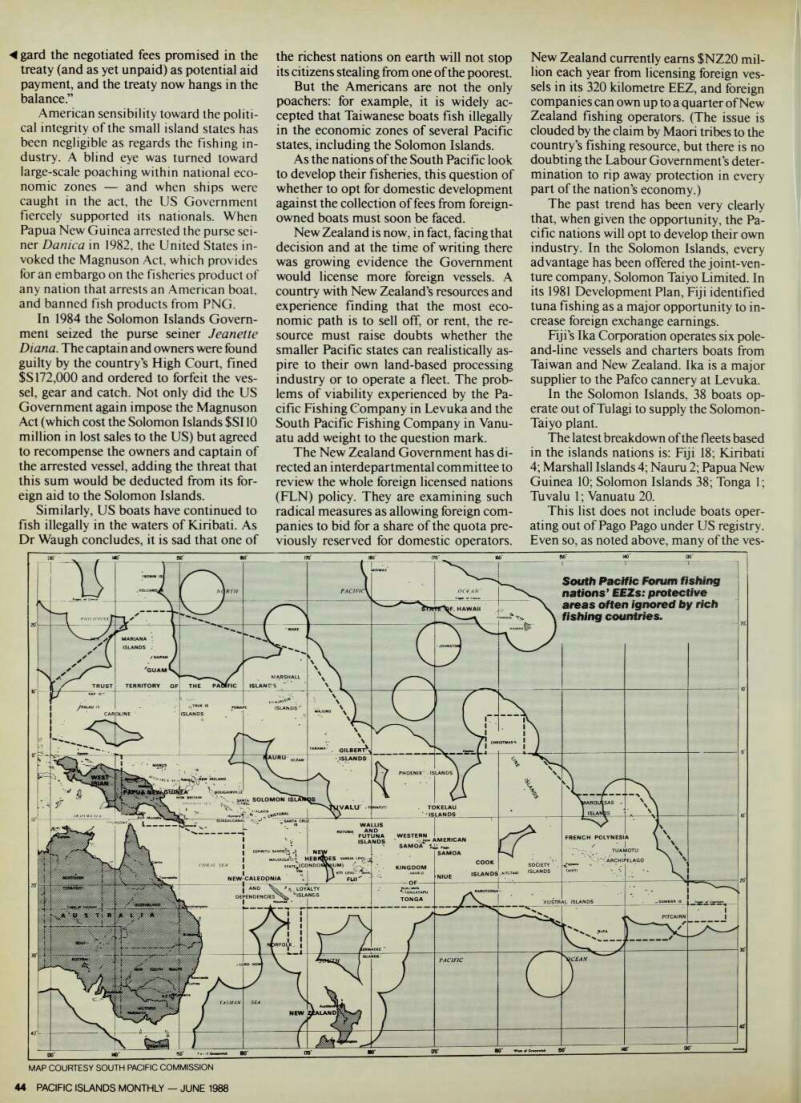
The latest breakdown of the fleets based in the islands nations is: Fiji 18; Kiribati 4; Marshall Islands 4; Nauru 2; Papua New Guinea 10; Solomon Islands 38; Tonga 1; Tuvalu 1; Vanuatu 20.
This list does not include boats oper ating out of Pago Pago under US registry.
Even so, as noted above, many of the ves-
Map Courtesy South Pacific Commission
sels listed are not owned by nationals of the countries from which they operate.
Their operations are viewed by govern ments as creating employment, adding value to the resource and generating for eign exchange.
Dr Waugh says such gains may be il lusory. He argues that the “value-added” case falls down if fish processing is unec onomically fostered at the expense of other more productive activities. Pafco plant in Levuka faced so many problems that the Japanese partner, C Itoh, pulled out in 1987 when its agreement with the Fijian Government expired. Pafco’s major sup plier, Ika Corporation, has faced financial difficulties for several years.
As for employment, Dr Waugh argues that to be of value, jobs created must not just replace those in another sector of the economy; even then, there are doubts whether propping up an inefficient indus try is the best way to create employment.
As for foreign exchange, Waugh acknowl edges the concern in the mind of many government officials and planners that so many people have to buy imported fish the incongruous sight of islanders going to the supermarket for tinned fish from Aus tralia or Japan while being surrounded by thousands of square kilometres of ocean.
But if locally produced fish costs more than the imported varieties, it hits the pockets of the consumers most of whom are on very low incomes.
And if the venture goes wrong, it can create serious repercussions. One closed factory in Australia or New Zealand is a minor hiccup, but in a tiny economy it can be critical.
Then there is the initial cost. One 1983 study published by the South Pacific Commission showed that the average American purse seiner of 1100 tonnes costs about SUSII million to build and almost SUS 3 million a year to run. When placed against gross domestic products for ex ample, the Solomon Islands’, at SAI62 million the scale of the undertaking for the smaller states is daunting. By 1983, Fi ji’s Ika Corporation had accumulated losses of $F2.24 million. Vanuatu’s South Pacific Fishing Company, owned primar ily by Mitsui, had by 1984 accumulated losses of SUS 3.7 million.
A case could be made for the Pacific states to take a two-pronged approach to development: foreign participation in ex pansion of offshore fisheries, and locally funded expansion of onshore fisheries.
The offshore fisheries are lucrative but require large amounts of capital, both for harvesting and processing. The onshore fisheries are labour-intensive and can be operated with small vessels.
Fiji, Solomon Islands and Vanuatu all have had some experience with offshore fisheries. Fiji has developed both onshore and offshore operations. There is an abun dance of tuna and reasonable supplies of
baitfish (which is crucial, especially to pole-and-line operators). While Pafco’s operation at Levuka shows what can be done in processing, the decision to operate vessels through the Government-owned Ika Corporation clearly has not.
In a paper published by Hawaii’s East- West Centre, Dr David Doulman identi fied one significant handicap to expand ing the fishing industry: trans-shipment.
The only shore-based trans-shipment bases in the Pacific islands that have the capacity to service the international tuna fishery are in Palau and Vanuatu.
Dr Doulman identified the Federated States of Micronesia, Papua New Guinea and Guam as the most promising loca tions for trans-shipment operations.
Already, the Japanese are financing a wharf and cold store at Majuro in the Mar
shall Islands to serve about 400 boats, most of them Japanese, working in the islands’ waters. Papua New Guinea and Fiji have both been keen to attract a similar base to one of their ports.
But, Doulman stresses, any projects established in the Pacific to exploit tuna fishing should be: internationally compet itive in terms of cost and price; produce a finished item that is international quality; provide fair returns to equity partners; have competent managers and marketing expertise to ensure the industries endure; and contribute to the socio-economic goals of the host governments.
The tuna fishing resource in the Pa cific has rich potential. Whether it can be reaped and exploited to the benefit of all the participants and island nations re mains to be seen. Robin Bromby □