Mitterrand’s Challenge
pp. 10-11 · Read in the full issue
How the Kanaks’ struggle will determine the new French Government’s policy at home and in the Pacific. Nicolas Rothwell reports from Paris.
RETURNED to the French Presidency for a second term, Francois Mitterrand finds himself confronting a familiar crisis that will test even his own considerable negotiating skills.
For far distant New Caledonia, long a troubling topic for the politicians of Paris, has suddenly exploded into the most urgent policy issue for the new presidency.
The pace of events in the territory quickened over the French presidential campaign. The wordy debates of French mainland politics were quickly drowned by the bloody drama unfolding in the territory.
Just before the first round of the pres idential election, Kanak militants seized 27 hostages on the island of Ouvea. A spasmodic ripple of reaction coursed through the electorate, which gave the Conservative candidate and then Prime Minister Jacques Chirac a paltry 19.8 per cent of the vote and drastically increased the strength of the far right National Front of Mr Jean-Marie Le Pen.
In the fortnight between the two rounds of voting, the Chirac Government mounted its extraordinary last minute rally with three successive coups; first the freeing of hostages in Lebanon then the rescue of the captives on Ouvea, with the heavy toll of 21 lives lost, all but two Kanaks.
As a kind of coda, the French Govern ment repatriated Dominique Prieur, the secret agent convicted of involvement in the 1985 sinking of the Greenpeace protest vessel Rainbow Warrior in Auckland harbour.
Prieur was being kept on Hao Atoll, a military base in French Polynesia, under
a United Nations mediated agreement be tween Paris and Wellington that provided for her to stay there until July 1989.
Yet this flurry of pre-electoral resolve did not seem to impress the French voters.
Sources close to former Prime Minister Chirac denied that he was trying to influ ence the electorate they claim that the Government knew its candidate was likely to lose, and the time had come for some urgent “settling of accounts”.
As regards the Pacific, certainly, Mr Chirac unilaterally took steps that will affect the future diplomacy of the new Government chosen by the re-elected President Mitterrand.
Barely a day after his landslide 54 per cent win in the second round vote on May 8, Mr Mitterrand named an intriguing Prime Minister moderate socialist Michel Rocard, the most impressive of the centre left, and no slavish devotee of Mr Mitterrand’s avuncular personality cult.
As Minister for Overseas Territories, the President chose Mr Olivier Stim, a former Minister in the centrist govern-
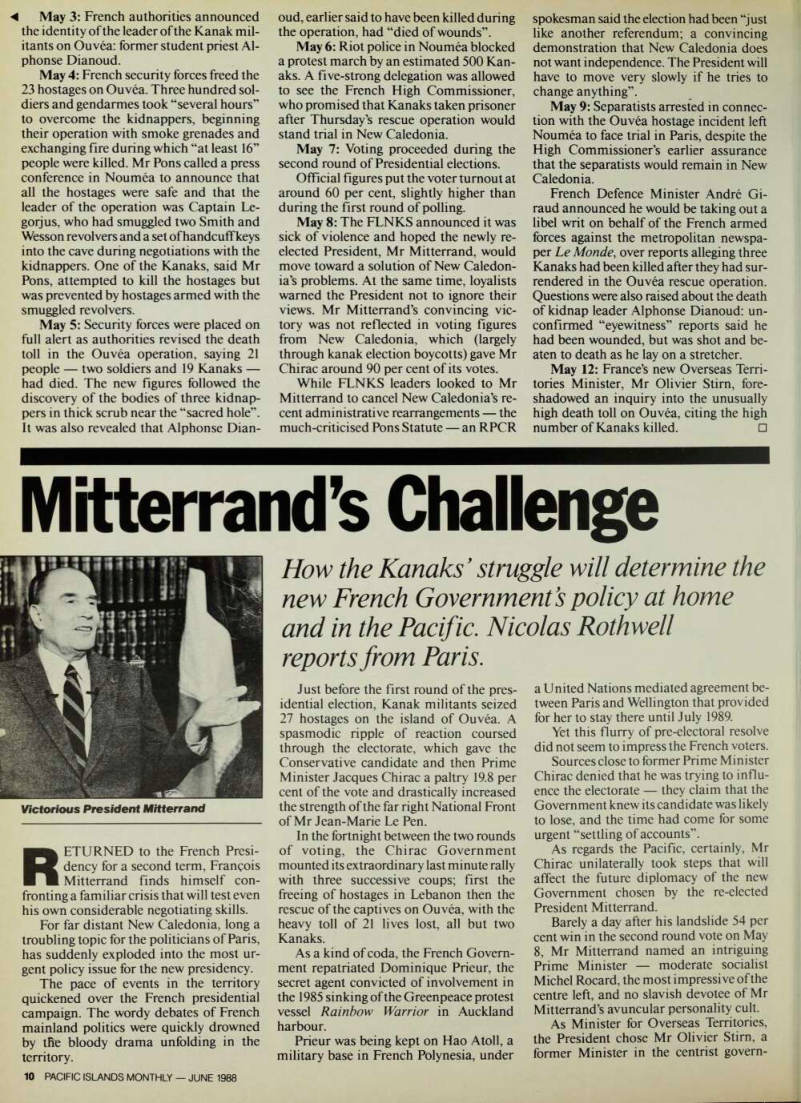
Victorious President Mitterrand
ment of President Giscard d’Estaing.
Mr Stim is an old Pacific hand and a canny choice to try to reduce tension in New Caledonia he may reassure the fiercely patriotic European settler community in the territory that France is not about to sell them down the river.
But twin problems confront France and President Mitterrand as he moves to address the nation’s Pacific woes.
First President Mitterrand has called new legislative elections for June, in a bid to secure a moderate socialist majority and a clear mandate for his new political creed; the fostering of unity, tolerance and national consensus.
Thus breakthroughs in New Caledonia must wait on the achievement of political stability in France.
Second and far more important, the situation in New Caledonia is more deeply polarised than at any time in the recent past and Mr Mitterrand’s return to power may only worsen that division.
The political balance in Noumea is a grisly mirror of the changes that have taken place in Metropolitan France; for the New Caledonian National Front is the newly ascendant party among the territory’s Europeans.
Once again the absence of a political centre in New Caledonia is the island’s greatest tragedy.
Conservatives in the Caledonian establishment party, the Rassemblement Pour la Caledonie dans la Republique, find
their uncompromising attitudes subtly reinforced by the rhetoric of their Gaullist counterparts in France.
Meanwhile the main political leaders of the pro independent Kanaks believe Mr Mitterrand is the man who will grant them their wish.
Yet here is the heart of the problem. The President knows his history, and doubtless sees, like many French commentators, the alarming parallels between the current situation in New Caledonia and the earlier colonial debacle of Algeria.
In place now is a recipe for disaster: a French leader anxious to increase the political rights of Kanaks, the memory of recent bloodshed, and an edgy European loyalist majority, armed to the teeth and deeply suspicious of Mr Mitterrand’s intention.
What the President’s strategy will be remains unclear —just the way he likes it.
But several basic truths now guide French policy.
First, the territory is small and wins no votes; second, all major parties support France’s presence in the Pacific; third, action must be taken or more blood will flow, especially now a re-elected socialist President has raised Kanak hopes.
Although his is a distinctly un-French approach, the new look Mitterrand may opt for a vaguely drafted scheme to provide something like independence in association a solution similar to that applied by the US to some of its territories.
If the Kanaks and Europeans might be persuaded to agree, there could even be a move to introduce the kind of advanced autonomy that now exists in French Po lynesia, providing for local political con trol backed by hefty external funding, Imposing full independence on the Eu ropeans of New Caledonia might be be yond even Mr Mitterrand’s powers of persuasion.
The worst alternative is the one now being most vigorously discussed by the more creative fantasists of empire on the French right partition, This was in the air when France rela tantly gave Vanuatu its freedom in 1980 and it was applied in the case of the Indian Ocean territory of Mayotte, But dividing the island of Grande Terre down its mountain spine would simply draw a line through the problem, admit the need for apartheid and invent a West Bank for the Pacific.
What is required in today’s New Cale donia is a human solution, not a grand scheme to command the future, President Mitterrand definitely needs a mediator who can bridge both commu nities and who can speak for the interests of all New Caledonians, not just Kanaks or whites. He needs a man who is neither FLNKS nor RPCR a man of that long ignored force, the centre. Step forward, Nidoish Naisseline, both traditional chief and most Parisian of all Kanak politicians your time has come at last. □
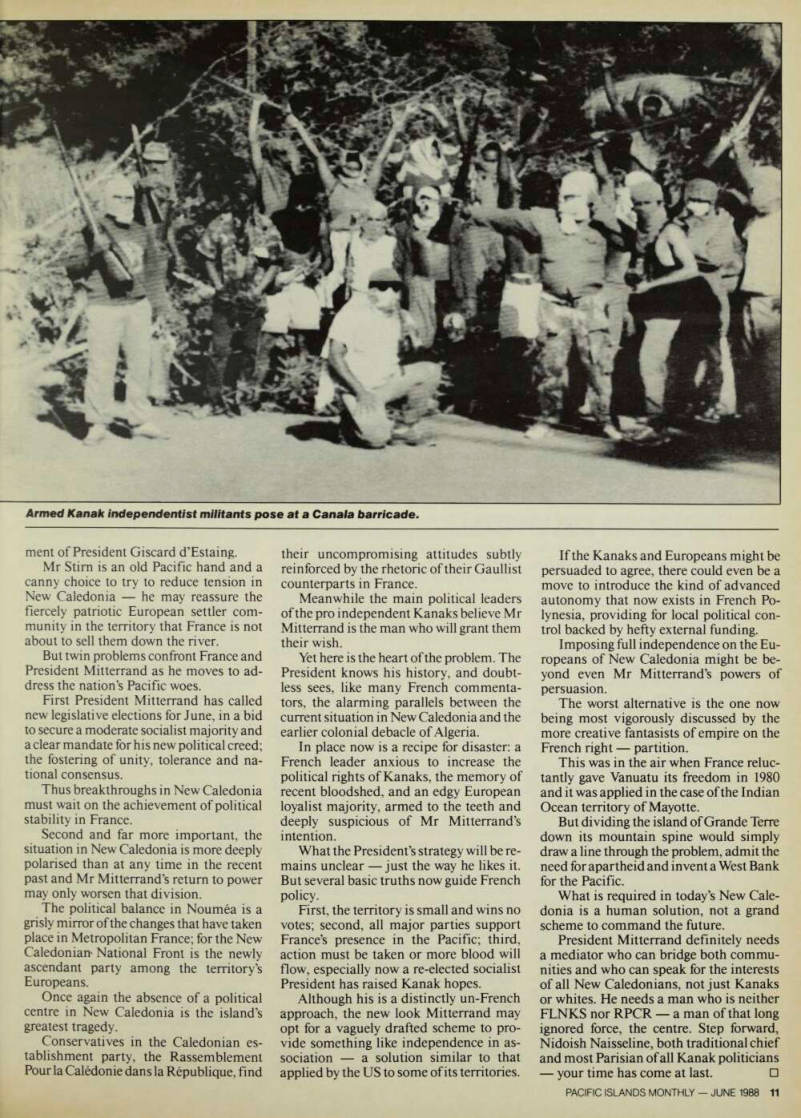
Armed Kanak independentist militants pose at a Canala barricade.