Days Of Rage
pp. 8-10 · Read in the full issue
New Caledonia
Days Of Rage And Mourning
War comes to the Pacific as Kanaks finally abandon non-violent resistance to
French rule.
By Carson Creagh
AS THE tumult dies after the most momentous month in the troubled history of New Caledonia, it is at last possible to tentatively assess the ef fects of the Kanaks’ decision to abandon non-violent resistance and resort to “mus cular mobilisation” to achieve their objectives.
Ultimately, the Kanaks demand noth ing less than independence and self-deter mination, but for now they will accept, they say, social justice, land rights and a greater say in the administration of the territory.
The events of April and May will change New Caledonia for ever. As Pacific Is lands Monthly went to press: France was still firmly in control; at least 26 Kanaks and French gendarmes, soldiers and sup porters had been killed; the FLNKS was established as a force to be respected; the controversial Pons Statute had been tor pedoed; the conservative Government of Jacques Chirac had been swept from of fice with events in New Caledonia a telling factor in its demise.
The drama began at dawn on April 22, when a “commando” of 40 or so Kanaks descended on police quarters at Fayaoue, the administrative centre on Ouvea, larg est of the Loyalty Islands, and there hacked to death four gendarmes. Three Kanaks were injured in the raid, which ended with 27 police taken hostage and handcuffed. A first group of 11 hostages was taken to the south of the island, to be released several days later; the remaining 16 were trans ported to the tribal territory of Gossana, in the far north of the island, and hidden in a cave known locally as the “sacred hole”.
Authorities in Paris set up a “crisis centre” at the Hotel Matignon (the govern ment headquarters) and reinforcements were flown to New Caledonia. Ouvea was declared a zone militaire and entry was forbidden to the Press.
More than 300 soldiers were sent to
Ouvea’s north, but were unable to locate the militants’ hiding place: the “sacred hole” was eventually found, but proved unassailable: captors and military officers prepared for the long process of negotiation.
April 24: The first round of elections was disturbed by incidents throughout the archipelago: roadblocks were erected on the islands of Lifou and Mare as well as at Canala and Pouebo on Grande Terre, and bands of masked Kanaks fired on police who attempted to remove roadblocks. The
gendarmerie at Canala was besieged; gendarmes were wounded and a 17-year-old Melanesian woman was killed by a stray bullet.
However, voting went ahead with only 31 of the territory’s 139 polling stations closed. An estimated 56 per cent of the population voted; the loyalist RPCR gained 64.46 per cent of votes, winning 35
of the 48 seats in the Territorial Congress, The ultra-conservative National Front in creased its support, gaining eight seats from 22.49 per cent of the vote, while the remaining five seats were divided be tween a number of small right-wing and moderate independentist parties, April 26: Thirty civilians were air lifted from Canala to Noumea as Kanaks
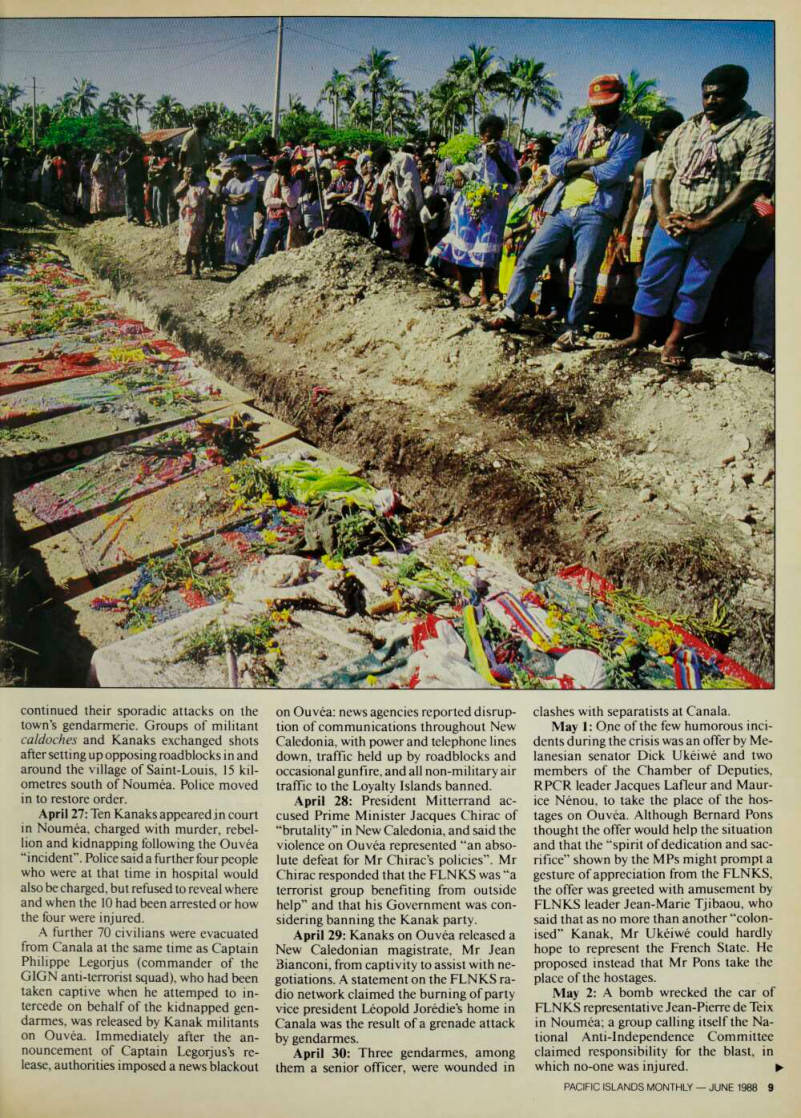
Above: A Kanak roadblock.
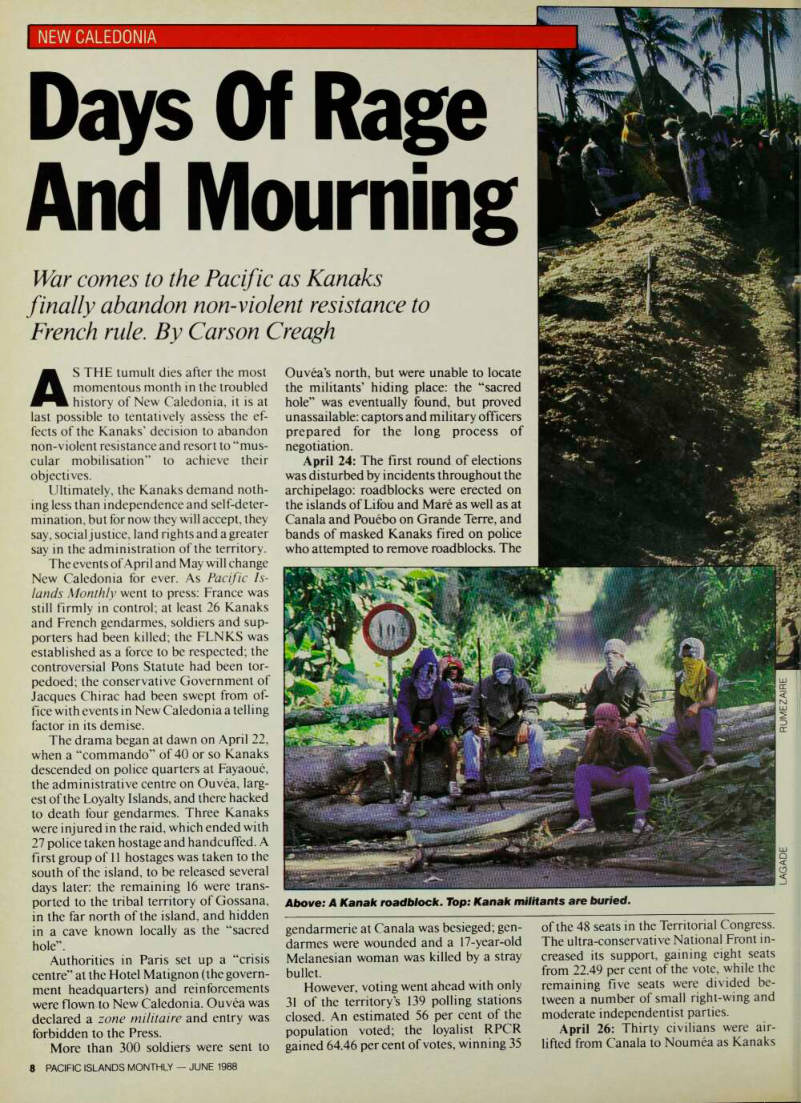
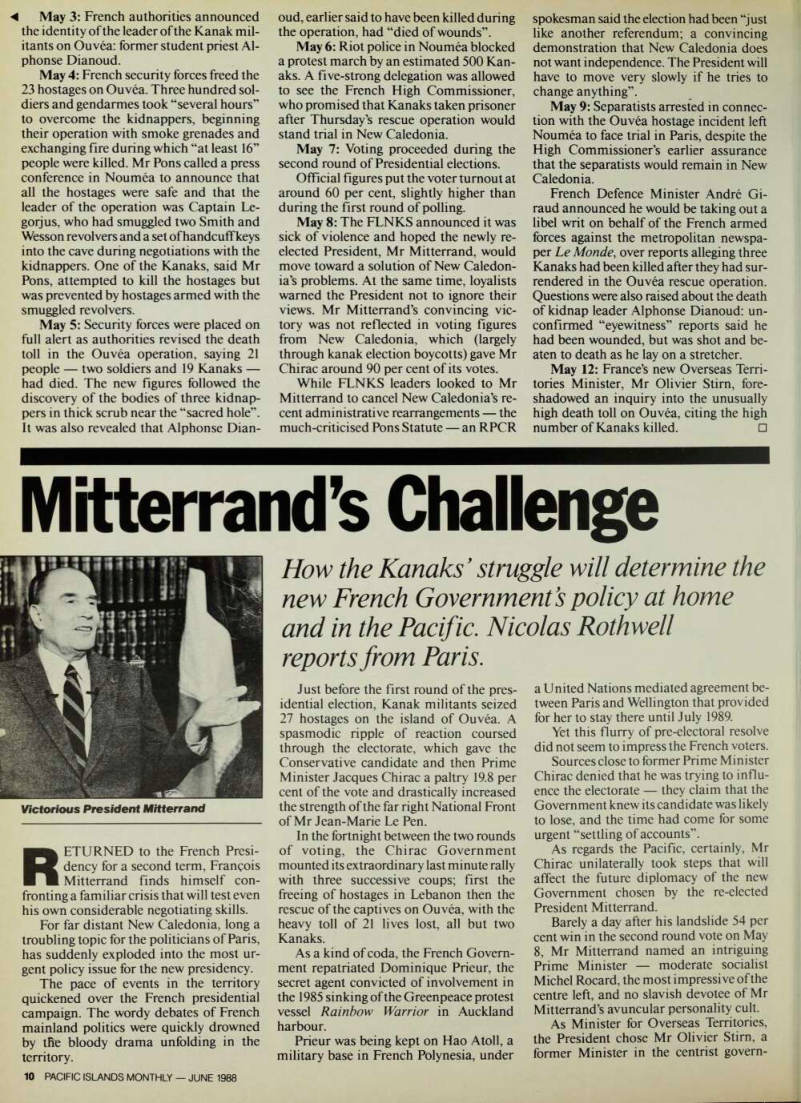
Top: Kanak militants are buried.
Lagade
Rumeza1Re
continued their sporadic attacks on the town’s gendarmerie. Groups of militant caldoches and Kanaks exchanged shots after setting up opposing roadblocks in and around the village of Saint-Louis, 15 kil ometres south of Noumea. Police moved in to restore order.
April 27: Ten Kanaks appeared in court in Noumea, charged with murder, rebel lion and kidnapping following the Ouvea “incident”. Police said a further four people who were at that time in hospital would also be charged, but refused to reveal where and when the 10 had been arrested or how the four were injured.
A further 70 civilians were evacuated from Canala at the same time as Captain Philippe Legorjus (commander of the GIGN anti-terrorist squad), who had been taken captive when he attemped to in tercede on behalf of the kidnapped gen darmes, was released by Kanak militants on Ouvea. Immediately after the an nouncement of Captain Legorjus’s re lease, authorities imposed a news blackout
on Ouvea: news agencies reported disrup tion of communications throughout New Caledonia, with power and telephone lines down, traffic held up by roadblocks and occasional gunfire, and all non-military air traffic to the Loyalty Islands banned.
April 28: President Mitterrand ac cused Prime Minister Jacques Chirac of “brutality” in New Caledonia, and said the violence on Ouvea represented “an abso lute defeat for Mr Chirac’s policies”. Mr Chirac responded that the FLNKS was “a terrorist group benefiting from outside help” and that his Government was con sidering banning the Kanak party.
April 29: Kanaks on Ouvea released a New Caledonian magistrate, Mr Jean Bianconi, from captivity to assist with ne gotiations. A statement on the FLNKS ra dio network claimed the burning of party vice president Leopold Joredie’s home in Canala was the result of a grenade attack by gendarmes.
April 30: Three gendarmes, among them a senior officer, were wounded in
clashes with separatists at Canala.
May 1: One of the few humorous inci dents during the crisis was an offer by Me lanesian senator Dick Ukeiwe and two members of the Chamber of Deputies, RPCR leader Jacques Lafleur and Maur ice Nenou, to take the place of the hos tages on Ouvea. Although Bernard Pons thought the offer would help the situation and that the “spirit of dedication and sac rifice” shown by the MPs might prompt a gesture of appreciation from the FLNKS, the offer was greeted with amusement by FLNKS leader Jean-Marie Tjibaou, who said that as no more than another “colon ised” Kanak, Mr Ukeiwe could hardly hope to represent the French State. He proposed instead that Mr Pons take the place of the hostages.
May 2: A bomb wrecked the car of FLNKS representative Jean-Pierre de Teix in Noumea; a group calling itself the Na tional Anti-Independence Committee claimed responsibility for the blast, in which no-one was injured. *
◄ May 3: French authorities announced the identity of the leader of the Kanak mil itants on Ouvea: former student priest Al phonse Dianoud.
May 4: French security forces freed the 23 hostages on Ouvea. Three hundred sol diers and gendarmes took “several hours” to overcome the kidnappers, beginning their operation with smoke grenades and exchanging fire during which “at least 16” people were killed. Mr Pons called a press conference in Noumea to announce that all the hostages were safe and that the leader of the operation was Captain Le goijus, who had smuggled two Smith and Wesson revolvers and a set of handcuff keys into the cave during negotiations with the kidnappers. One of the Kanaks, said Mr Pons, attempted to kill the hostages but was prevented by hostages armed with the smuggled revolvers.
May 5: Security forces were placed on full alert as authorities revised the death toll in the Ouvea operation, saying 21 people two soldiers and 19 Kanaks had died. The new figures followed the discovery of the bodies of three kidnap pers in thick scrub near the “sacred hole”.
It was also revealed that Alphonse Dian
oud, earlier said to have been killed during the operation, had “died of wounds”.
May 6: Riot police in Noumea blocked a protest march by an estimated 500 Kanaks. A five-strong delegation was allowed to see the French High Commissioner, who promised that Kanaks taken prisoner after Thursday’s rescue operation would stand trial in New Caledonia.
May 7: Voting proceeded during the second round of Presidential elections.
Official figures put the voter turnout at around 60 per cent, slightly higher than during the first round of polling.
May 8: The FLNKS announced it was sick of violence and hoped the newly reelected President, Mr Mitterrand, would move toward a solution of New Caledonia’s problems. At the same time, loyalists warned the President not to ignore their views. Mr Mitterrand’s convincing vietory was not reflected in voting figures from New Caledonia, which (largely through kanak election boycotts) gave Mr Chirac around 90 per cent of its votes.
While FLNKS leaders looked to Mr Mitterrand to cancel New Caledonia’s recent administrative rearrangements the much-criticised Pons Statute an RPCR
spokesman said the election had been “just like another referendum ; a convincing demonstration that New Caledonia does not want independence. The President will have to move very slowly if he tries to change anything”, May 9: Separatists arrested in connec tion with the Ouvea hostage incident left Noumea to face trial in Paris, despite the High Commissioner’s earlier assurance that the separatists would remain in New Caledonia.
French Defence Minister Andre Gi raud announced he would be taking out a libel writ on behalf of the French armed forces against the metropolitan newspa per Le Monde, over reports alleging three Kanaks had been killed after they had sur rendered in the Ouvea rescue operation, Questions were also raised about the death of kidnap leader Alphonse Dianoud: un confirmed “eyewitness” reports said he had been wounded, but was shot and be aten to death as he lay on a stretcher, May 12: France’s new Overseas Terri tories Minister, Mr Olivier Stim, fore shadowed an inquiry into the unusually high death toll on Ouvea, citing the high number of Kanaks killed. □