Keeping The Language Alive
pp. 14-15 · Read in the full issue
Vanuatu
The voices of Vanuatu are recorded for posterity. By Nicolas Rothwell
IN THE furthest forests of verdant Am bae, .in the deepest valleys of Pente cost; all across the scattered islands of Vanuatu, something strange and wonder ful is taking place. Even as the forces of modern civilisation spread inexorably across the archipelago. ni-Vanuatu field workers are collecting a rich store of myths and traditions the vanishing cultural patrimony of their new nation.
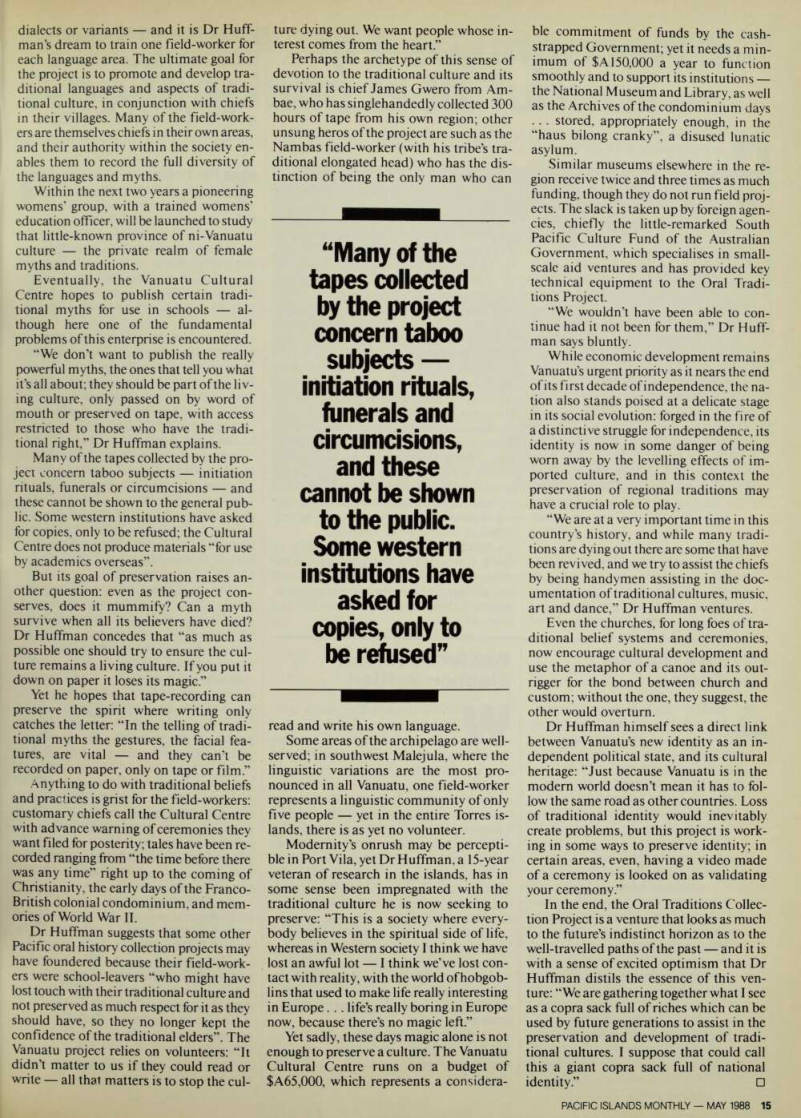
Conceived a decade ago and run on a shoestring budget, the Pacific’s most suc cessful oral traditions collection project is an intense and idiosyncratic exer cise. In place of western-trained anthro pologists, volunteers from different language groups have fanned out across the islands, equipped only with tape-re corders and enthusiasm, in a race to cap ture the fine thread of traditional life for future generations. Despite the tenacious hold of custom in Vanuatu, old ways are being eroded or subtly changed, and have almost died out completely in some of the islands: the oral traditions project aims to document the songs, dances and myths of the ancestral culture, and so to restore among the younger generations of ni-Van uatu (people of Vanuatu) a sense of pride in the world of their forefathers.
The scheme, the brainchild of ethno musicologist Peter Crowe and linguist Jean-Michel Charpentier, was launched with the approval of the nation’s Cultural Centre, and is now presided over by Van uatu Museum and Cultural Centre direc tor Dr Kirk Huffman. Already 36 field workers are active, each in his own lin guistic and cultural area; slowly, as the years pass, the project grows in ambition and complexity, with the gift of a new camera or video system from donor governments but the entire enterprise is still co-ordinated from the inspired con fusion of Dr Huffman’s office in Port Vila, one of the South Pacific’s most charmed (and most cluttered) corners.
Since 1982, the field workers have been instructed in the transcription of their own languages by the Australian National Uni versity’s Dr Darryl Tryon, a pre-eminent authority on South Pacific linguistics but the project remains a race against time rather than a measured and conventional research venture: “The amount we’ve got already would take years to transcribe, but the most important thing is to get material on tape from the old people before they die, and to try to get young people interested,”
Dr Huffman explains.
“We wouldn’t need to do any of this if
the younger generations were interested in ensuring the cultures continued, and sat down and learned the songs and dances they have the rights to but the world is changing, and things will die out.”
Yet this sombre note is counterbal anced by the sheer range and exuberance of the traditional culture, and the passion of the field-workers. Vanuatu has 105 sep arate languages as well as uncounted
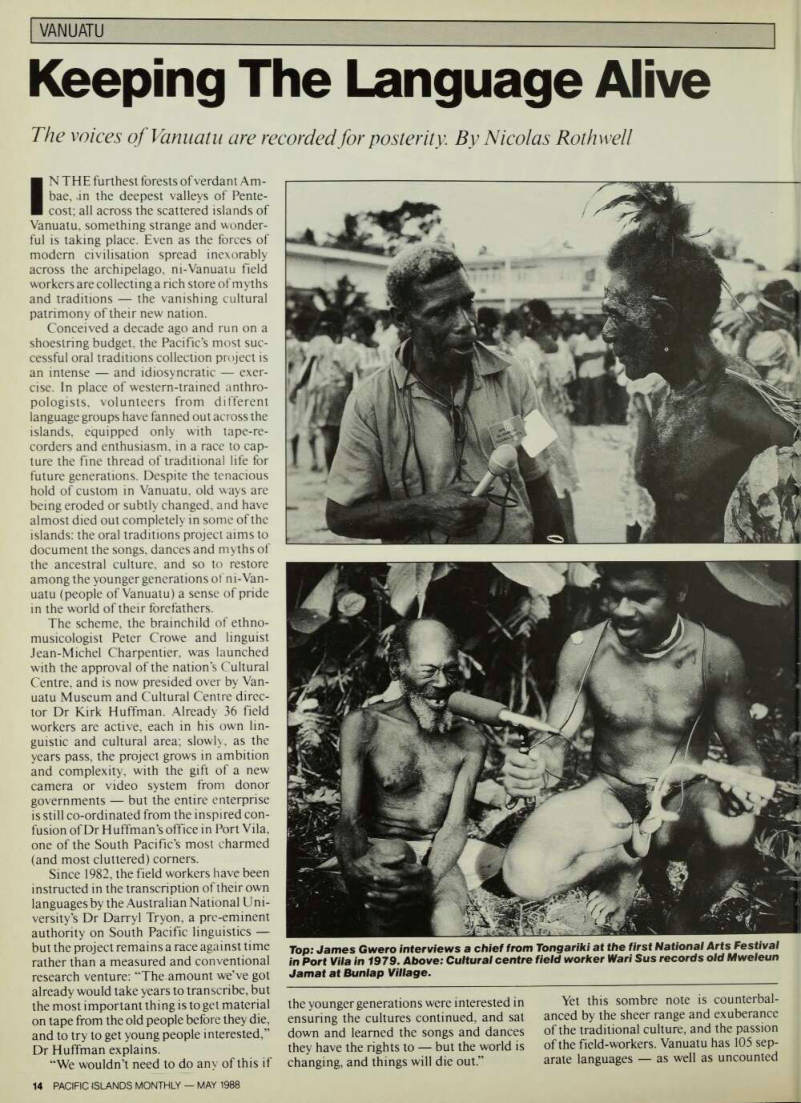
Top: James Gwero interviews a chief from Tongariki at the first National Arts Festival in Port Vila in 1979. Above: Cultural centre field worker Wari Sus records old Mweleun Jamat at Bunlap Village.
dialects or variants and it is Dr Huff man’s dream to train one field-worker for each language area. The ultimate goal for the project is to promote and develop tra ditional languages and aspects of tradi tional culture, in conjunction with chiefs in their villages. Many of the field-work ers are themselves chiefs in their own areas, and their authority within the society en ables them to record the full diversity of the languages and myths.
Within the next two years a pioneering womens’ group, with a trained womens’ education officer, will be launched to study that little-known province of ni-Vanuatu culture the private realm of female myths and traditions.
Eventually, the Vanuatu Cultural Centre hopes to publish certain tradi tional myths for use in schools al though here one of the fundamental problems of this enterprise is encountered.
“We don’t want to publish the really powerful myths, the ones that tell you what it’s all about; they should be part of the liv ing culture, only passed on by word of mouth or preserved on tape, with access restricted to those who have the tradi tional right,” Dr Huffman explains.
Many of the tapes collected by the pro ject concern taboo subjects initiation rituals, funerals or circumcisions and these cannot be shown to the general pub lic. Some western institutions have asked for copies, only to be refused; the Cultural Centre does not produce materials “for use by academics overseas”.
But its goal of preservation raises an other question: even as the project con serves, does it mummify? Can a myth survive when all its believers have died?
Dr Huffman concedes that “as much as possible one should try to ensure the cul ture remains a living culture. If you put it down on paper it loses its magic.”
Yet he hopes that tape-recording can preserve the spirit where writing only catches the letter; “In the telling of tradi tional myths the gestures, the facial fea tures, are vital and they can’t be recorded on paper, only on tape or film.”
Anything to do with traditional beliefs and practices is grist for the field-workers: customary chiefs call the Cultural Centre with advance warning of ceremonies they want filed for posterity; tales have been re corded ranging from “the time before there was any time” right up to the coming of Christianity, the early days of the Franco- British colonial condominium, and mem ories of World War 11.
Dr Huffman suggests that some other Pacific oral history collection projects may have foundered because their field-work ers were school-leavers “who might have lost touch with their traditional culture and not preserved as much respect for it as they should have, so they no longer kept the confidence of the traditional elders”. The Vanuatu project relies on volunteers: “It didn’t matter to us if they could read or write all that matters is to stop the cul
ture dying out. We want people whose in terest comes from the heart.”
Perhaps the archetype of this sense of devotion to the traditional culture and its survival is chief James Gwero from Am bae, who has singlehandedly collected 300 hours of tape from his own region; other unsung heros of the project are such as the Nambas field-worker (with his tribe’s tra ditional elongated head) who has the dis tinction of being the only man who can
“Many of the tapes collected by the project concern taboo subjects initiation rituals, funerals and circumcisions, and these cannot be shown to the public.
Some western institutions have asked for copies, only to be refused”
read and write his own language.
Some areas of the archipelago are well served; in southwest Malejula, where the linguistic variations are the most pro nounced in all Vanuatu, one field-worker represents a linguistic community of only five people yet in the entire Torres is lands, there is as yet no volunteer.
Modernity’s onrush may be percepti ble in Port Vila, yet Dr Huffman, a 15-year veteran of research in the islands, has in some sense been impregnated with the traditional culture he is now seeking to preserve: “This is a society where every body believes in the spiritual side of life, whereas in Western society I think we have lost an awful lot I think we’ve lost con tact with reality, with the world of hobgob lins that used to make life really interesting in Europe... life’s really boring in Europe now, because there’s no magic left.”
Yet sadly, these days magic alone is not enough to preserve a culture. The Vanuatu Cultural Centre runs on a budget of $A65,000, which represents a considera
ble commitment of funds by the cash strapped Government; yet it needs a min imum of SA 150,000 a year to function smoothly and to support its institutions the National Museum and Library, as well as the Archives of the condominium days . . . stored, appropriately enough, in the “haus bilong cranky”, a disused lunatic asylum.
Similar museums elsewhere in the re gion receive twice and three times as much funding, though they do not run field proj ects. The slack is taken up by foreign agen cies, chiefly the little-remarked South Pacific Culture Fund of the Australian Government, which specialises in small scale aid ventures and has provided key technical equipment to the Oral Tradi tions Project.
“We wouldn’t have been able to con tinue had it not been for them,” Dr Huff man says bluntly.
While economic development remains Vanuatu’s urgent priority as it nears the end of its first decade of independence, the na tion also stands poised at a delicate stage in its social evolution: forged in the fire of a distinctive struggle for independence, its identity is now in some danger of being worn away by the levelling effects of im ported culture, and in this context the preservation of regional traditions may have a crucial role to play.
“We are at a very important time in this country’s history, and while many tradi tions are dying out there are some that have been revived, and we try to assist the chiefs by being handymen assisting in the doc umentation of traditional cultures, music, art and dance,” Dr Huffman ventures.
Even the churches, for long foes of tra ditional belief systems and ceremonies, now encourage cultural development and use the metaphor of a canoe and its out rigger for the bond between church and custom; without the one, they suggest, the other would overturn.
Dr Huffman himself sees a direct link between Vanuatu’s new identity as an in dependent political state, and its cultural heritage: “Just because Vanuatu is in the modern world doesn’t mean it has to fol low the same road as other countries. Loss of traditional identity would inevitably create problems, but this project is work ing in some ways to preserve identity; in certain areas, even, having a video made of a ceremony is looked on as validating your ceremony.”
In the end, the Oral Traditions Collec tion Project is a venture that looks as much to the future’s indistinct horizon as to the well-travelled paths of the past and it is with a sense of excited optimism that Dr Huffman distils the essence of this ven ture: “We are gathering together what I see as a copra sack full of riches which can be used by future generations to assist in the preservation and development of tradi tional cultures. I suppose that could call this a giant copra sack full of national identity.” □