Behind The Grand Coalition
pp. 12-13 · Read in the full issue
The Australian’s Asia-Pacific Editor Bruce Loudon analyses the tumultuous times in Papua New Guinea.
IF IT sticks, it could usher in the sort of political stability that has for the most part eluded Papua New Guinea since Independence.
But that “if’ is both overbearing and daunting, and nothing is more certain than that failure will spell serious new trouble for the country.
In a nutshell, this is how most seasoned analysts in Port Moresby see the situation following the dramatic announcement of the “grand coalition” formed by the Prime Minister, Mr Paias Wingti, and the Leader of the Opposition, Mr Michael Somare.
Only days before the announcement of what is clearly a marriage of convenience, Mr Wingti and Mr Somare were at their mutually antagonistic best, furiously scor ing political points off each other. From Mr Somare in particular there was unmiti gated fury: Parliament had been called for the first time in seven months but when the Opposition introduced a motion of “no confidence” in the Government, the meeting ended after only two hours and the
Prime Minister moved the adjournment of the session until June 27.
The Leader of the Opposition was en raged. Bitterly, he accused the Prime Min ister of destroying democracy in PNG.
And when, in the aftermath of the ad journment debate, Mr Wingti disclosed that he wanted to amend the constitution to minimise the use of “no confidence” motions and thus ensure duly elected governments were able to serve their full five-year terms in office, Mr Somare at least publicly was even more furious.
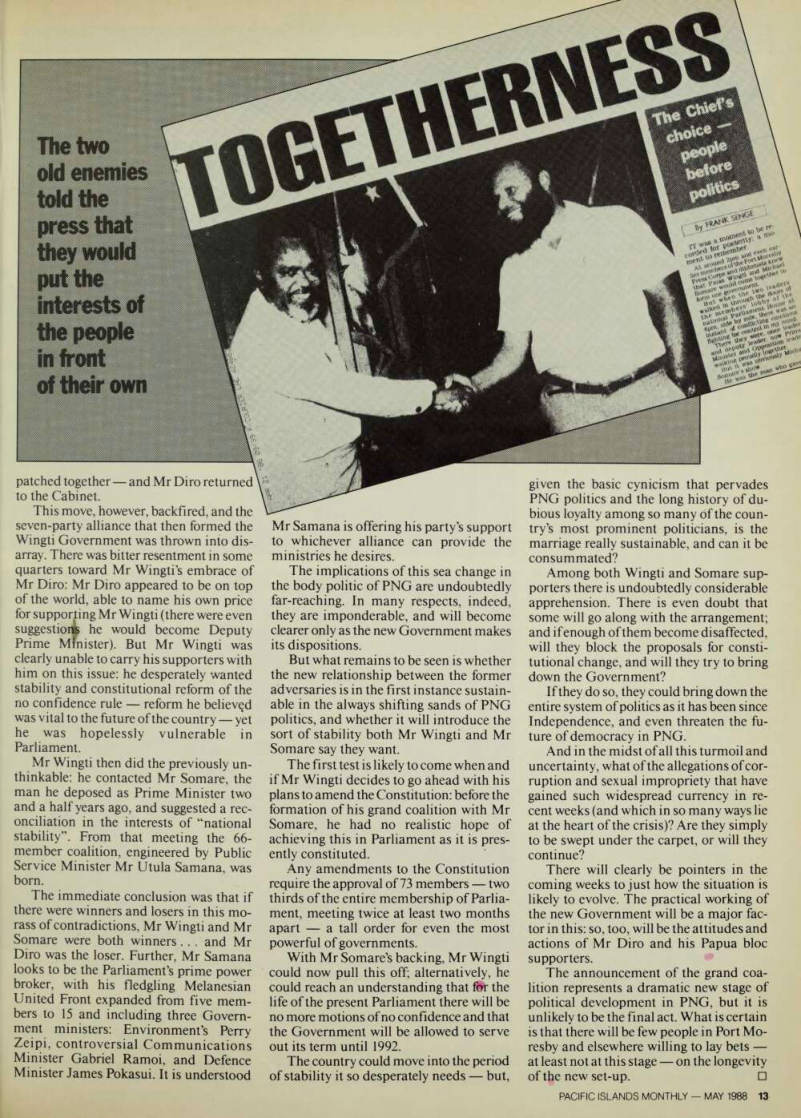
Days later, in a breathtaking change of stance, the two men were together at a news conference announcing that for the good of the country they were sinking their political differences and forming their “grand coalition”.
Compare all the bitterness that sur rounded the abortive no confidence de bate with what was said at the joint Wingti- Somare news conference: “Our interest is the stability of the country. The nation must move forward.
It’s very important that at this level we must have dialogue,” said Mr Wingti.
“We have our individual feelings, our individual egos, but first and foremost we must put the interests of the country ahead of us,” said Mr Somare.
It is clearly a long way from those high sounding words to the effective imple mentation of a government of national un ity, but what happened to provoke the dramatic change of stance? And what are the prospects?
At the centre of the political cauldron was Mr Ted Diro, the former Defence Force Commander and leader of the Pap uan bloc in Parliament. When he left Mr Wingti’s government it was made plain that he would remain out of the cabinet at least until he had been cleared of corrup tion allegations. But when the Prime Min ister was confronted by the no confidence motion he needed all the help he could get and, against the wishes of some of his clos est advisers, turned to Mr Diro.
An alliance between the two was^
patched together and Mr Diro returned to the Cabinet.
This move, however, backfired, and the seven-party alliance that then formed the Wingti Government was thrown into dis array. There was bitter resentment in some quarters toward Mr Wingti’s embrace of Mr Diro: Mr Diro appeared to be on top of the world, able to name his own price for supporting Mr Wingti (there were even suggestion he would become Deputy Prime Minister). But Mr Wingti was clearly unable to carry his supporters with him on this issue: he desperately wanted stability and constitutional reform of the no confidence rule reform he believed was vital to the future of the country yet he was hopelessly vulnerable in Parliament.
Mr Wingti then did the previously un thinkable: he contacted Mr Somare, the man he deposed as Prime Minister two and a half years ago, and suggested a rec onciliation in the interests of “national stability”. From that meeting the 66member coalition, engineered by Public Service Minister Mr Utula Samana, was born.
The immediate conclusion was that if there were winners and losers in this mo rass of contradictions, Mr Wingti and Mr Somare were both winners.. . and Mr Diro was the loser. Further, Mr Samana looks to be the Parliament’s prime power broker, with his fledgling Melanesian United Front expanded from five mem bers to 15 and including three Govern ment ministers: Environment’s Perry Zeipi, controversial Communications Minister Gabriel Ramoi, and Defence Minister James Pokasui. It is understood
Mr Samana is offering his party’s support to whichever alliance can provide the ministries he desires.
The implications of this sea change in the body politic of PNG are undoubtedly far-reaching. In many respects, indeed, they are imponderable, and will become clearer only as the new Government makes its dispositions.
But what remains to be seen is whether the new relationship between the former adversaries is in the first instance sustainable in the always shifting sands of PNG politics, and whether it will introduce the sort of stability both Mr Wingti and Mr Somare say they want.
The first test is likely to come when and if Mr Wingti decides to go ahead with his plans to amend the Constitution: before the formation of his grand coalition with Mr Somare, he had no realistic hope of achieving this in Parliament as it is presently constituted.
Any amendments to the Constitution require the approval of 73 members two thirds of the entire membership of Parliament, meeting twice at least two months apart a tall order for even the most powerful of governments.
With Mr Somare’s backing, Mr Wingti could now pull this off; alternatively, he could reach an understanding that for the life of the present Parliament there will be no more motions of no confidence and that the Government will be allowed to serve out its term until 1992.
The country could move into the period of stability it so desperately needs but,
given the basic cynicism that pervades PNG politics and the long history of du bious loyalty among so many of the coun try’s most prominent politicians, is the marriage really sustainable, and can it be consummated?
Among both Wingti and Somare sup porters there is undoubtedly considerable apprehension. There is even doubt that some will go along with the arrangement; and if enough of them become disaffected, will they block the proposals for consti tutional change, and will they try to bring down the Government?
If they do so, they could bring down the entire system of politics as it has been since Independence, and even threaten the fu ture of democracy in PNG.
And in the midst of all this turmoil and uncertainty, what of the allegations of cor ruption and sexual impropriety that have gained such widespread currency in re cent weeks (and which in so many ways lie at the heart of the crisis)? Are they simply to be swept under the carpet, or will they continue?
There will clearly be pointers in the coming weeks to just how the situation is likely to evolve. The practical working of the new Government will be a major fac tor in this: so, too, will be the attitudes and actions of Mr Diro and his Papua bloc supporters.
The announcement of the grand coa lition represents a dramatic new stage of political development in PNG, but it is unlikely to be the final act. What is certain is that there will be few people in Port Mo resby and elsewhere willing to lay bets at least not at this stage on the longevity of the new set-up. □