Grass-Roots Growth Strategy
p. 21 · Read in the full issue
Kiribati
Kiribati’s development plans concentrate on community industries.
A RECENT visit to Australia by Kiribati’s Minister for Trade, In dustry and Labour, Mr Raion Ba taroma, confirms that one of the South Pacific’s tiniest nations has an approach to aid and development that should be a model for its larger, and more populous neighbours.
“Small is beautiful” may have fallen out of favour in the West, where large-scale en terprises are integral to our perception of success. On Kiribati, however, a large en terprise would fail not because of lack of technical or management expertise, but because few would consider the bureauc racy that grows out of bigger business to be a reasonable way of spending one’s time.
Life on Kiribati’s islands demands a more considered pace and a more low-key approach which is just what the Government of Kiribati is providing. Mr Bataroma, in Sydney to acquaint the Aus tralian Government with his nation’s de velopment strategies, outlined a pragmatic and efficient Five Year Plan for Kiribati’s gradual move into self-sufficiency.
The plan consists of four major objec tives: to aim for self-reliance, which in volves increased import substitution; to utilise Kiribati’s natural resources such as fishing and coconut production; to bal ance the nation’s deficit budget as far as possible; and to improve the quality of life for all i-Kiribati.
Within these major objectives the Government is concentrating on produc
tion, communication, outer island development and making the best use of aid. Mr Bataroma described his visit as an “export market mission” on behalf of “Kiribati’s production sector, exploring export possibilities under the SPARTECA pact and developing ways of making Kiribati capable of generating exports.
“Kiribati has established 10 projects in the past 18 months,” Mr Bataroma said in the offices of the South Pacific Trade Commission. “They are up and running, with nine in the private sector and only one the Tarawa Biscuit Company under Government control.
“The total capital input over these 10 projects is only $A72,000, and they have generated a turnover ofsA3oo,ooo in their first year and a half of operation, employmg 45 people,” he said. The projects, chosen under the expert guidance of United Nations Development Program industry development advisor Mr Nardeo Singh, are highly labour intensive and have already shown great profit potential: an aluminium can crushing plant generated $A40,000 in export earnings in its first 12 months of business.
“We are confident our visit will be a success,” Mr Bataroma said. “The Australian Government is pleased with the resuits of its initial aid investment and is willing to assist us further. The Australian High Commissioner in Tarawa has been instructed to make available up to $A50,000 in aid funds for each of 11 additional projects planned for 1988/89.”
Together with three “integrated” projects on five of Kiribati’s outer islands, the planned projects 26 in all will em-
ploy more than 250 people, and their benefits will be available to an ever larger number of i-Kiribati.
The most encouraging aspect of the Kiribati Government’s industrial plans is their simplicity, community scale and ap propriateness to island life. Four of the current industries, for example, are oper ated by local women ice-cream manu facture, a snack-food outlet, confectionery making and a photographic studio while planned developments range from seaweed and desiccated coconut proceed ingto the possible export of fresh coconuts to Australia, increased laundry soap pro duction (currently 11 tonnes a year, with a further 200 tonnes being imported) and the processing and export of toddy syrup, This last venture has a high chance of appealing to the health-conscious Aus tralian and New Zealand markets: very high in Vitamin C and with a two-year shelf life, toddy syrup (known as Kamai mai in Kiribati) if attractively packaged may well prove a steady income earner, Representatives of AIDAB will be vis iting Kiribati in the next few months to as sess the operations of existing businesses and to report on projects as yet in the pipe line. Mr Bataroma and Mr Singh are con fident AIDAB’s officers will be impressed, Kiribati’s determination to proceed from small beginnings minimises the risk of ac cident or failure, its careful progress with the development of a tourist nexus on Christmas Island and its interest in train ing young craftsmen and craftswomen, in dicate that the harsh lessons learned by other developing nations have not been lost on the people of Kiribati. □
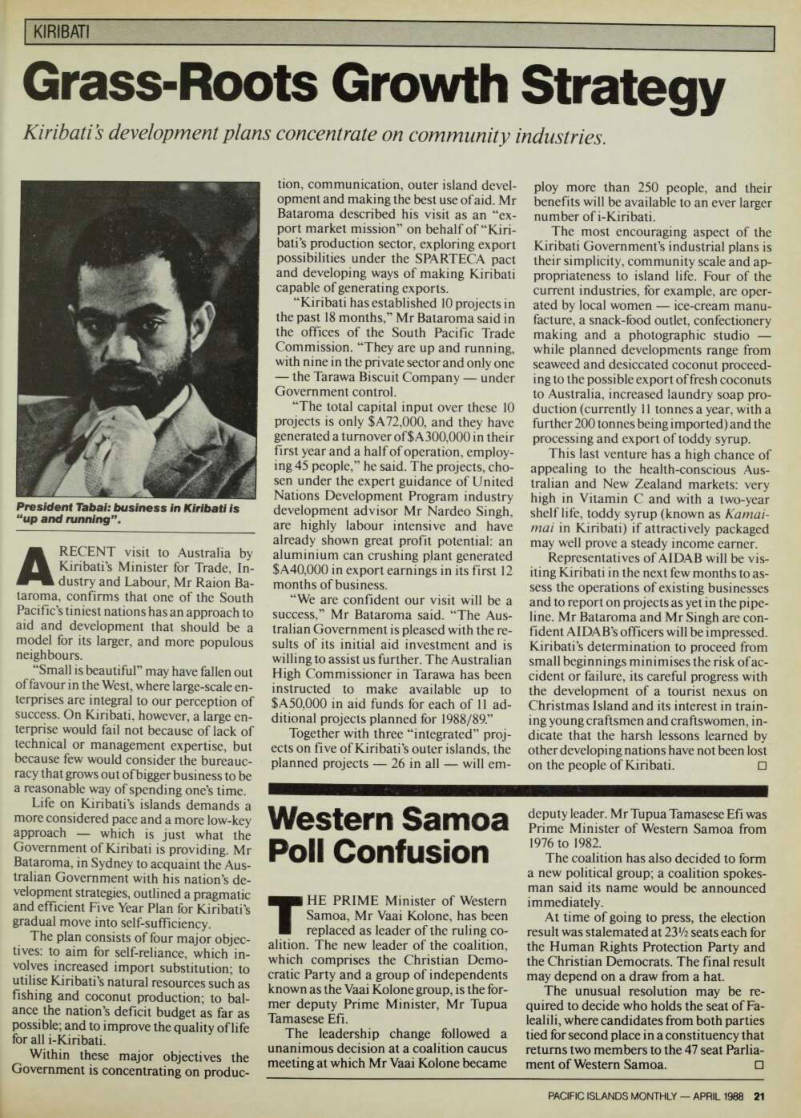
President Tabai: business in Kiribati is “up and running