Ho’olokahi For A Year Of Pride
p. 20 · Read in the full issue
Native Hawaiians gather to hail their heritage.
By Deborah A Janov
WITH THE dawning of January 23 came the beating of the pahu drums and the chants and dances of hula halaus on every Hawaiian island, calling the people of Hawaii to unite. The island of Oahu, “The Gathering Place”, was beckoning thousands of Hawaiians from near and far to its shores for Ho’olokahi the celebration that marked the culmination of The Year of the Hawaiian, “Ho’olako 1987”.
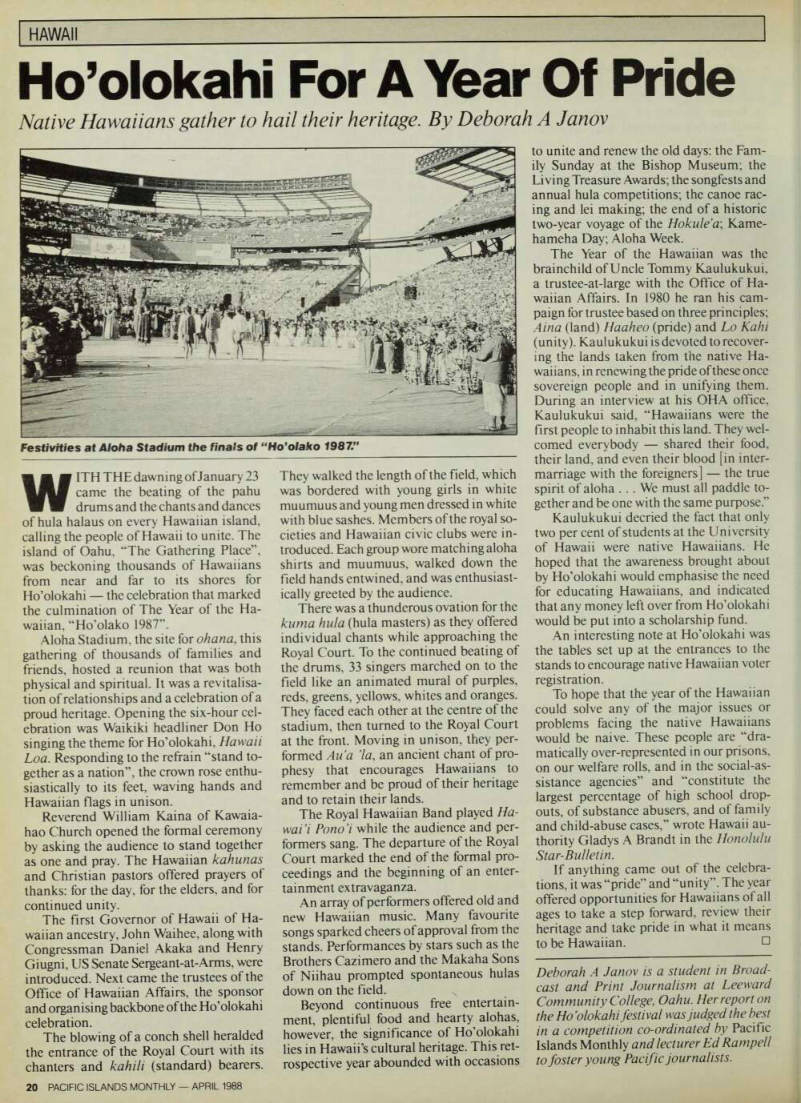
Aloha Stadium, the site for ohana , this gathering of thousands of families and friends, hosted a reunion that was both physical and spiritual. It was a revitalisation of relationships and a celebration of a proud heritage. Opening the six-hour celebration was Waikiki headliner Don Ho singing the theme for Ho’olokahi, Hawaii Loa. Responding to the refrain “stand together as a nation”, the crown rose enthusiastically to its feet, waving hands and Hawaiian flags in unison.
Reverend William Kaina of Kawaiahao Church opened the formal ceremony by asking the audience to stand together as one and pray. The Hawaiian kahunas and Christian pastors offered prayers of thanks: for the day, for the elders, and for continued unity.
The first Governor of Hawaii of Hawaiian ancestry, John Waihee, along with Congressman Daniel Akaka and Henry Giugni, US Senate Sergeant-at-Arms, were introduced. Next came the trustees of the Office of Hawaiian Affairs, the sponsor and organising backbone of the Ho’olokahi celebration.
The blowing of a conch shell heralded the entrance of the Royal Court with its chanters and kahili (standard) bearers,
They walked the length of the field, which was bordered with young girls in white muumuus and young men dressed in white with blue sashes. Members of the royal so cieties and Hawaiian civic clubs were in troduced. Each group wore matching aloha shirts and muumuus, walked down the field hands entwined, and was enthusiast ically greeted by the audience.
There was a thunderous ovation for the kuma hula (hula masters) as they offered individual chants while approaching the Royal Court. To the continued beating of the drums, 33 singers marched on to the field like an animated mural of purples, reds, greens, yellows, whites and oranges.
They faced each other at the centre of the stadium, then turned to the Royal Court at the front. Moving in unison, they per formed Au’a ’la, an ancient chant of pro phesy that encourages Hawaiians to remember and be proud of their heritage and to retain their lands.
The Royal Hawaiian Band played Ha wai’i Pono’i while the audience and per formers sang. The departure of the Royal Court marked the end of the formal pro ceedings and the beginning of an enter tainment extravaganza.
An array of performers offered old and new Hawaiian music. Many favourite songs sparked cheers of approval from the stands. Performances by stars such as the Brothers Cazimero and the Makaha Sons of Niihau prompted spontaneous hulas down on the field.
Beyond continuous free entertain ment, plentiful food and hearty alohas, however, the significance of Ho’olokahi lies in Hawaii’s cultural heritage. This ret rospective year abounded with occasions
to unite and renew the old days: the Fam ily Sunday at the Bishop Museum; the Living Treasure Awards; the songfests and annual hula competitions; the canoe rac ing and lei making; the end of a historic two-year voyage of the Hokulea\ Kame hameha Day; Aloha Week.
The Year of the Hawaiian was the brainchild of Uncle Tommy Kaulukukui, a trustee-at-large with the Office of Ha waiian Affairs. In 1980 he ran his cam paign for trustee based on three principles; Aina (land) Haaheo (pride) and Lo Kahi (unity). Kaulukukui is devoted to recover ing the lands taken from the native Ha waiians, in renewing the pride of these once sovereign people and in unifying them.
During an interview at his OHA office, Kaulukukui said, “Hawaiians were the first people to inhabit this land. They wel comed everybody shared their food, their land, and even their blood [in inter marriage with the foreigners] the true spirit of aloha ... We must all paddle to gether and be one with the same purpose.”
Kaulukukui decried the fact that only two per cent of students at the University of Hawaii were native Hawaiians. He hoped that the awareness brought about by Ho’olokahi would emphasise the need for educating Hawaiians, and indicated that any money left over from Ho’olokahi would be put into a scholarship fund.
An interesting note at Ho’olokahi was the tables set up at the entrances to the stands to encourage native Hawaiian voter registration.
To hope that the year of the Hawaiian could solve any of the major issues or problems facing the native Hawaiians would be naive. These people are “dra matically over-represented in our prisons, on our welfare rolls, and in the social-as sistance agencies” and “constitute the largest percentage of high school drop outs, of substance abusers, and of family and child-abuse cases,” wrote Hawaii au thority Gladys A Brandt in the Honolulu Star-Bulletin.
If anything came out of the celebra tions, it was “pride” and “unity”. The year offered opportunities for Hawaiians of all ages to take a step forward, review their heritage and take pride in what it means to be Hawaiian. □
Deborah A Janov is a student in Broad cast and Print Journalism at Leeward Community College, Oahu. Her report on the Ho’olokahi festival was judged the best in a competition co-ordinated by Pacific Islands Monthly and lecturer Ed Rampell to foster young Pacific journalists.
Festivities at Aloha Stadium the finals of “Ho’olako 1987.”