Divisions Rock The Nation
pp. 18-19 · Read in the full issue
Papua New Guinea
Regional jealousies and entrenched cultural factions threaten Papua New Guinea’s
political and economic stability.
By Frank Senge
UNITY IN Diversity” was the motto coined by Papua New Guinea’s founding fathers to describe the unification of the new nation’s more than 700 distinct language groups, as well as many different cultures and traditions, under one democratic government.
But over the years, political leaders more concerned with providing goods and services to supporters in their own regions have failed to formulate policies and to lay down infrastructures that guarantee unity and provide machinery to solve the inev itable differences in PNG’s diverse cul tures. Now that diversity is threatening the unity and stability of the nation.
Mr Michael Somare believes the coun try is heading toward fragmentation be cause of its entrenched tribal and regional groupings; “About 20 years ago, he says, “a handful of people from various parts of the country sat down and discussed seri ously how to get this country to become strong, stable, prosperous and united.
“We were on our way to achieving this.
However, 12 years after Independence, there are already cracks: cracks that are obviously the direct result of policies and beliefs based on tribal and regional
groupings.”
Mr Somare’s fears are compounded by recent rumours of a military coup d’etat fuelled by disaffected regional interests and political in-fighting in the Government of PM Paias Wingti. Other observers also fear that the in-fighting could escalate, throw ing PNG into chaos.
In PNG, regionalism often unleashes a rush of emotions that can eventually per meate every institution from the clan to the cabinet... with the same drastic effects.
Regionalism can destroy individual ca reers, business houses and even governments.
From the beginning of self-govern ment, leaders set out with vigour and en thusiasm to bring development to their own electorates. But every electorate in the country and there are 109 of them had the same need for basic necessities such as roads, bridges and classrooms.
Realising they could not achieve much alone, the leaders formed regional blocs, comprising groups of electorates, to lobby together in a process made easier by the Wantok (one language) system whereby those from certain regions shared similar languages and traditions. Four regional groupings emerged: Papua, Mamose, Highlands and New Guinea Islands.
They filtered down through all levels of
government and the bureaucracy, the ar gument being that more representatives m influential positions in the public service even the cabinet meant more funds for development.
But the government did not have the
money to make this theory work. It de cided that those provinces that made money would get a larger share of the na tional budget. Consequently, those prov inces already well off received more funds and became better developed, while some
“12 years after Independence there are cracks that are obviously the result of policies and beliefs based on tribal and regional groupings”
Michael Somare
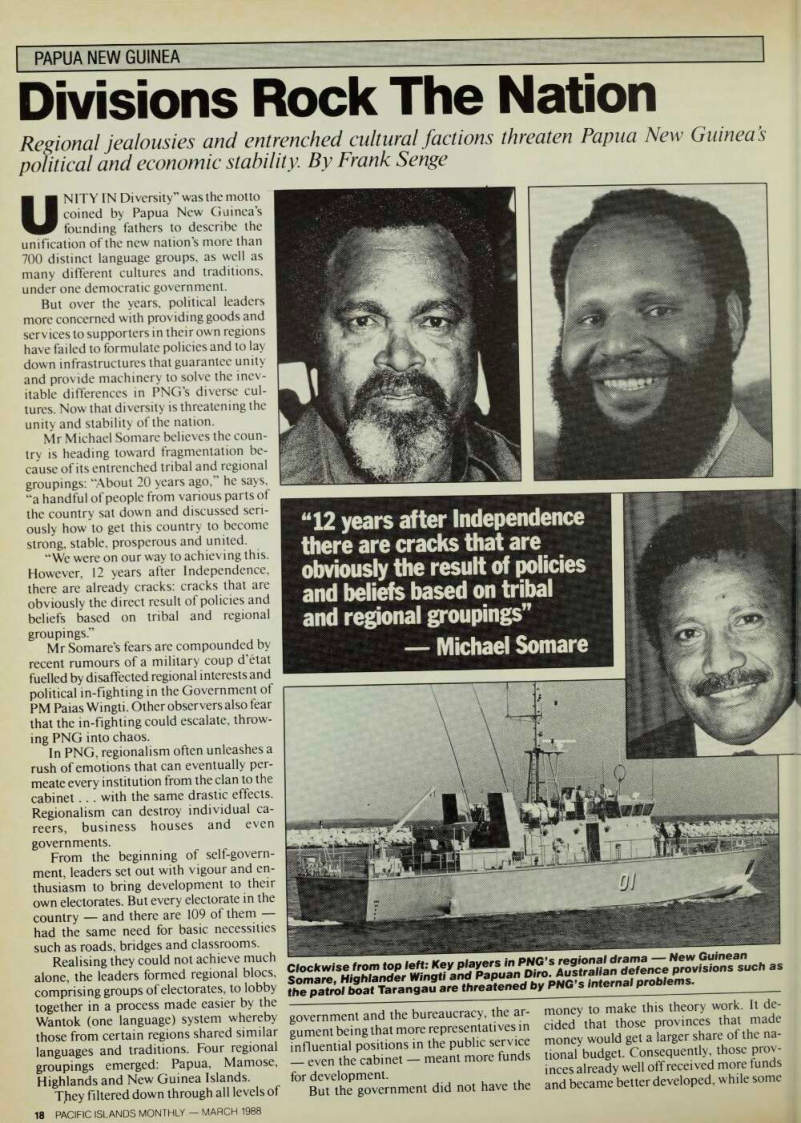
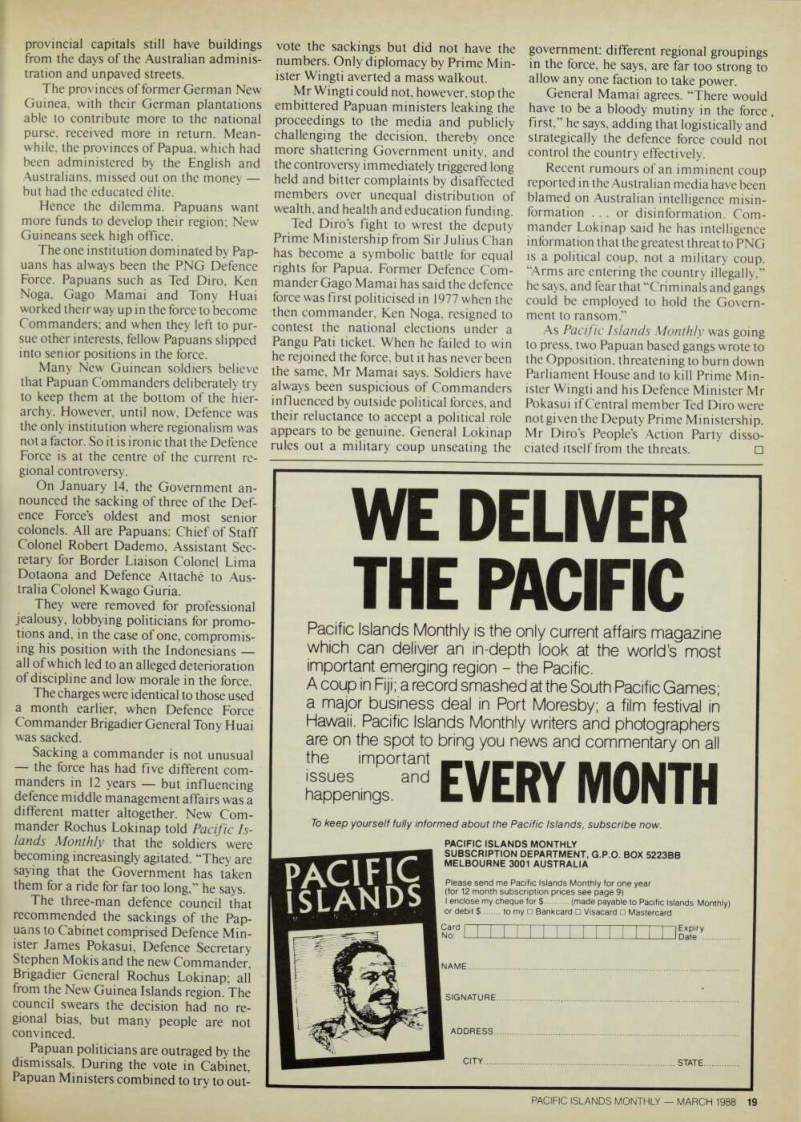
Clockwise from top left: Key Players in PNG's regional drama-New Guinean Somare, Highlander Wingti and Papuan Diro. Australian defence provision such as the patrol boat Tarangau are thereatend by PNG's internal problems.
provincial capitals still have buildings from the days of the Australian adminis tration and unpaved streets.
The provinces of former German New Guinea, with their German plantations able to contribute more to the national purse, received more in return. Mean while, the provinces of Papua, which had been administered by the English and Australians, missed out on the money but had the educated elite.
Hence the dilemma. Papuans want more funds to develop their region; New Guineans seek high office.
The one institution dominated by Pap uans has always been the PNG Defence Force. Papuans such as Ted Diro, Ken Noga, Gago Mamai and Tony Huai worked their way up in the force to become Commanders; and when they left to pur sue other interests, fellow Papuans slipped into senior positions in the force.
Many New Guinean soldiers believe that Papuan Commanders deliberately try to keep them at the bottom of the hier archy. However, until now, Defence was the only institution where regionalism was not a factor. So it is ironic that the Defence Force is at the centre of the current re gional controversy.
On January 14, the Government an nounced the sacking of three of the Def ence Force’s oldest and most senior colonels. All are Papuans; Chief of Staff Colonel Robert Dademo, Assistant Sec retary for Border Liaison Colonel Lima Dotaona and Defence Attache to Aus tralia Colonel Kwago Guria.
They were removed for professional jealousy, lobbying politicians for promo tions and, in the case of one, compromis ing his position with the Indonesians all of which led to an alleged deterioration of discipline and low morale in the force.
The charges were identical to those used a month earlier, when Defence Force Commander Brigadier General Tony Huai was sacked.
Sacking a commander is not unusual the force has had five different com manders in 12 years but influencing defence middle management affairs was a different matter altogether. New Com mander Rochus Lokinap told Pacific Is lands Monthly that the soldiers were becoming increasingly agitated. “They are saying that the Government has taken them for a ride for far too long,” he says.
The three-man defence council that recommended the sackings of the Pap uans to Cabinet comprised Defence Min ister James Pokasui, Defence Secretary Stephen Mokis and the new Commander, Brigadier General Rochus Lokinap; all from the New Guinea Islands region. The council swears the decision had no re gional bias, but many people are not convinced, Papuan politicians are outraged by the dismissals. During the vote in Cabinet, Papuan Ministers combined to try to out
vote the sackings but did not have the numbers. Only diplomacy by Prime Min ister Wingti averted a mass walkout.
Mr Wingti could not, however, stop the embittered Papuan ministers leaking the proceedings to the media and publicly challenging the decision, thereby once more shattering Government unity, and the controversy immediately triggered long held and bitter complaints by disaffected members over unequal distribution of wealth, and health and education funding.
Ted Diro’s fight to wrest the deputy Prime Ministership from Sir Julius Chan has become a symbolic battle for equal rights for Papua. Former Defence Com mander Gago Mamai has said the defence force was first politicised in 1977 when the then commander, Ken Noga, resigned to contest the national elections under a Pangu Pati ticket. When he failed to win he rejoined the force, but it has never been the same, Mr Mamai says. Soldiers have always been suspicious of Commanders influenced by outside political forces, and their reluctance to accept a political role appears to be genuine. General Lokinap rules out a military coup unseating the
government: different regional groupings in the force, he says, are far too strong to allow any one faction to take power.
General Mamai agrees. “There would have to be a bloody mutiny in the force first,” he says, adding that logistically and strategically the defence force could not control the country effectively.
Recent rumours of an imminent coup reported in the Australian media have been blamed on Australian intelligence misin formation ... or disinformation. Com mander Lokinap said he has intelligence information that the greatest threat to PNG is a political coup, not a military coup.
“Arms are entering the country illegally,” he says, and fear that “Criminals and gangs could be employed to hold the Govern ment to ransom.”
As Pacific Islands Monthly was going to press, two Papuan based gangs wrote to the Opposition, threatening to burn down Parliament House and to kill Prime Min ister Wingti and his Defence Minister Mr Pokasui if Central member Ted Diro were not given the Deputy Prime Ministership.
Mr Diro’s People’s Action Party disso ciated itself from the threats. □