Leontieff Gets Tough
pp. 16-17 · Read in the full issue
French Polynesia
A steely realist takes control in Tahiti. Exclusive interview by Nicolas Rothwell
Alexandre leontieff the new President of French Polyne sia’s Government, both architect and symbol of the territory’s freshly de vised politics of consensus, is himself a man of intriguing contradictions. A skilled technocrat, he look the reins of govern ment at the end of last year with the con summate ease of a born politician; a steely economist, he was impelled to reach for power because of the growing social un rest in Tahiti; an enthusiastic nationalist at the head of a coalition that includes pro independence leaders, he is still an ardent advocate of continued lies with France. In an interview with Pacific Islands Monthly in the presidential offices in Papeete last month, he outlined his policies for both the territory of French Polynesia and the Pa cific region.
A leader whose political ascendancy is founded on the urgent need for change in his realm. Alexandre Leontieff freely ad mits that 1987 was a “very bad year” for French Polynesia; a year that saw the ter ritory’s capital, Papeete, in flames, eco nomic activity slumpingand even tourism, the mainstay ofTahili, savaged by the drop in the SUS. “The need for a new economic and social policy, a new social dialogue with our partners, is what led to the for mation of the new political majority,” Mr Leontieff says of his dramatic move to de sert the established Territorial Govern ment of the Tahoeraa Huiraalira parly and establish a new multi-party ruling coalition.
He believes his grouping, made up of defectors from the old Tahoeraa majority, together with allies of the Mayor of Pa peete, Mr Jean Juvenlin, and politicians from the Aia Api and la Mana Te Nunaa parlies, forms a “solid” bloc “its parts are absolutely complementary, and there is no reason it should not last, for it has already proved its cohesion,” he contends.
One crucial test of the new majority will be the reaction to the new 1988 budget, which Mr Leontieff views as the “political expression of a government”. French Po lynesia’s budgets have recently been of more than incidental political impor tance. Many commentators feel the at tempt by the previous government’s President, Mr Jacky Teuira, to impose his last budget without debate was the last straw that triggered the formation of the Leontieff Government.
“The measures that form our new eco nomic initiative are in the budget, but there’s another factor that must not be underestimated: confidence the fact that a number of politicians who were
previously in the opposition have joined together to tackle the real economic and social problems of Polynesia, putting aside their ideological differences this brings with it a confidence, a hope for the future, that forms the basis of our initiative,” Mr Leontieff explains.
"Investors, local or external, will not invest if they don't see in my Government this willingness to act, this rigour that is essential in public life, and if there is not tangible in the population the answering sentiment of support that one does in fact find everywhere,” he says.
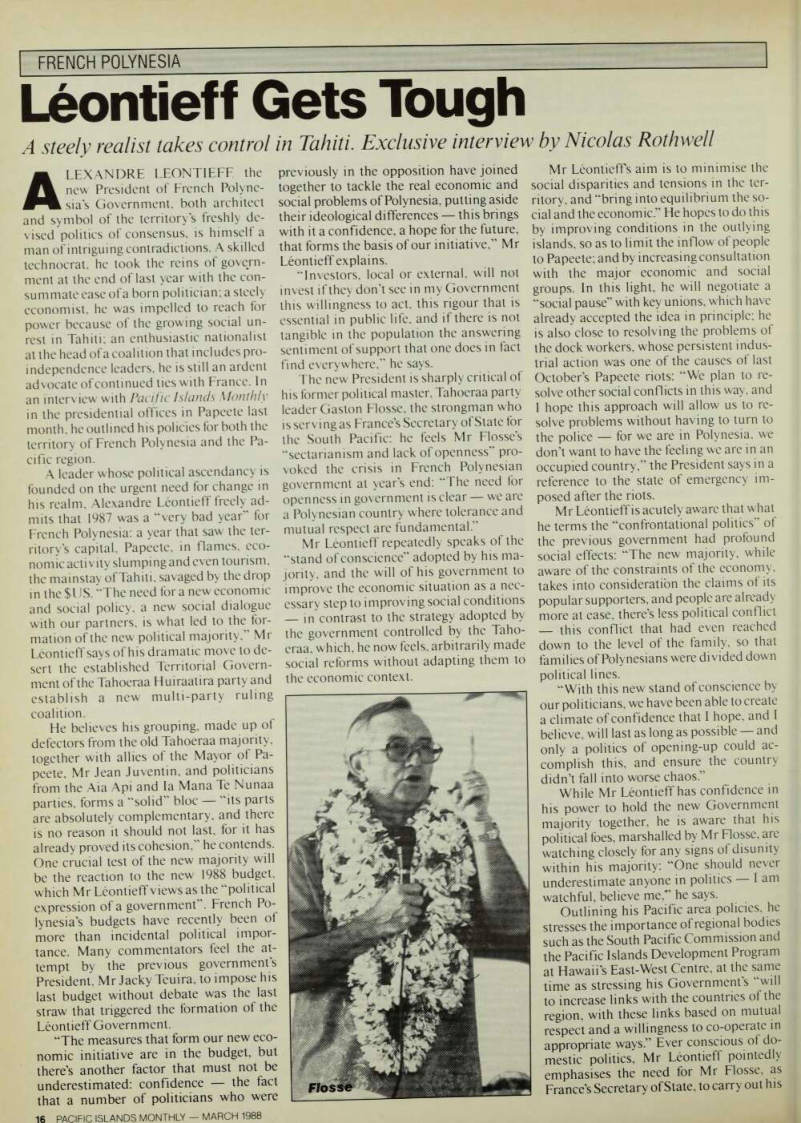
The new President is sharply critical of his former political master. Tahoeraa party leader Gaston Flosse, the strongman who is serving as France’s Secretary of Stale for the South Pacific; he feels Mr Flosses “sectarianism and lack of openness” pro voked the crisis in French Polynesian government at year’s end: “The need for openness in government is clear we are a Polynesian country where tolerance and mutual respect are fundamental.
Mr Leontieff repeatedly speaks of the “stand of conscience” adopted by his ma jority, and the will of his government to improve the economic situation as a nec essary step to improving social conditions in contrast to the strategy adopted by the government controlled by the Taho craa, which, he now feels, arbitrarily made social reforms without adapting them to the economic context.
Mr Leontieffs aim is to minimise the social disparities and tensions in the ter ritory, and “bring into equilibrium the so cial and the economic.” He hopes to do this by improving conditions in the outlying islands, so as to limit the inflow of people to Papeete; and by increasing consultation with the major economic and social groups. In this light, he will negotiate a “social pause” with key unions, which have already accepted the idea in principle; he is also close to resolving the problems of the dock workers, whose persistent indus trial action was one of the causes of last October’s Papeete riots: “We plan to re solve other social conflicts in this way, and I hope this approach will allow us to re solve problems without having to turn to the police for we are in Polynesia, we don’t want to have the feeling we are in an occupied country,” the President says in a reference to the state of emergency im posed after the riots.
Mr Leontieff is acutely aware that what he terms the “confrontational politics” of the previous government had profound social effects; “The new majority, while aware of the constraints of the economy, takes into consideration the claims of its popular supporters, and people are already more at ease, there’s less political conflict this conflict that had even reached down to the level of the family, so that families of Polynesians were divided down political lines.
“With this new stand of conscience by our politicians, we have been able to create a climate of confidence that I hope, and 1 believe, will last as long as possible and only a politics of opening-up could ac complish this, and ensure the country didn’t fall into worse chaos.”
While Mr Leontieff has confidence in his power to hold the new Government majority together, he is aware that his political foes, marshalled by Mr Flosse, are watching closely for any signs of disunity within his majority; “One should never underestimate anyone in politics I am watchful, believe me,"’ he says.
Outlining his Pacific area policies, he stresses the importance of regional bodies such as the South Pacific Commission and the Pacific Islands Development Program at Hawaii’s East-West Centre, at the same time as stressing his Government’s “will to increase links with the countries of the region, with these links based on mutual respect and a willingness to co-operate in appropriate ways.” Ever conscious of do mestic politics, Mr Leontieff pointedly emphasises the need for Mr Flosse, as France’s Secretary of State, to carry out his
duties in the region: “He should not give the impression that his Pacific mission is affected by his status as a member of the minority in this territory he was chosen for his special qualities so he could repre sent France in the region, and France does have a special mission to spread its culture and technology.”
Politically, Mr Leontieff describes himself as a “convinced autonomist”. His position is that French Polynesia’s statute of internal autonomy is the best arrange ment for the territory, given its history and social and economic context, and offers “all the advantages of independence with out its inconveniences.” He stresses that independence was a possibility in the fu ture, if the population voted for it in a ref erendum, but “at the moment I don’t think Polynesians are preoccupied with secur ing their independence.”
Mr Leontieff is a staunch defender, against regional critics, of the current sta tus of French Polynesia, claiming that the notion of political independence is one that should be “relativised”: “There are peoples who present the appearance of political in dependence but who are in reality de pendent on other countries, through aid or by economic means, and there are coun tries that are politically independent, yet living in poverty and there are coun tries that have made the choice to be eco nomically strong and less politically independent,” he claims.
“I feel that above all it is the people who matter Polynesians should have the best social and economic standards possible, within the framework of a statute that pre serves their dignity and safeguards essen tial powers for the territory.
“As for political independence, in the end, why? We have an autonomous government, the High Commissioner of France does not intervene; we are masters of all the economic, social and cultural decisions.”
Mr Leontieffs economic masterplan for the territory, framed in a new three-year blueprint, seeks to build on the elevated standard of living in French Polynesia easily the highest of any Pacific island in an attempt to develop high value-added products and strengthen the high-quality tourist industry. He sees the main chal lenge for the territorial government in the need to develop new industries that can help solve the crippling unemployment on Tahiti itself, as well as gradually to reduce the role of the French nuclear experiment centre, the CEP, in the overall economy.
“There is a need to prepare for the eventual departure of the CEP, to increase economic activity,” Mr Leontieff explains but in the same breath rejects reports from overseas contending that the test centre poses threats to the regional envi ronment: “It is shameful for foreign jour nalists to talk in this way; we would not let the tests go on without being vigilant. All the political parties keep a very close eye
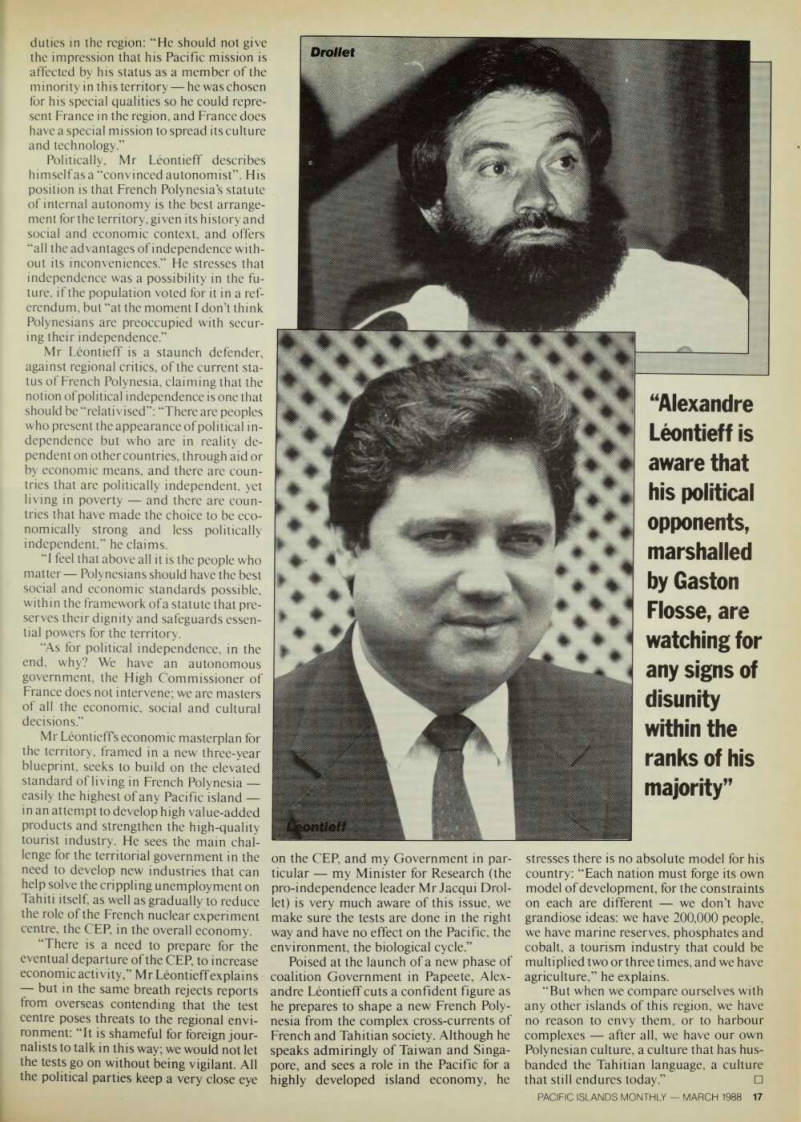
on the CEP, and my Government in par ticular my Minister for Research (the pro-independence leader Mr Jacqui Drol let) is very much aware of this issue, we make sure the tests are done in the right way and have no effect on the Pacific, the environment, the biological cycle.”
Poised at the launch of a new phase of coalition Government in Papeete, Alex andre Leontieff cuts a confident figure as he prepares to shape a new French Poly nesia from the complex cross-currents of French and Tahitian society. Although he speaks admiringly of Taiwan and Singa pore, and sees a role in the Pacific for a highly developed island economy, he
stresses there is no absolute model for his country; “Each nation must forge its own model of development, for the constraints on each are different we don’t have grandiose ideas: we have 200,000 people, we have marine reserves, phosphates and cobalt, a tourism industry that could be multiplied two or three times, and we have agriculture,” he explains.
“But when we compare ourselves with any other islands of this region, we have no reason to envy them, or to harbour complexes after all, we have our own Polynesian culture, a culture that has hus banded the Tahitian language, a culture that still endures today.” □
“Alexandre Leontieff is aware that his political opponents, marshalled by Gaston Flosse, are watching for any signs of disunity within the ranks of his majority”