A Bad Month For France
p. 26 · Read in the full issue
The Region
It’s a host of headaches for the Pacific power.
By Carson Creagh
RELATIONS between France and the Pacific continued to deterio rate over past weeks, with disputes over nuclear testing going on, outrage in New Zealand over the illegal removal of convicted Rainbow Warrior saboteur Alain Mafart from imprisonment on Hao Atoll, accusations of sensationalist tele vision filming in Papua New Guinea and most significantly, demonstrations pro testing France’s perceived interference in free speech in New Caledonia.
Opposition to testing on Mururoa con tinued, though New Zealand's Foreign Minister Russell Marshall conceded that the recent Superpowers Agreement on nu clear weapons “provides the best chance for ending French nuclear testing” in the Pacific. “It is offensive,” he said, “that a country in Western Europe should come to the South Pacific and continue. . . tests despite opposition from communities in the Pacific.” Several days after his state ment, Western Samoa’s Economic Affairs Minister, Mr Le Tagaloa Pita, visited Mu ruroa at the invitation of the French Min ister for Pacific Affairs, Mr Gaston Flosse.
Denying that his visit constituted ap proval of the tests, he said Western Samoa would continue to accept aid from France and “political issues should be separated from economics and trade”.
New Zealand is still waiting for an of ficial reply over the removal to France of Captain Mafart for medical tests, despite the fact that New Zealand was informed neither of the French Intelligence agent’s illness or given the opportunity of sending a New Zealand doctor to examine him.
French television journalists from Channel 5, part of the group that also owns the conservative Paris newspaper Le Fi garo, have earned the censure of both the PNG and Australian Governments over what has been called biased and exploi tative reports of both countries. In PNG, the French ambassador was summoned by officers of the Foreign Affairs Department to view a film that portrayed PNG as a land of “cannibals, savages and backward people”. The Ambassador, Mr Jean-Paul Schricke, reportedly agreed that the film was not balanced and that it showed more of the bad aspects of PNG than the good.
Similar moves are expected in Australia, where it is alleged French television jour nalists arranged for kangaroos to be shot illegally and provided free alcohol to Ab origines, reportedly to show scenes of cru elty to animals and insobriety.
Although only the most credulous would see recent events in New Caledonia
as the beginning of the end for French rule there, it is apparent France cannot expect to have its Caledonian cake and eat it. The bill to grant New Caledonia a new statute — one that would enshrine anti-inde pendence rule — was passed by a margin of only eight votes, with an unlikely alli ance of Socialists, Communists and the extreme right-wing National Front voting against the statute.
The vote may mean that the bill is cer tain to be enacted, but many French and Pacific observers suspect it will never be
acted on: instead, they say, it is a sop to ensure the European majority in New Caledonia will vote for the Chirac Government in upcoming metropolitan elections, They point out that the statute is effeclively unworkable, and that it would result in a net loss of financial and trading advantages for Europeans living and working in New Caledonia. It would also, no doubt, so inflame independence feelings that violence would result: which would lead to a greater military presence in the territory, which would lead to a painful decrease in revenue from tourism . . .
The arrest, on charges of inciting violence and murder, of FLNKS deputy leader Yeiwene Yeiwene, and the threat of simi-
lar action against Jean-Marie Tjibaou, provoked protest on a domestic and inter national scale. The justification was a call to arms by Mr Yeiwene a call that was itself a response to the acquittal of French settlers accused of murdering 10 Kanaks in 1984. The call to arms was, in reality, a call to Kanaks to arm themselves in self defence. One immediate reaction was civil disobedience on a large scale, as Kanaks in the Loyalty Islands (of which Mr Yei wene is regional representative in the New Caledonian administration) protested against his arrest. Local gendarmes were reinforced by CRS riot police and soldiers to restore order, but the unrest continued to simmer until the French Government sent urgent instructions to Noumea or dering the Public Prosecutor to appeal against Mr Yeiwene’s imprisonment.
The case has caused a controversy in France, and has been an obvious embar
rassment to the Chirac Government already assailed by a furore over internal splits and accusations of financial irregu larity. Even supporters of the Govern ment, it is reported, described the decision to jail Mr Yeiwene as a blunder by the ex amining magistrate in Noumea, One of the few bright notes in France’s calendar over recent months is its devel oping relationship with the Republic of Fiji. Promises of increased aid and over tures regarding development of industry have given the French some ease from an escalating “image problem” a problem that threatens to haunt whichever govern ment is in power in Paris after this year’s elections. □
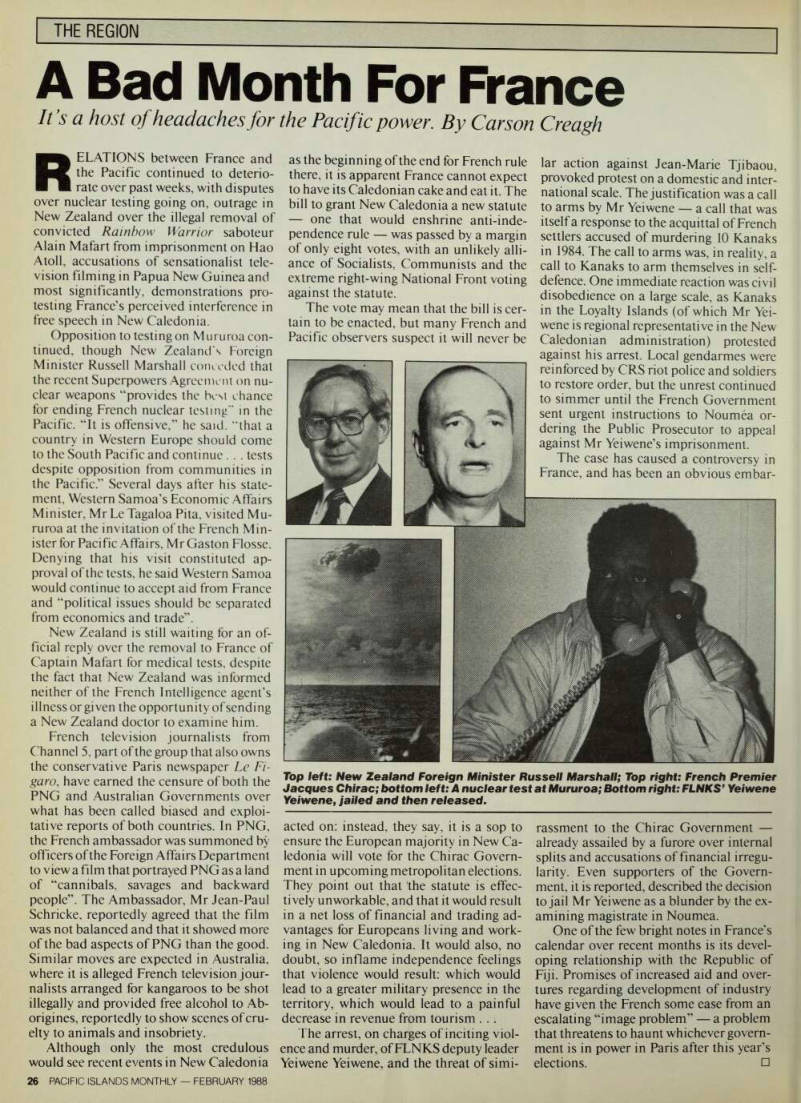
Top left: New Zealand Foreign Minister Russell Marshall; Top right: French Premier Jacques Chirac; bottom left: A nuclear test at Mururoa; Bottom right: FLNKS’ Yeiwene Yeiwene, jailed and then released.