Treasures On Display
pp. 24-25 · Read in the full issue
The Arts
A major exhibition at the Australian museum will bring traditional and modern
Pacific culture to a new audience.
By Susan Simons
PIECES of Paradise, a wide-ranging exhibition of Pacific cultures, will be the focal point of the opening of the new wing of the Australian Museum, Sydney, in April this year.
The building is a Bicentennial project, and will provide the museum with two new exhibition spaces, better storage facilities, an extended library and conservation laboratories and a mezzanine level restaurant. Pieces of Paradise has taken three years to develop. Dr Jim Specht, head of the Pacific Anthropology section at the
Australian Museum and curator of the exhibition, says its underlying theme is to show how the meanings and values we attach to objects vary from culture to culture and change over time.
Through the series of 17 units, each of which explores an angle of the main theme, visitors are encouraged to view the artifacts not as the products of exotic peoples, but as having qualities or similarities to familiar objects from their own lives. The “Mothers and Metaphors” unit, for example, which features the decorated bil-
urns or string bags of the mountain Ok people of Papua New Guinea’s Western Province, shows how a man’s ritual status can be identified by the kind of bag he carries. People unfamiliar with Ok culture may have thought these were simply decorated string bags and attached no other value to them.
The geographic scope of Pieces of Paradise is essentially Melanesian (the major portion of the museum’s collection derives from Melanesia, largely due to Australia s historical association with this part
of the Pacific), but there are also some par ticularly interesting objects from Polyne sia including some from Cook’s last, fatal visit to Hawaii in 1779. Some arti facts have had little previous exposure and are among the finest specimens of their type in existence. In other instances the artifacts, such as children’s toys from Ban aba and Nauru, are not valuable because of their rarity or historical value, but have been selected because they are especially pertinent to the exhibition’s theme.
The pieces from Cook’s voyage were
presented to or collected by him in Hawaii in January, 1779. This collection, which includes a helmet, a feather cape, a knife, a ring, four feather leis and three turtle fig ures carved from bone, was in the posses sion of a relation of Cook’s family until the NSW Government purchased it late in the 19th century.
The 1880 s and ’9os saw the acquisition of many exceptional sculptural pieces from Melanesia by scientific expeditions, mis sionaries, traders and planters. Perhaps the world’s best collection of malanggan fig ures from New Ireland came to the Aus tralian Museum from such colourful characters as Captain Thomas Farrell and Emma Kolbe (“Queen Emma”).
The 1980 s are represented by some contemporary art from Papua New Guinea, including a large painting by the artist Kauage purchased by the museum in 1987. The audiovisual section features an impromptu event, recorded by Ulli Beier, when a group of fringe dwellers in Port Moresby staged a feast for a returning council member, using objets trouves from the rubbish tip for their decorations, throwing them back when they had fin ished a fascinating example of ephemeral art at its best.
The oldest items are Capita pottery sherds from 2500 to 3000 years old, from Ambitle Island in the New Ireland Prov ince of Papua New Guinea. There are also carved stone figures and stone mortars and pestles of unknown antiquity from the mainland of Papua New Guinea. Between 1914 and 1921, major ethnographic studies of the Gogodala people of Aramia River, Papua were made by anthropologists who assembled collections of Gogodala mate rial culture. Items went to the Australian Museum as part of the Papuan Collection of Sir Hubert Murray, then Lieutenant- Governor. In the Pieces of Paradise exhi bition, some of these pieces will be brought together for the first time in half a century, and exhibited with more recent pieces from the Gogodala collected by Tony Crawford in the 1970 s when he was actively encour aging a cultural revival movement.
Even earlier, when Sir William MacGregor was Lieutenant-Governor of British New Guinea (1884-1901), he amassed thousands of artifacts from the areas under his administration, particu larly southeastern Papua. In this, the MacGregor collection (initially held at the
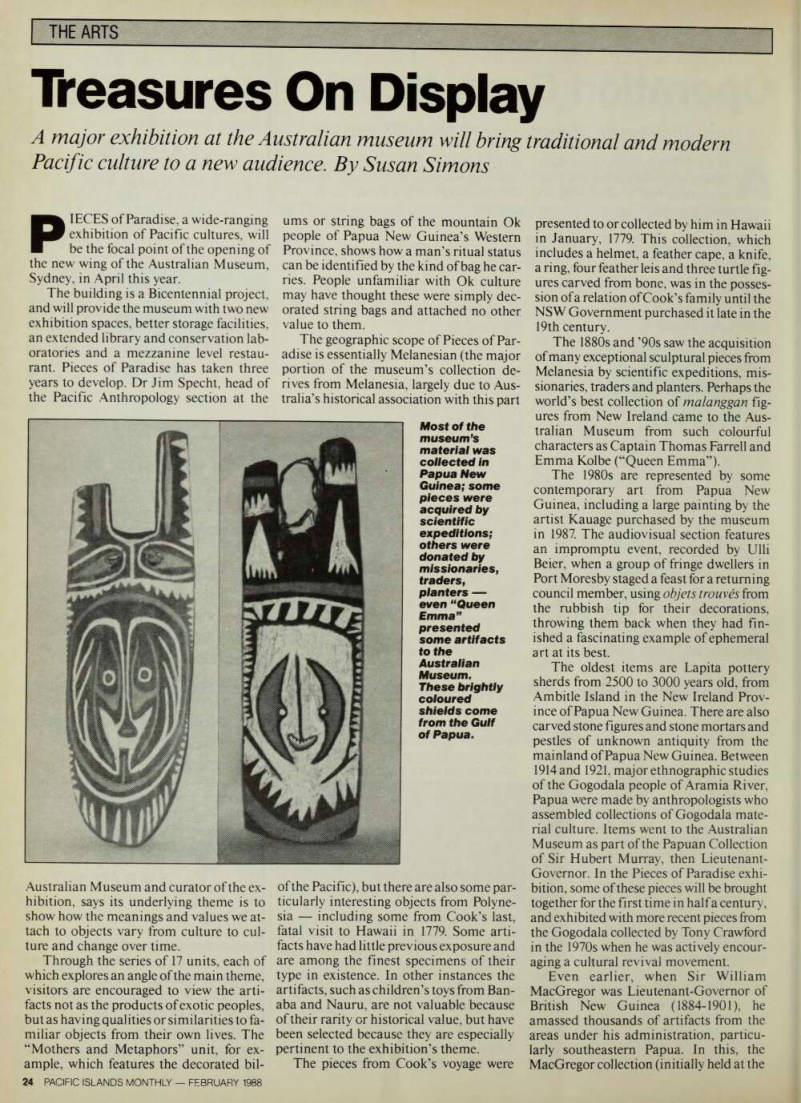
Most of the museum’s material was collected in Papua New Guinea; some pieces were acquired by scientific expeditions; others were donated by missionaries, traders, planters even “Queen Emma” presented some artifacts to the Australian Museum.
These brightly coloured shields come from the Gulf of Papua.
Queensland Museum, but later partially dis persed to several other Australian museums), weapons vastly outnum ber other artifacts: a dis proportionately high representation that re flects his concern with pacification, but which fails to give an accurate impression of the pro portion in which weap ons occurred in the material culture of a so ciety (as opposed to, say, cooking pots or fishing equipment). As a result, the Australian Museum has many weapons from the Massim (Milne Bay) Province, but for the purposes of the exhibi tion has borrowed three intricately carved lagim (splashboards) from kula canoes from the Papua New Guinea National Museum and Art Gal lery. These splashboards
are interesting, not because of their an tiquity but because they were described by Chief Narabutau of the Trobriand Islands, a kula participant who could recognise the skills of each carver and the correct align ment of each motif in the complete design.
Unlike the flood of art criticism to which we are exposed in newspapers and maga zines, such comment has rarely been made about objects in a museum collection by someone familiar with the social signifi cance of pieces from his own society.
Pieces of Paradise will last for one year, in contrast with an exhibition such as the Abelam Gallery in the same museum, which will have a life of 10 years. However, Pieces of Paradise will be well supported with auxiliary programs. A colour cata logue illustrating 90 items will be pub lished as a supplement to Australian Natural History, the Australian Museum Society’s magazine. This has been de signed as a low-cost production to enable it to be widely distributed, instead of pre paring a more scholarly “coffee table” book commemorating the exhibition. The So ciety will conduct activities for the dura tion of the exhibition including a lecture series, special children’s events and craft demonstrations and performances.
One significant part of the opening cer emony will be the return of an important artifact from the Australian Museum to each of Papua New Guinea, Vanuatu and the Solomon Islands. The museum is amenable to requests for the return of sig nificant cultural material to its country of origin; each case is considered on its mer its, and the museum has previously re turned items to all these Pacific nations. □
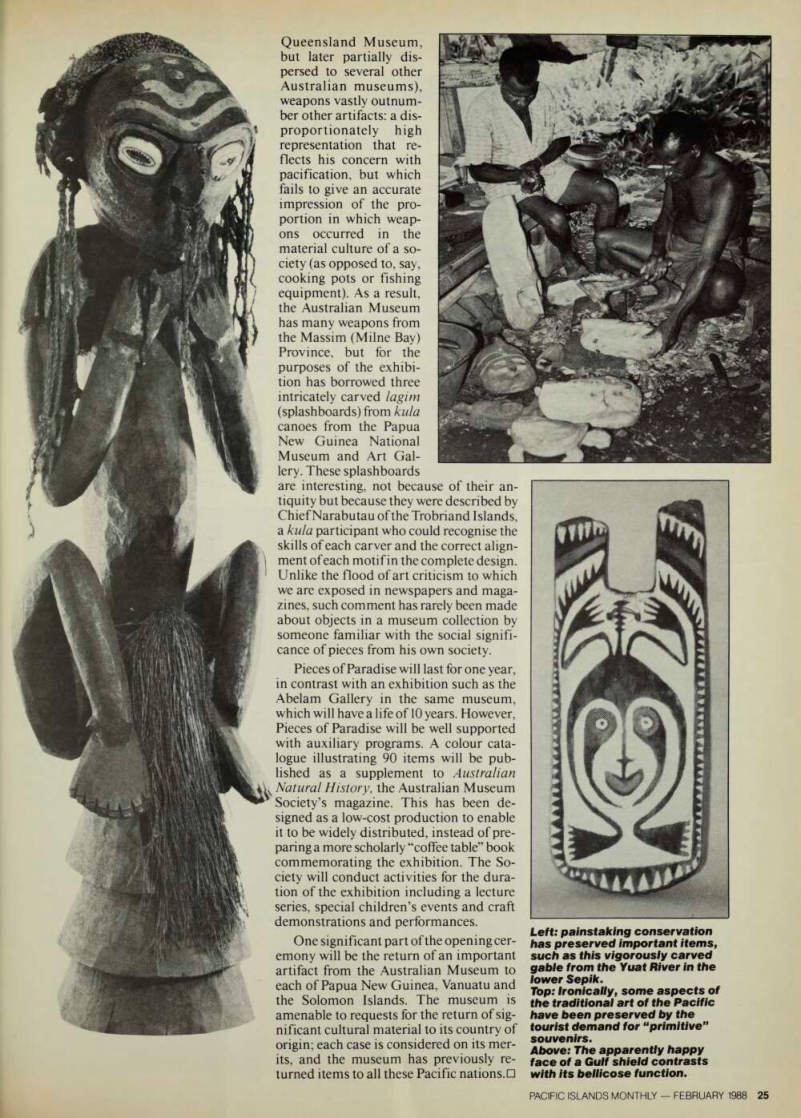
Left: painstaking conservation has preserved important items, such as this vigorously carved gable from the Yuat River in the lower Sepik.
Top: Ironically, some aspects of the traditional art of the Pacific have been preserved by the tourist demand for “ primitive" souvenirs.
Above: The apparently happy face of a Gulf shield contrasts with its bellicose function.